- Plants
- ›Vascular Plants
- ›Ferns
- ›Leptosporangiate Ferns
- ›Filmy Ferns and Bristle Ferns
- ›Filmy Ferns and Bristle Ferns
- ›Filmy Ferns
- ›Hymenophyllum
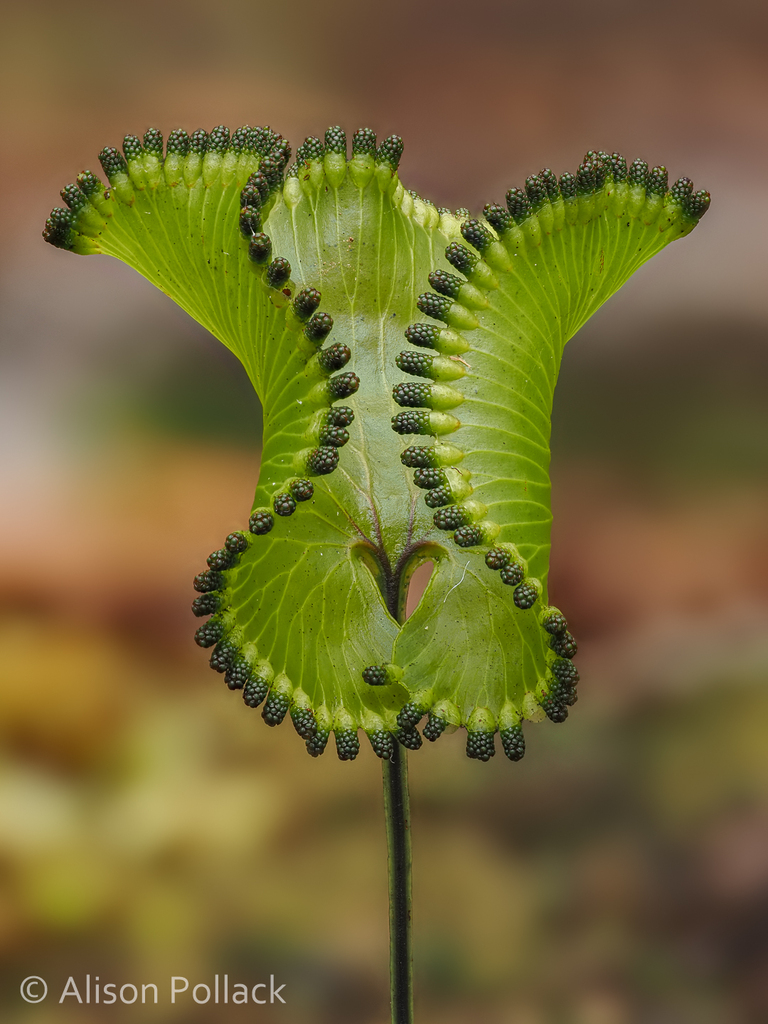
kidney fern
Hymenophyllum nephrophyllum
Hymenophyllum nephrophyllum, commonly known as the kidney fern, is a filmy fern species native to New Zealand. It commonly grows on the forest floor of open native bush. Individual kidney-shaped fronds stand about 5–10 cm tall. In hot weather they shrivel up to conserve moisture, but open up again when the wet returns. This species has very thin fronds which are only four to six cells in thickness. In the Māori language they are also called raurenga.
A specific example of occurrence of H. nephrophyllum is within forested areas of Westland, New Zealand, where it occurs with other fern species including crown fern, Blechnum discolor.
From the article Hymenophyllum nephrophyllum on Wikipedia (CC BY-SA), quoted section by section
Description
Hymenophyllum nephrophyllum is a fern distinctive for its undivided, kidney-shaped fronds, which give the plant its English common name, the kidney fern. The fronds, or laminae, are 3–10 cm by 4–13 cm and are a shiny, translucent green. The translucent nature of the kidney fern's fronds is due to them being very thin, only one cell thick as a sporeling, which increases to 3–4 cells when the plant reaches maturity. The fronds are supported on brittle stipes 5–25 cm in length. Mature plants have a row of sori (a collection of sporangia) crowning the upper margin of their frond, where they resemble a row of small brown pegs. A feature Hymenophyllum nephrophyllum shares with some other filmy ferns is the ability to curl up tightly during dry conditions in order to reduce moisture loss; this gives kidney fern one of its Māori common names, kopakopa (to wrap or clasp). After rain or when conditions improve, it unfurls and recovers.
Range & habitat
Hymenophyllum nephrophyllum is endemic to New Zealand, meaning it is native to and found only in New Zealand. Other members of the Hymenophyllum genus can be found throughout the world as well as New Zealand.
Wikipedia: “Natural global range”
What it does
Like all ferns, Hymenophyllum neprhophyllum reproduces and disperses offspring through spores. It has tubular indusia (spore protecting structures) that stick out from the edge of the fronds. Stalks carrying sori, with sporangia that develop sequentially from base to apex, grow out of the indusia until at plant maturity they emerge and release their spores. Hymenophyllum nephrophyllum also spreads by vegetative reproduction, putting out far-creeping rhizomes (an underground stem that puts out adventitious shoots and roots) that form the distinctive mats of fronds on the forest floor. Little else grows in mats of Hymenophyllum nephrophyllum as the rhizomes produce a compound inhibiting the root growth of seedlings of other species.
Wikipedia: “Life cycle and phenology”
Where it lives
Recorded sightings
—
geo-referenced records in GBIF, from museums, herbaria and field observers.
Drag the globe to turn it. Dots are where records exist, not a range map; darker means more records.
In the stacks
Searching the stacks…
Every page naming Hymenophyllum nephrophyllum in the Biodiversity Heritage Library →
This page is assembled live from iNaturalist, GBIF, Wikipedia, the Source Library and the Internet Archive. It is not yet part of the hand-edited codex. iNaturalist taxon 340730.