- Plants
- ›Vascular Plants
- ›flowering plants
- ›monocots
- ›Agaves, Orchids, Irises, and Allies
- ›amaryllis, onions, and allies
- ›amaryllis subfamily
- ›Galantheae
- ›Acis
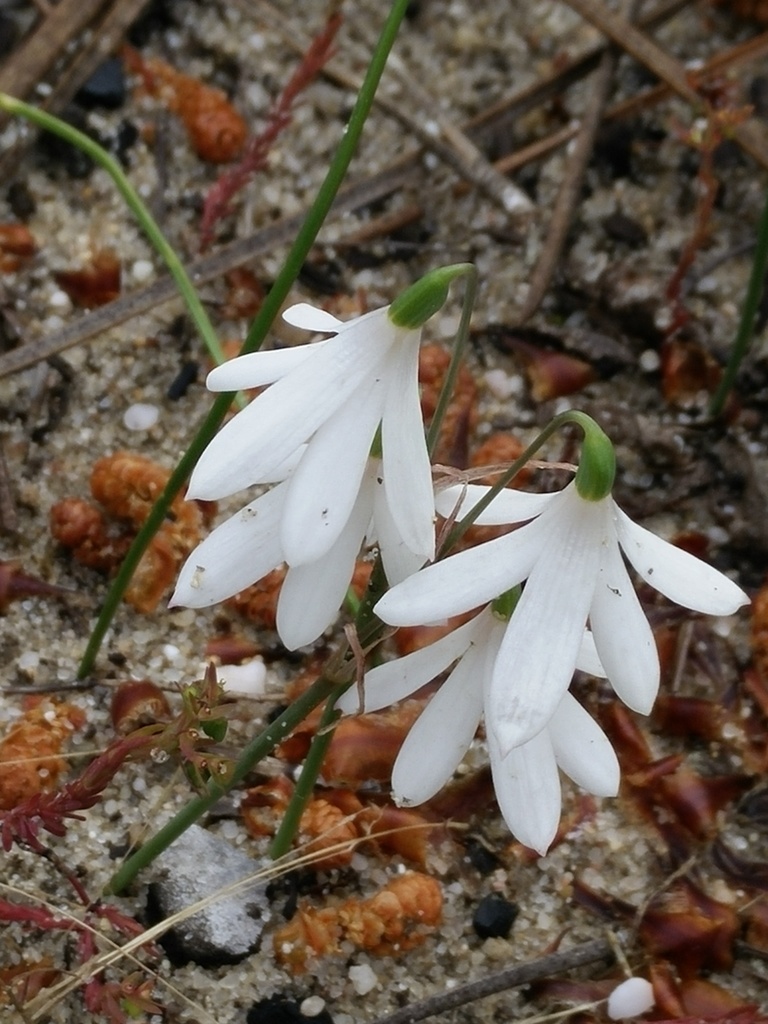
Three-leaved Snowflake
Acis trichophylla
Acis trichophylla, commonly called the triangular-leaved snowflake, is a species of flowering plant in the family Amaryllidaceae, native to Portugal, Spain and Morocco. It has very narrow leaves. The flowers are produced in late winter or early spring and are usually white, but sometimes pink-tinged or all pink. The species is cultivated as an ornamental bulb, but requires protection from hard frost.
From the article Acis trichophylla on Wikipedia (CC BY-SA), quoted section by section
Description
Acis trichophylla is a bulbous perennial, growing up to 30 cm (12 in) tall, although usually shorter. There are generally three very narrow leaves per bulb, appearing before the flowers, each leaf being up to 18 cm (7.1 in) long but only at most 1 mm wide. Flowering is in late winter or early spring. The flowers are white, sometimes with pink tinges or occasionally all pink, and are arranged in groups of two to four on a stem (scape) that is about as long as or longer than the leaves. Each flower is borne on a long stalk (pedicel), up to 45 or 60 mm long, and has six tepals, 12–20 mm long, with sharp tips, that open widely to form a bell shape. The two spathes are shorter than the pedicels. The style is slightly longer than the stamens.
Range & habitat
Acis trichophylla is found in central and southern Portugal, south central and south-western Spain and across the Mediterranean in Morocco. It is found in dry sandy ground.
Wikipedia: “Distribution and habitat”
How it is grown
Acis trichophylla is cultivated as an ornamental bulb. It requires protection from frost, and warm dry conditions for a long time in summer, hence growing in an alpine house or bulb frame is recommended. Unless planted deeply, around 15 cm (6 in), it tends to divide into small non-flowering bulbs.
== References ==
Wikipedia: “Cultivation”
Where it lives
Recorded sightings
—
geo-referenced records in GBIF, from museums, herbaria and field observers.
Drag the globe to turn it. Dots are where records exist, not a range map; darker means more records.
In the stacks
Searching the stacks…
Every page naming Acis trichophylla in the Biodiversity Heritage Library →
This page is assembled live from iNaturalist, GBIF, Wikipedia, the Source Library and the Internet Archive. It is not yet part of the hand-edited codex. iNaturalist taxon 341107.