- Plants
- ›Vascular Plants
- ›flowering plants
- ›Dicots
- ›Sunflowers, Bellflowers, Fanflowers, and Allies
- ›Sunflowers, Daisies, Asters, and Allies
- ›Asteroideae
- ›Chamomiles, yarrows, and allies
- ›Artemisiinae
- ›Artemisia
- ›Seriphidium
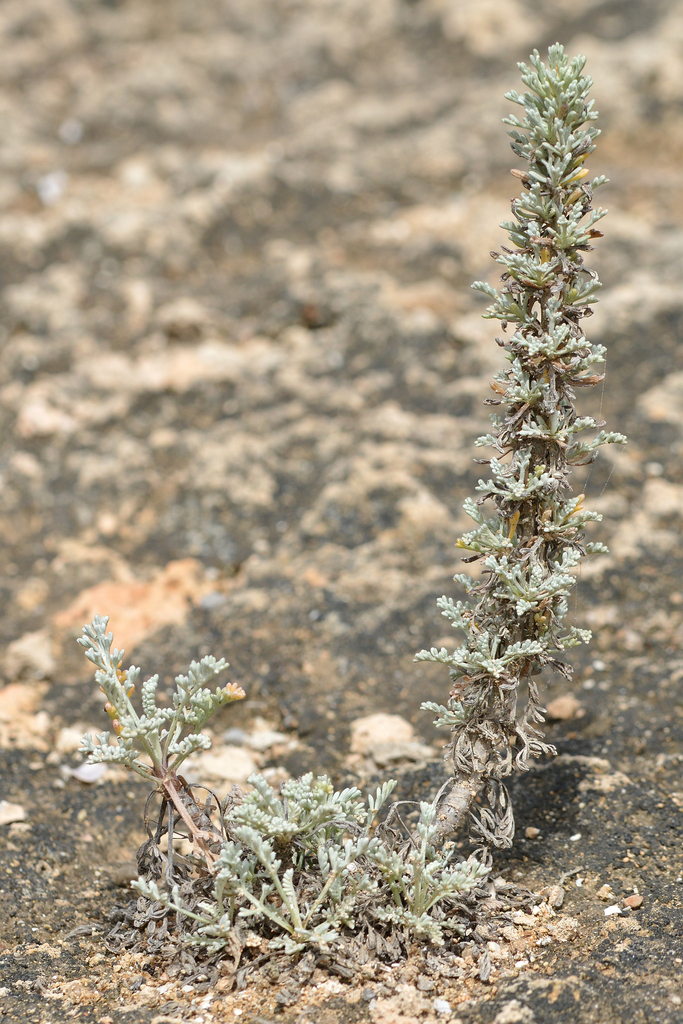
Bluish-leaved Wormwood
Artemisia caerulescens
Artemisia ( art-ə-MEE-zee-ə) is a large, diverse genus of plants belonging to the daisy family, Asteraceae, with almost 500 species. Common names for various species in the genus include mugwort, wormwood, and sagebrush.
Some botanists split the genus into several genera, but DNA analysis does not support the maintenance of the genera Crossostephium, Filifolium, Neopallasia, Seriphidium, and Sphaeromeria; three other segregate genera—Stilnolepis, Elachanthemum, and Kaschgaria—are maintained by this evidence. Occasionally, some of the species are called sages, causing confusion with the Salvia sages in the family Lamiaceae.
From the article Artemisia (plant) on Wikipedia (CC BY-SA), quoted section by section
What it does
Artemisia species are found on every continent except Antarctica, and have become part of many ecosystems around the world as a result. Below is currently a partial view of the importance of Artemisia species in ecosystems around the world.
North America. In North America, several species of Artemisia have become important parts of local environments, with wide adaptability. Artemisia papposa described by S.F.Blake & Arthur Cronquist can grow in the harsh, dry expanses of alkali flats, but also adapts to meadowlands. Sagebrushes like A. papposa (of the Tridenteae subgenus) in general are found in the north and southwest areas of the North American continent. In the Intermountain West, in a habitat known as Sagebrush Steppe, A. tridentata, A. tripartite, and A. arbuscula grow alongside various grasses and species of bitter bush, creating an important environment for mule deer, pygmy rabbits, antelopes, and the sage grouse. Understanding the phylogenetic relationships among the sagebrushes has been helpful in understanding the relationships among these plants and their environments, as well as learning more about how these plants formed these communities over long stretches of time. Sagebrushes, which include A. ludoviciana and A. …
Wikipedia: “Ecology”
At the table
Historically, Artemisia species were used in the attempted cure of various medical ailments, particularly related to women's health. In the Middle Ages, Artemisia sp. were regarded as herbs of significant medical power, and described as "the most important master against all exhaustions". By the Renaissance, Artemisia sp. (particularly A. absinthium) was used particularly in the cure of digestive ailments, though the use of species such as A. vulgaris in women's health still persisted.
Women's medicine. Artemisia species (likely A. vulgaris and A. latifolia) were described by the Greco-Roman physician Dioscorides (c. 40–90 AD) in his De materia medica as being used for "driving out the menstrual flow" and as an "abortifacient". Historian John Scarborough (1940-2022) argued that Dioscorides' discussion of Artemisia sp. was an adaptation of folklore medicine that was commonly used in Asia Minor and Thrace. Learned medicine in the Middle Ages was largely based on humoral theory, which ascribed certain properties to herbs based on their use in heating/cooling and wetting/drying the body. A. vulgaris was described by the second century physician Galen (c. 129–216 AD) as having warming and drying effects, which recommended it to the treatment of urological diseases. …
Wikipedia: “Historical uses”
In medicine
Artemisinin (from Artemisia annua) and derivatives are a group of compounds used to treat malaria. Treatments containing an artemisinin derivative (artemisinin-combination therapies) are now standard treatment worldwide for malaria caused by Plasmodium falciparum. Administering Artemisia annua as dried whole leaves may cause resistance to develop more slowly than if it is administered as pure artemisinin. Tu Youyou received the 2015 Nobel Prize in Physiology or Medicine for her discovery of the semisynthetic derivatives. She conducted research on traditional Chinese medicine and potential contributions to cures for malaria, on the basis of folk medicine and ancient Chinese texts. From reviewing ancient Chinese texts, they found that the compound artemisinin was optimally extracted at lower temperatures, as high temperature water poured over sweet wormwood leaves destroyed essential treatment properties. The World Health Organization does not support the promotion or use of Artemisia plant material in any form for the prevention or treatment of malaria. They note that the plant form of medication has several problems. …
Wikipedia: “Medicinal uses”
Where it lives
Recorded sightings
—
geo-referenced records in GBIF, from museums, herbaria and field observers.
Drag the globe to turn it. Dots are where records exist, not a range map; darker means more records.
In the old herbals & bestiaries

In the stacks
Searching the stacks…
Every page naming Artemisia caerulescens in the Biodiversity Heritage Library →
This page is assembled live from iNaturalist, GBIF, Wikipedia, the Source Library and the Internet Archive. It is not yet part of the hand-edited codex. iNaturalist taxon 341583.