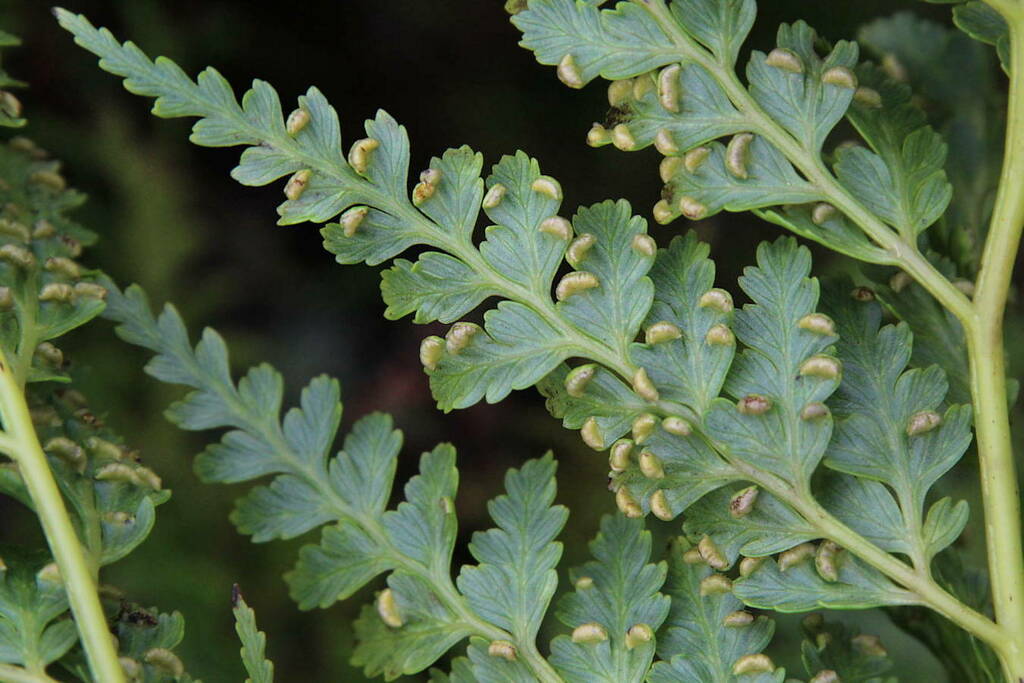
Woolly Tree Fern
Culcita macrocarpa
Culcita macrocarpa, the woolly tree fern, is a species of fern in the family Culcitaceae native to Macaronesia and parts of the Iberian Peninsula, where it might have been introduced. It is the only member of the order Cyatheales that is native to Europe.
From the article Culcita macrocarpa on Wikipedia (CC BY-SA), quoted section by section
Description
Culcita macrocarpa is a large plant that can reach up to 2 metres (6.6 ft) in height and has fronds up to 2 metres (6.6 ft) long. Its rhizomes are thickly coated with long silky, light brown hairs. Stipes are one third of the blade length, it has glabrous stabs and rachis and a shiny green, leathery, triangular blade on top. Serums are protected by the blade's curved lobes.
Range & habitat
Culcita macrocarpa is endemic to Portugal and Spain, both on the Iberian Peninsula and Macaronesia. It can be found in all of the Azores islands except Graciosa, in the Island of Madeira part of the Madeira Archipelago and in Tenerife on the Canary Islands. It is very rare in Santa Maria. In the Iberian Peninsula it is found in the north Cantabrian and Asturian coasts, northern Galicia and in mountainous areas around Porto and the Province of Cádiz. The populations found in Iberia might be the result of an introduction. It grows on siliceous rocky slopes, especially in deep valleys under evergreen forest and near coastal areas, sometimes in scrubland up to 1,100 metres (3,600 ft) elevation. It is usually found close to waterfalls or streams that provide moisture in the form of spray. This species requires shade and warm temperatures all year round, with high atmospheric humidity to flourish. It grows in all types of soils but avoids limestone substrates and is especially common on the herbaceous layer of high elevation montane forests of the Azores.
Wikipedia: “Distribution and habitat”
Where it lives
Recorded sightings
—
geo-referenced records in GBIF, from museums, herbaria and field observers.
Drag the globe to turn it. Dots are where records exist, not a range map; darker means more records.
In the stacks
Searching the stacks…
Every page naming Culcita macrocarpa in the Biodiversity Heritage Library →
This page is assembled live from iNaturalist, GBIF, Wikipedia, the Source Library and the Internet Archive. It is not yet part of the hand-edited codex. iNaturalist taxon 342154.