- Animals
- ›Arthropods
- ›Hexapods
- ›Insects
- ›Winged and Once-winged Insects
- ›Mantises
- ›Extant Mantises
- ›Schizomantodea
- ›Hymenopoidea
- ›Gargoyle Mantises
- ›Empusinae
- ›Empusini
- ›Empusina
- ›Empusa
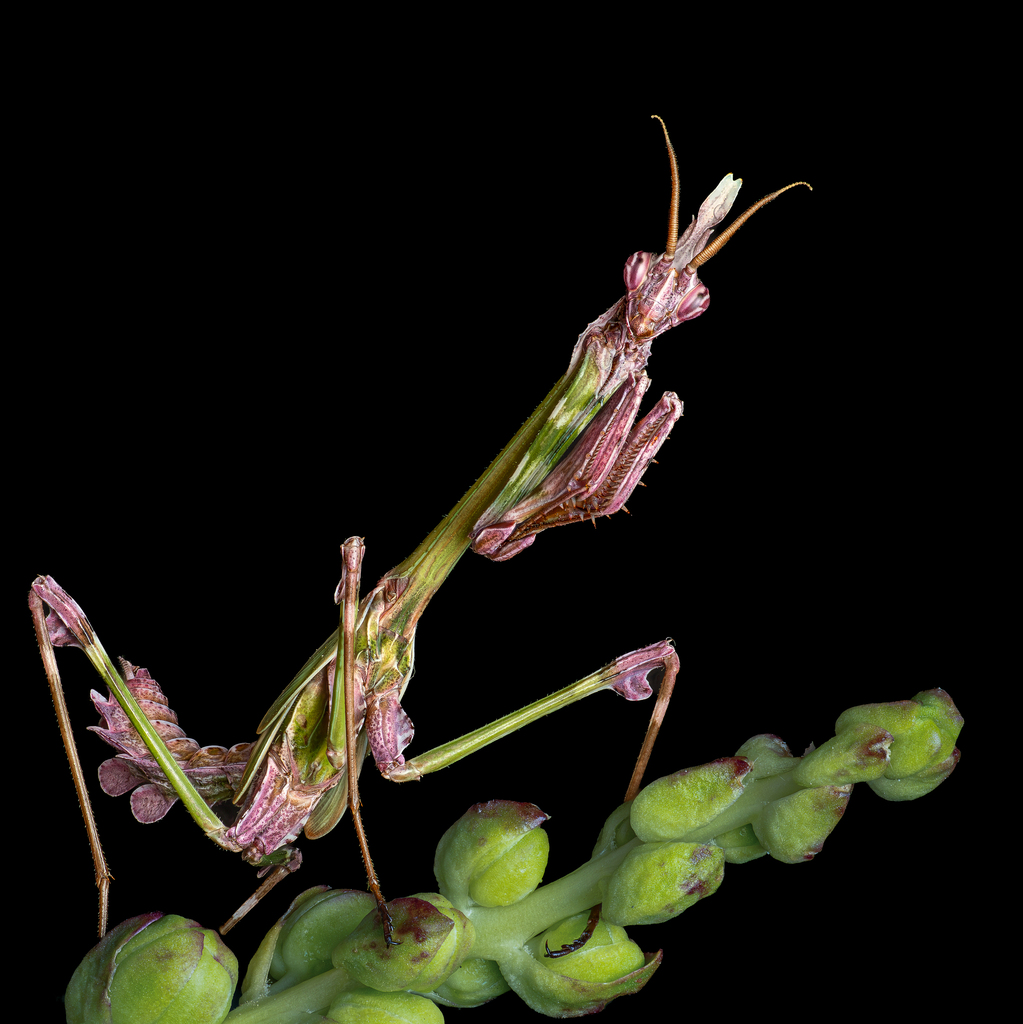
Fasciated Conehead Mantid
Empusa fasciata
Empusa fasciata, commonly known as the devil's mare, is a species of praying mantis in the genus Empusa in the order Mantodea.
From the article Empusa fasciata on Wikipedia (CC BY-SA), quoted section by section
Description
The praying mantis Empusa fasciata has a tapering head with a miter-like helmet, oval compound eyes, slender raptorial forelegs and a long thin thorax. E. fasciata often bends sharply upward at the abdomen, making the thorax appear even longer. The ventral abdomen and the femurs of the long thin walking legs have distinct lobules, which serve as camouflage. Due to its bizarre shape and the yellowish-green striped pattern of the legs, E. fasciata is well-camouflaged in vegetation, and is noticeable only when in motion.
Wikipedia: “Appearance”
Range & habitat
E. fasciata can be found from western Asia to the northeastern coast of Italy, in Morocco and southern Africa and appears most commonly in the southern Balkans. It prefers xerothermic sites. For instance, on the Adriatic coast, E. fasciata is found mainly on south-facing flysch and karst slopes, where Mantis religiosa can also occur. From Croatia to the bay of Trieste, E. fasciata reaches its adult stage in May. Mating can occur repeatedly, and females lay their eggs on vegetation. The adult males die soon after mating, and the females after oviposition. The nymphs hatch in July and overwinter in the pre-adult stage.
Wikipedia: “Distribution and life cycle”
What it does
E. fasciata is a highly successful ambush predator. In the course of evolution, it has specialized in preying on fast flying insects, such as flies and bees. One reason for this preference may be that flying insects serve as nutritious food, which is important in the spring when there is a limited food supply. Adult females often perch on flowers, where they wait to prey on honeybees. Insect prey can be captured upon landing, or even during flight, due to the fast strike of E. fasciata and its ability to rotate its head and the two powerful raptorial forelegs more than 90° laterally, without moving the rest of its body. E. fasciata shows no evidence of being cannibalistic. Distinct rocking and jerking movements are executed, which not only serve as camouflage in moving vegetation, but also facilitate spatial vision with the aid of motion parallax or retinal image displacement. Among the Mantodea, E. fasciata is a relatively good flyer. The fore and hind wings are moved up and down simultaneously, at a rate of about thirty wingbeats per second. E. fasciata is generally diurnal, however males fly at night to find pheromone plumes emitted by sexually active females. The odor receptors used for this are located on the long feathered antennae. …
Wikipedia: “Behavior”
Listen
Looking for field recordings…
Where it lives
Recorded sightings
—
geo-referenced records in GBIF, from museums, herbaria and field observers.
Drag the globe to turn it. Dots are where records exist, not a range map; darker means more records.
In the stacks
Searching the stacks…
Every page naming Empusa fasciata in the Biodiversity Heritage Library →
This page is assembled live from iNaturalist, GBIF, Wikipedia, the Source Library and the Internet Archive. It is not yet part of the hand-edited codex. iNaturalist taxon 342541.