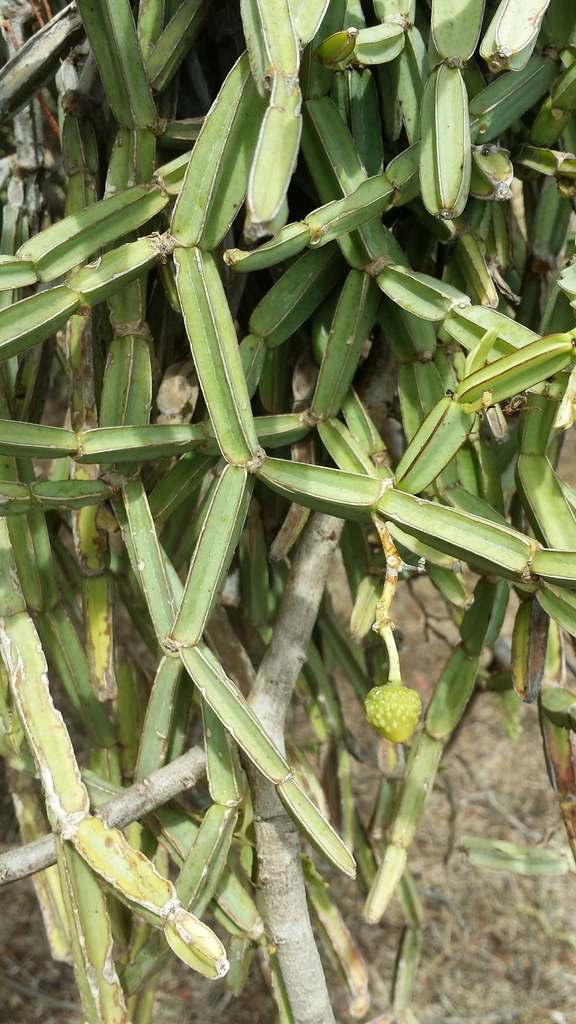
Adamant creeper
Cissus quadrangularis
Cissus quadrangularis is a perennial plant of the grape family. It is commonly known as veldt grape, winged treebine or adamant creeper. The species is native to tropical Asia, the Arabian Peninsula and much of Africa.
From the article Cissus quadrangularis on Wikipedia (CC BY-SA), quoted section by section
Description
Cissus quadrangularis reaches a height of 1.5 m (4.9 ft) and has quadrangular-sectioned branches with internodes 8–10 cm (3–4 in) long and 1.2–1.5 cm (0.5–0.6 in) wide. Along each angle is a leathery edge. Toothed trilobe leaves 2–5 cm (0.8–2.0 in) wide appear at the nodes. Each has a tendril emerging from the opposite side of the node. Racemes of small white, yellowish, or greenish flowers; globular berries are red when ripe. Cissus quadrangularis is an evergreen climber growing to 5 m (16 ft) by .5 m (1.6 ft) at a fast rate. It is hardy to zone (UK) 10. Suitable for: light (sandy), medium (loamy) and heavy (clay) soils, prefers well-drained soil and can grow in nutritionally poor soil. Suitable pH: acid, neutral and basic (alkaline) soils and can grow in very acid and very alkaline soils. It cannot grow in the shade. It prefers dry or moist soil and can tolerate drought.
In medicine
Cissus quadrangularis has been used as a medicinal plant since antiquity. Cissus has been used in various Ayurvedic classical medicines to heal broken bones and injured ligaments and tendons. In siddha medicine, it is considered a tonic and analgesic, and is believed to help heal broken bones, thus its name asthisamharaka (that which prevents the destruction of bones). The Assamese people and the Garo tribe of Meghalaya and Bangladesh have used C. quadrangularis for bone fracture.
Wikipedia: “Traditional medicine”
Where it lives
Recorded sightings
—
geo-referenced records in GBIF, from museums, herbaria and field observers.
Drag the globe to turn it. Dots are where records exist, not a range map; darker means more records.
In the stacks
Searching the stacks…
Every page naming Cissus quadrangularis in the Biodiversity Heritage Library →
This page is assembled live from iNaturalist, GBIF, Wikipedia, the Source Library and the Internet Archive. It is not yet part of the hand-edited codex. iNaturalist taxon 342728.