- Plants
- ›Vascular Plants
- ›flowering plants
- ›monocots
- ›Agaves, Orchids, Irises, and Allies
- ›iris family
- ›Crocoideae
- ›Ixieae
- ›Crocinae
- ›Crocus
- ›Crocus
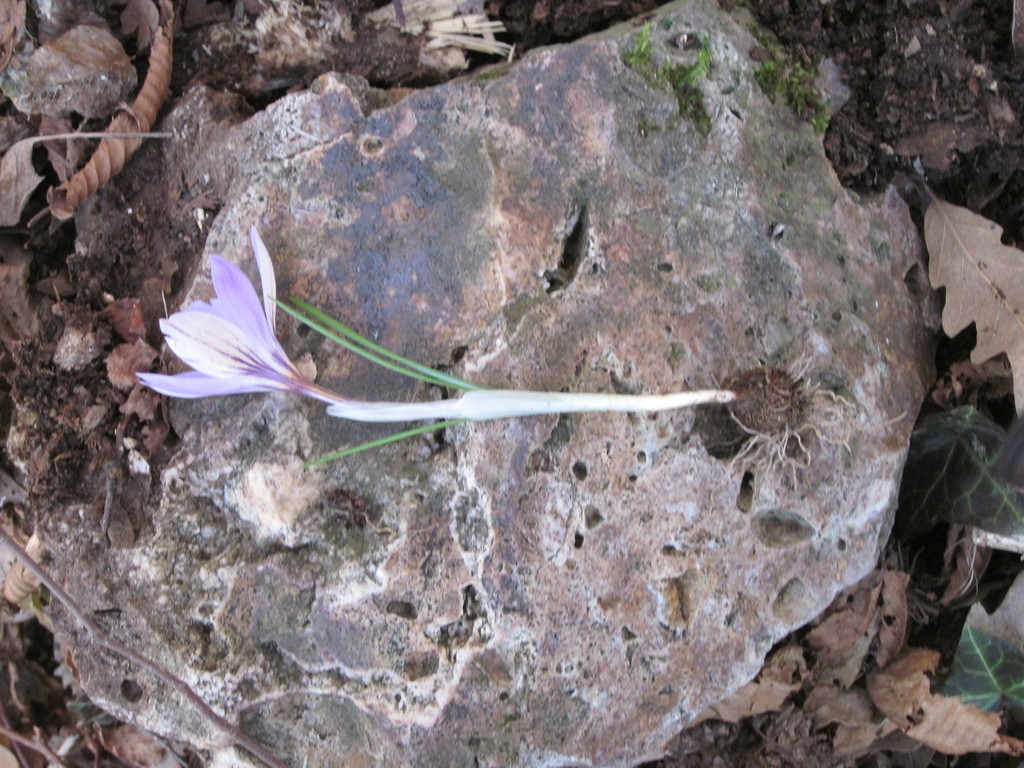
Etruscan Crocus
Crocus etruscus
Crocus etruscus (Tuscan crocus) is a species of flowering plant in the genus Crocus of the family Iridaceae, endemic to woodlands of Central Tuscany (Italy). It is a cormous perennial growing to 8 cm (3.1 in) tall. The lilac flowers with purple veining and prominent orange stigmas appear in early spring.
From the article Crocus etruscus on Wikipedia (CC BY-SA), quoted section by section
Description
Crocus etruscus is a herbaceous perennial geophyte growing from a corm. The corm is globe shaped with a flat top, the tunic is coarsely netted and a secondary star-shaped tunic is produced around the basal plate (where the roots are generated). Flowers are lavender-blue with gray-blue outer surfaces that are marked with dark veining. The three-branched, orange-red stigma is generally taller than the anthers. Flowering occurs in late winter- early spring. Plants are self-incompatible, meaning that viable seeds are not produced when pollination occurs among flowers of the same corm. The anthers open up away from the center of the flower to release pollen.
Range & habitat
It is found growing in sub-Mediterranean deciduous woods and stony fields; the species may be in bloom from February to April. The species is almost extinct in the wild. It has a restricted natural range, being endemic to the southwestern part of Tuscany. In nature the plant has "near-threatened" status. However, it also appears in cultivation. It has gained the Royal Horticultural Society's Award of Garden Merit.
Wikipedia: “Habitat”
Where it lives
Recorded sightings
—
geo-referenced records in GBIF, from museums, herbaria and field observers.
Drag the globe to turn it. Dots are where records exist, not a range map; darker means more records.
In the stacks
Searching the stacks…
Every page naming Crocus etruscus in the Biodiversity Heritage Library →
This page is assembled live from iNaturalist, GBIF, Wikipedia, the Source Library and the Internet Archive. It is not yet part of the hand-edited codex. iNaturalist taxon 342986.