- Animals
- ›Arthropods
- ›Hexapods
- ›Insects
- ›Winged and Once-winged Insects
- ›True Bugs, Hoppers, Aphids, and allies
- ›Plant-parasitic Hemipterans
- ›Aphids and Allies
- ›Aphidoidea
- ›Aphids
- ›Aphidinae
- ›Macrosiphini
- ›Dysaphis
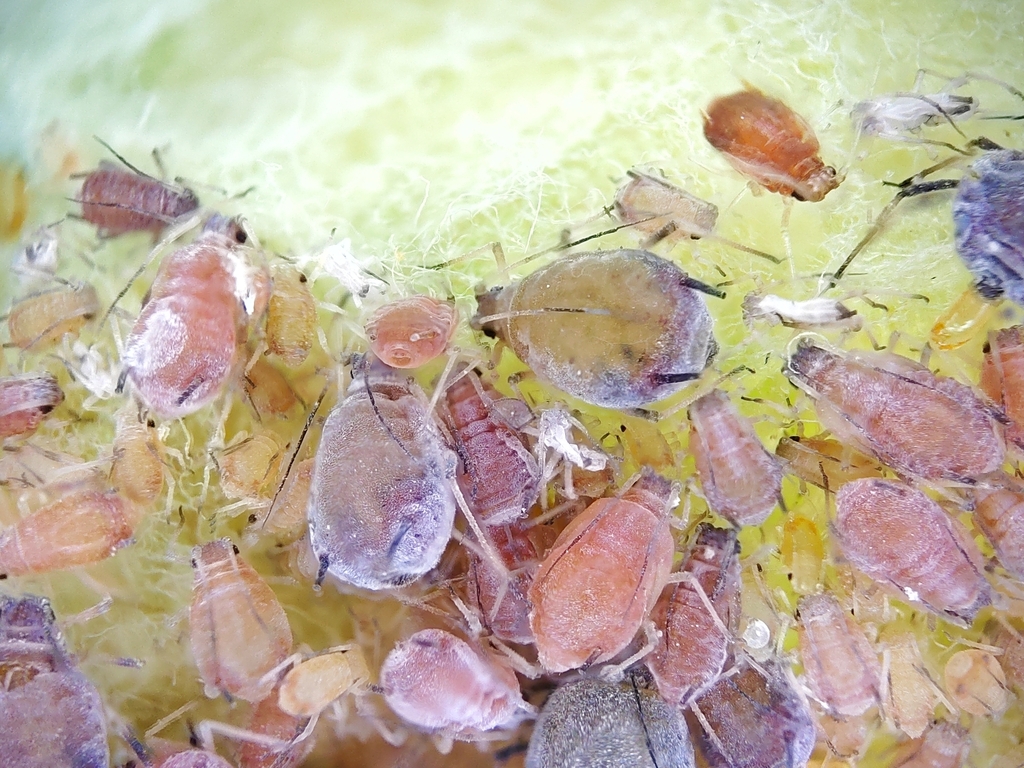
Rosy Apple Aphid
Dysaphis plantaginea
Dysaphis plantaginea, also known as the rosy apple aphid, is a species of aphid which inhabits apple trees and is considered a pest in apple cultivation. It was described in 1860 by Giovanni Passerini, an Italian entomologist.
From the article Dysaphis plantaginea on Wikipedia (CC BY-SA), quoted section by section
Description
The length of D. plantaginea ranges between 2-3mm. Rosy apple aphids develop into imagines after 2-3 weeks, after going through five nymphal instars. Initially, young aphids are beige, but develop a rosy pink hue as they mature. Imagines are colored bluish-green to grey. Winged individuals display a reddish-grey abdomen marked by a long, dark patch on the dorsal side. The abdomen of the imagines is covered in a white wax coating and their cornicles are black. In this aphid species, wingless individuals have antennae shorter than their body, while the antennae of winged individuals are around as long as their body length. At first, the eggs are green, but gradually turn glossy black.
Range & habitat
The aphid predominantly inhabits apple trees, and occasionally pear trees as its definitive host. It uses herbaceous plants, especially plantains, as its intermediate host. It is found across Europe, Asia, North Africa, and North America.
Wikipedia: “Habitat and distribution”
What it does
D. plantaginea produces 5-6 generations per year parthenogenetically without being fertilized. Winged individuals are produced from early summer onwards so they can migrate to their intermediate host, a herbeceous plant. In fall, they return to their definitive host, usually an apple tree, where, after sexual reproduction by winged females and males, the eggs are laid in bark crevices and fruit stem scars, where they stay over the winter. In spring, the aphids hatch. Ant attendance is common, typically by the Black garden ant, and has been proven to increase the size and growth of populations of D. plantaginea.
Wikipedia: “Life cycle”
Listen
Looking for field recordings…
Where it lives
Recorded sightings
—
geo-referenced records in GBIF, from museums, herbaria and field observers.
Drag the globe to turn it. Dots are where records exist, not a range map; darker means more records.
In the stacks
Searching the stacks…
Every page naming Dysaphis plantaginea in the Biodiversity Heritage Library →
This page is assembled live from iNaturalist, GBIF, Wikipedia, the Source Library and the Internet Archive. It is not yet part of the hand-edited codex. iNaturalist taxon 343383.