- Plants
- ›Vascular Plants
- ›flowering plants
- ›monocots
- ›grasses, sedges, cattails, and allies
- ›grasses
- ›Panicums, Bluestems, Paspalums, and Allies
- ›Thysanolaeneae
- ›Thysanolaena
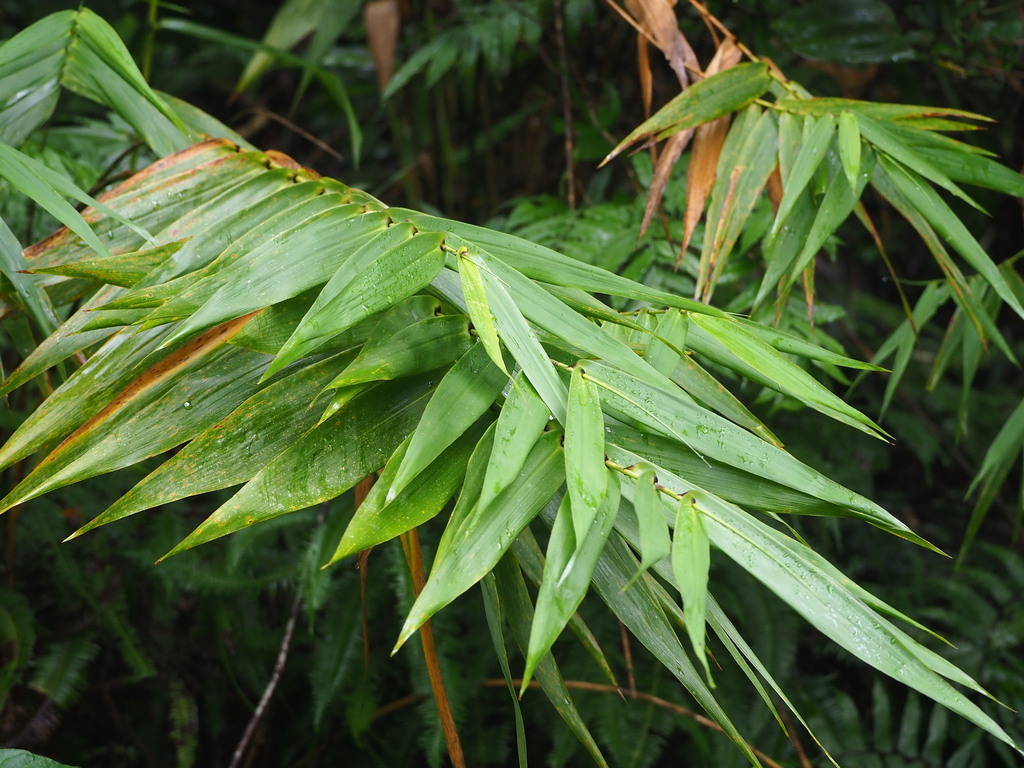
Nepalese Broom Grass
Thysanolaena latifolia
Thysanolaena is a monotypic genus of the grass family, in the tribe Thysanolaeneae. Its only recognized species is Thysanolaena latifolia (formerly Thysanolaena maxima), native to Bangladesh, Bhutan, Cambodia, China (Guangdong, Guangxi, Guizhou, Hainan, Yunnan), India, Indonesia, Laos, Malaysia, Myanmar, Nepal, New Guinea, Philippines, Sri Lanka, Taiwan, Thailand, and Vietnam. It is also naturalized in Mauritius, Seychelles, Gambia, Tanzania, Hawaii, California, the West Indies and Brazil.
Tiger grass, Nepalese broom grass, broom grass, broom stick are common names for this plant, in Nepali amriso and jhadu in Assamese . The flowers of this plant are used as cleaning tool or broom, which is known as kuchcho in Nepali and jhadu (phool jhadu) in Hindi.
From the article Thysanolaena on Wikipedia (CC BY-SA), quoted section by section
Range & habitat
It is found growing along steep hills, sandy banks of rivers and damp steep banks along ravines. It is widely distributed throughout Nepal but only up to an altitude of 2000 metres. The grass can be grown on severely degraded and marginal lands. Broom grass tends to grow in tussocks, with 4-5 tussocks in a 100-metre radius and is harvested during the winter seasons between January and March.
Wikipedia: “Habitat”
How it is grown
Tiger grass is another common name for this plant throughout the tropics where it is grown as an ornamental. It may be used to create the effect of bamboo, which it resembles. Although both are grasses (Family Poaceae), bamboos are in the subfamily Bambusoideae, while T. latifolia is in the subfamily Panicoideae.
Wikipedia: “Horticultural use”
Where it lives
Recorded sightings
—
geo-referenced records in GBIF, from museums, herbaria and field observers.
Drag the globe to turn it. Dots are where records exist, not a range map; darker means more records.
In the stacks
Searching the stacks…
Every page naming Thysanolaena latifolia in the Biodiversity Heritage Library →
This page is assembled live from iNaturalist, GBIF, Wikipedia, the Source Library and the Internet Archive. It is not yet part of the hand-edited codex. iNaturalist taxon 344244.