- Fungi Including Lichens
- ›Basidiomycete Fungi
- ›Higher Basidiomycetes
- ›Mushrooms, Bracket Fungi, Puffballs, and Allies
- ›Russulales
- ›Milkcaps, Brittlegills and Allies
- ›Russula
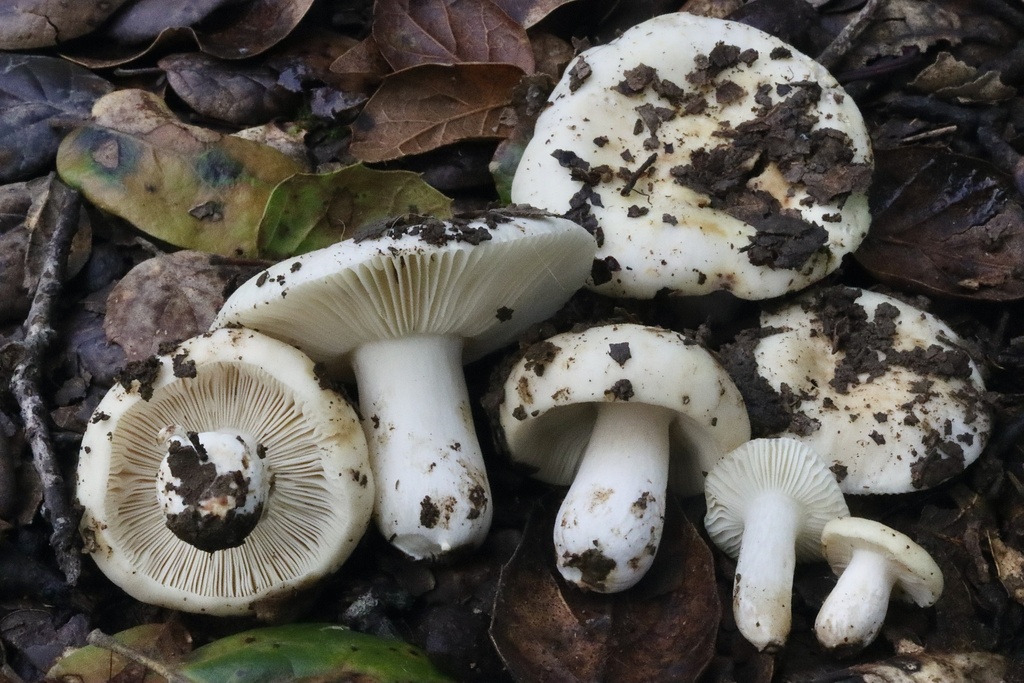
Russula albidula
Russula albidula is a species of fungus in the genus Russula. It is commonly known as the boring white russula or the whitish brittlegill. It produces a fairly small whitish mushroom with a highly acrid taste, which renders it inedible. It is found in the woods of eastern North America.
From the article Russula albidula on Wikipedia (CC BY-SA), quoted section by section
Description
The cap of the fruit body is convex to almost flat, 2.5 to 10 cm (1.0 to 3.9 in) broad, with a white surface that becomes yellowish when dry. The cap surface is viscid when moist, and have a cuticle that can be peeled off. The gills are white, equal, sometimes forking next to the stipe, and have an adnate or slightly decurrent attachment to the stem. The stipe is white, smooth, 2.5 to 6 cm (1.0 to 2.4 in) long and 0.8 to 2 cm (0.3 to 0.8 in) wide. The flesh, which is fragile and white, has a very bitter taste. Specimens found in the field are typically dirty and dingy. In deposit, the spores are pale yellow. Viewed microscopically, they are roughly spherical, thin-walled, and have dimensions of 6–7.5 by 7.5–10 μm. The surface of the spores is marked by broken reticulations.
Edibility. The highly acrid taste of Russula albidula is a deterrent to consumption, although it is not considered poisonous.
Similar species. Other Russula species that bear a resemblance to R. albidula include R. albella, R. albida, R. anomala, and R. subalbidula. It may also be confused with white waxycaps (genus Hygrophorus) or Tricholoma species.
Range & habitat
R.albidula is distributed in eastern North America. Its fruit bodies can be found growing solitary or grouped together on the ground in woods (both mixed and coniferous) or the edges of woods; specimens are often found near oak trees. The species has a penchant for appearing in poor soil like that found on roadsides and along trails. Adults of the pleasing fungus beetle Tritoma angulata have been recorded from this mushroom, but it does not seem to be a regular food source for them.
Wikipedia: “Distribution and ecology”
Where it lives
Recorded sightings
—
geo-referenced records in GBIF, from museums, herbaria and field observers.
Drag the globe to turn it. Dots are where records exist, not a range map; darker means more records.
In the stacks
Searching the stacks…
Every page naming Russula albidula in the Biodiversity Heritage Library →
This page is assembled live from iNaturalist, GBIF, Wikipedia, the Source Library and the Internet Archive. It is not yet part of the hand-edited codex. iNaturalist taxon 344494.