- Fungi Including Lichens
- ›Basidiomycete Fungi
- ›Higher Basidiomycetes
- ›Mushrooms, Bracket Fungi, Puffballs, and Allies
- ›Agaricomycetidae
- ›boletes and allies
- ›Gomphidiaceae
- ›Gomphidius
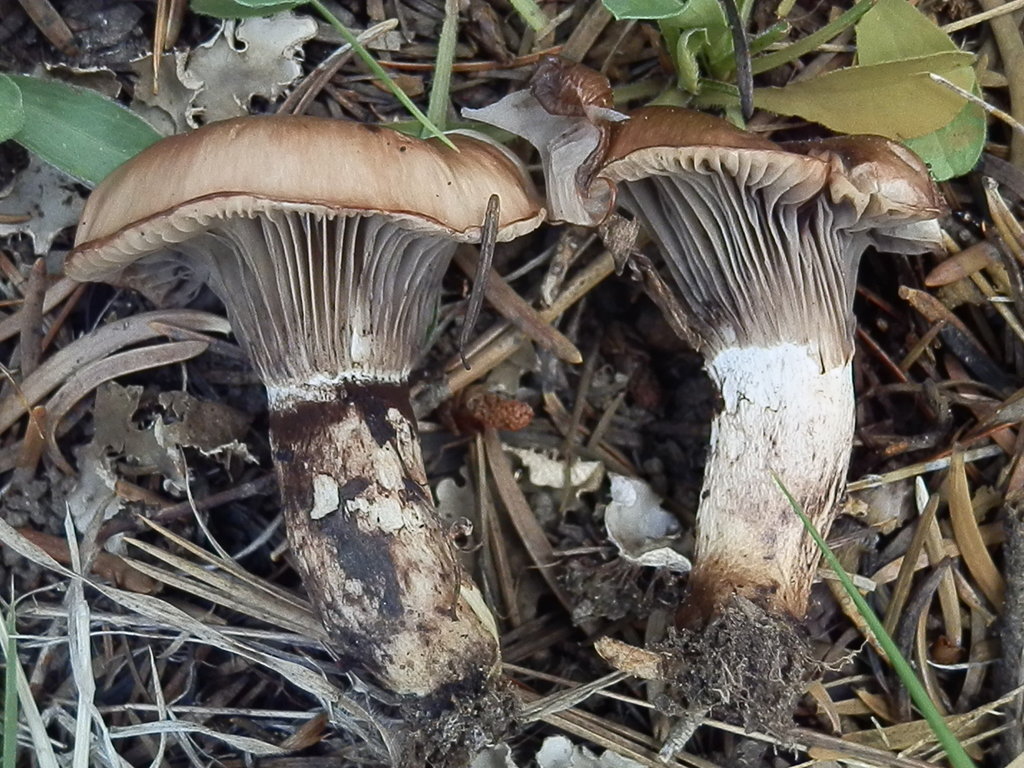
Smith's Slime Spike
Gomphidius smithii
Gomphidius smithii, commonly known as Smith's slime spike, is a species of mushroom in the family of Gomphidiaceae. It is found in the Pacific Northwest. It accumulates heavy metals.
From the article Gomphidius smithii on Wikipedia (CC BY-SA), quoted section by section
Description
The cap of Gomphidius smithii is about 1.5-7 centimeters in diameter. It starts out rounded, before becoming convex and eventually flat. The surface of the cap is slimy. The stipe is about 4-7 centimeters long and 0.5-1 centimeters wide, with a veil. Unlike many other Gomphidius species, G. smithii is not yellow at the base of the stipe. The gills are decurrent and start out white, before graying with age. The spore print is dark gray, sometimes almost black.
Range & habitat
Gomphidius smithii is found under douglas fir trees. It grows in association with and is likely parasitic to Suillus lakei, a mycorrhizal fungus that grows in association with douglas fir. It may also grow in association with other Suillus species.
Wikipedia: “Habitat and ecology”
Where it lives
Recorded sightings
—
geo-referenced records in GBIF, from museums, herbaria and field observers.
Drag the globe to turn it. Dots are where records exist, not a range map; darker means more records.
In the stacks
Searching the stacks…
Every page naming Gomphidius smithii in the Biodiversity Heritage Library →
This page is assembled live from iNaturalist, GBIF, Wikipedia, the Source Library and the Internet Archive. It is not yet part of the hand-edited codex. iNaturalist taxon 344565.