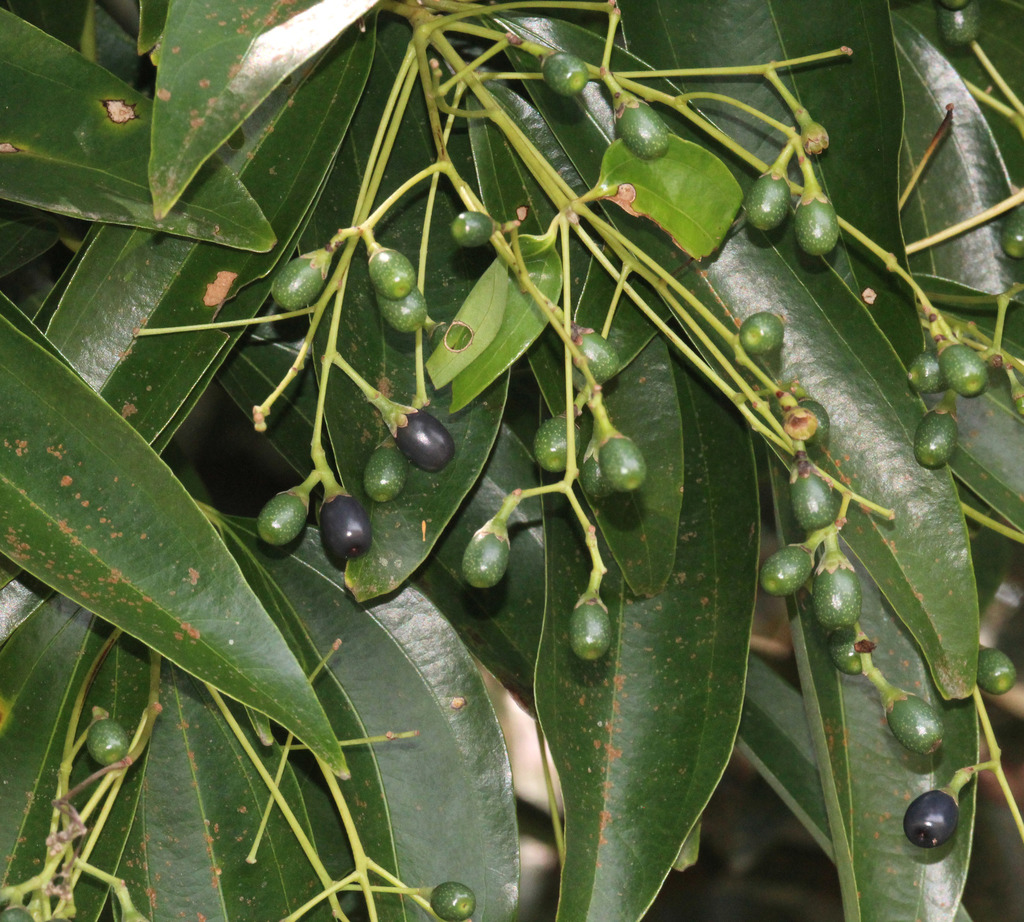
Wild Cinnamon
Cinnamomum iners
Cinnamomum iners is a tree species in the family Lauraceae described by Reinwardt and Blume. No subspecies are listed in the Catalogue of Life. It occurs naturally in Myanmar, Thailand, Laos, Cambodia, Vietnam, Malaysia, Indonesia, Brunei, Singapore, the Philippines and southern China.
In Malay C. iners is called pokok medang teja; in Vietnamese it may be called: quế rừng, quế giả, quế lá to, quế lợn, hậu phác, or hậu phác nam.
From the article Cinnamomum iners on Wikipedia (CC BY-SA), quoted section by section
Description
Cinnamomum iners is an evergreen tree growing up to 20 m in height; the branches have opposite twigs, robust and angular, sometimes tetragonal, glabrescent. Leaves are subopposite, ovate to elliptic, measuring 120–350 mm long and 60–85 mm broad. They are glabrous and the base of the leaf is wedge-shaped with a blunt apex (see illustrations); petioles are more or less pubescent, have a reddish brown colour and 10–30 mm in length. Flowers small and bisexual, pubescent, grouped in axillary or terminal panicles; these inflorescences are 60–260 mm in length. Fruits are ovoid in shape, typically 10 mm long and 7 mm in width. Trees bloom and start to bear fruit from March to June.
Where it lives
Recorded sightings
—
geo-referenced records in GBIF, from museums, herbaria and field observers.
Drag the globe to turn it. Dots are where records exist, not a range map; darker means more records.
In the old herbals & bestiaries


In the stacks
Searching the stacks…
Every page naming Cinnamomum iners in the Biodiversity Heritage Library →
This page is assembled live from iNaturalist, GBIF, Wikipedia, the Source Library and the Internet Archive. It is not yet part of the hand-edited codex. iNaturalist taxon 344847.