- Plants
- ›Vascular Plants
- ›flowering plants
- ›Dicots
- ›myrtles, evening primroses, and allies
- ›myrtle family
- ›Myrtoideae
- ›Melaleuceae
- ›Melaleuca
- ›Melaleuca leucadendra
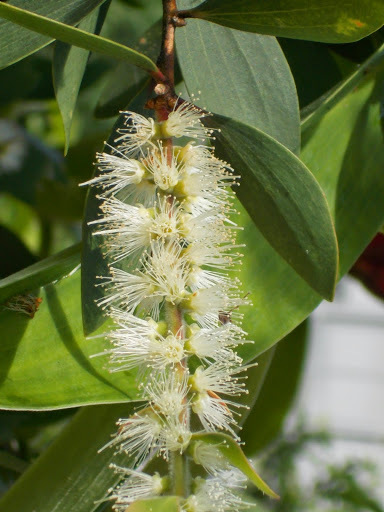
Melaleuca cajuputi
Melaleuca cajuputi, commonly known as cajuput or white samet is a plant in the myrtle family, Myrtaceae and is widespread in Australia, Southeast Asia, New Guinea and the Torres Strait islands. It is a medium to tall tree with papery bark, silvery new growth and white or greenish flower spikes. It has important uses as a source of cajuput oil.
From the article Melaleuca cajuputi on Wikipedia (CC BY-SA), quoted section by section
Description
Melaleuca cajuputi is usually a medium to large tree, often growing to 35 metres (100 ft) and sometimes to 46 metres (200 ft) with grey, brownish or whitish papery bark. The new growth is silky-hairy, becoming glabrous as it matures. The leaves are arranged alternately 40–140 millimetres (2–6 in) long and 7.5–60 millimetres (0.3–2 in) wide, tapering at both ends. The flowers are white, cream or greenish-yellow mostly in dense spikes at the ends of the branches which continue to grow after flowering but also often in the axils of the upper leaves. The spikes contain 8 to 20 groups of flowers, each group with three flowers. The stamens are grouped in five bundles around the flower, each bundle containing 6 to 18 stamens. Timing of flowering varies with subspecies. The fruits are woody, cup-shaped capsules clustered loosely along the branches, each fruit 2–2.8 millimetres (0.08–0.1 in) long.
Range & habitat
Melaleuca cajuputi subsp. cajuputi occurs in the Dampier Peninsula, Calder River, Fitzroy Crossing district in the Central Kimberley biogeographic zone in Western Australia, the northern part of the Northern Territory, Ambon Island, Buru Island of Maluku, and East Timor. It grows in woodland, vine forest, gallery forest and savannah forest, on clayey and peaty loam. Melaleuca cajuputi subsp. cumingiana (Turcz.) Barlow occurs in Myanmar, Thailand, Vietnam, Malaysia and Indonesia (Sumatra, West Java and south-west Kalimantan). It grows in coastal swamp forest. In Thailand, the species is known as White Samet. Melaleuca cajuputi subsp. platyphylla Barlow occurs in New Guinea, the Torres Strait islands and north-western Queensland as far south as Cairns. It grows in similar habitats to subsp. cajuputi.
Wikipedia: “Distribution and habitat”
Where it lives
Recorded sightings
—
geo-referenced records in GBIF, from museums, herbaria and field observers.
Drag the globe to turn it. Dots are where records exist, not a range map; darker means more records.
In the stacks
Searching the stacks…
Every page naming Melaleuca cajuputi in the Biodiversity Heritage Library →
This page is assembled live from iNaturalist, GBIF, Wikipedia, the Source Library and the Internet Archive. It is not yet part of the hand-edited codex. iNaturalist taxon 344896.