- Plants
- ›Vascular Plants
- ›flowering plants
- ›Dicots
- ›Gentians, Dogbanes, Madders, and Allies
- ›Dogbane Family
- ›milkweeds
- ›Marsdenieae
- ›Dischidia
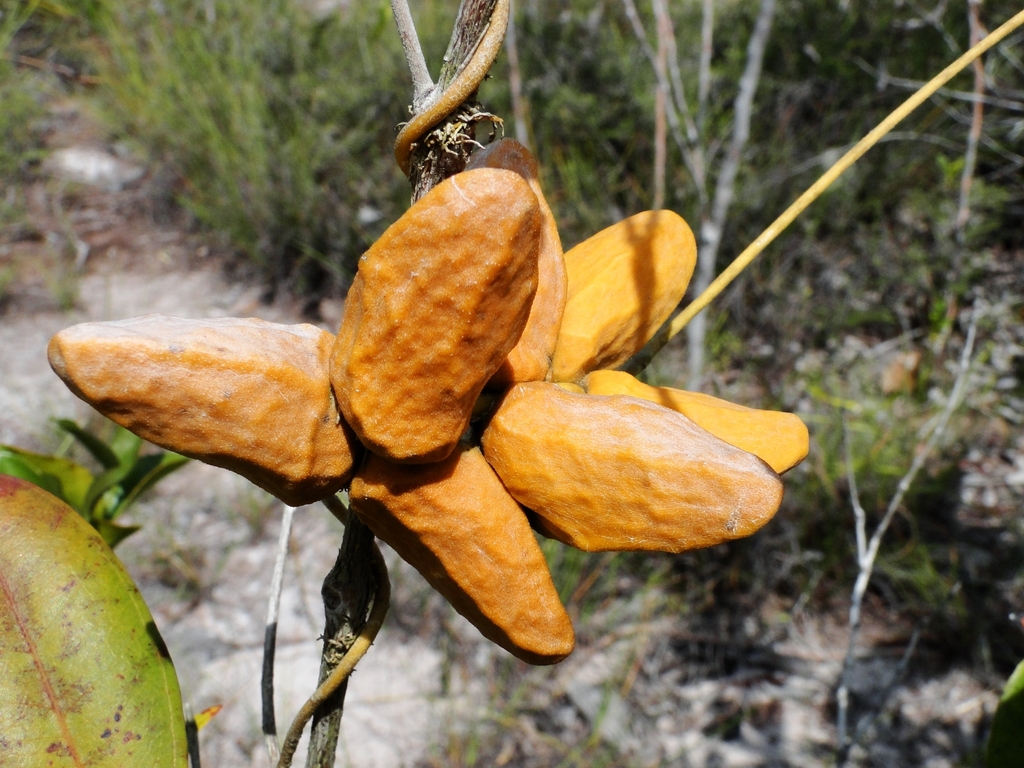
Malayan Urn Vine
Dischidia major
Dischidia major (Synonym Dischidia rafflesiana), the Malayan urn vine, is a plant in the genus Dischidia. They carry modified leaves, offering accommodation to ants, including those of the family Dolichoderinae, (most commonly Iridomyrmex myrmecodiae) and in return gain some sustenance from increased carbon dioxide and nitrogen levels, and a degree of protection from noxious animals and plants. This mutualism trait, known as myrmecophily, is widespread across the plant world and clearly carries considerable benefits for both ants and plant.
Dischidia major is found in wet-tropical forests in Southeast Asia from Malaya east to northern Australia. It twines around the branches and trunks of trees, having a preference for those that are decaying. It produces both circular succulent leaves of about 2 cm diameter, and hollow, pouch-like 12 cm long leaves, reminiscent of the fruits of Araujia sericifera, a related species. These modified leaves, pitchers or ascidia, are purplish and richly dotted with stomata on the inner surface, and have an opening at the top end near the stalk. Organic debris and rainwater, possibly augmented by secreted fluids, accumulate in the cavity over the course of time, offering a source of nutrition which the plant uses by growing roots into the chamber. Dischidia astephana and D. parvifolia do not provide housing for resident ants, but have roots that penetrate decaying wood and humus, reaching into the ant nests and presumably obtaining nutrients from the ant waste there.
Where it lives
Recorded sightings
—
geo-referenced records in GBIF, from museums, herbaria and field observers.
Drag the globe to turn it. Dots are where records exist, not a range map; darker means more records.
In the stacks
Searching the stacks…
Every page naming Dischidia major in the Biodiversity Heritage Library →
This page is assembled live from iNaturalist, GBIF, Wikipedia, the Source Library and the Internet Archive. It is not yet part of the hand-edited codex. iNaturalist taxon 345969.