- Plants
- ›Vascular Plants
- ›flowering plants
- ›monocots
- ›Agaves, Orchids, Irises, and Allies
- ›iris family
- ›Crocoideae
- ›Ixieae
- ›Crocinae
- ›Crocus
- ›Crocus
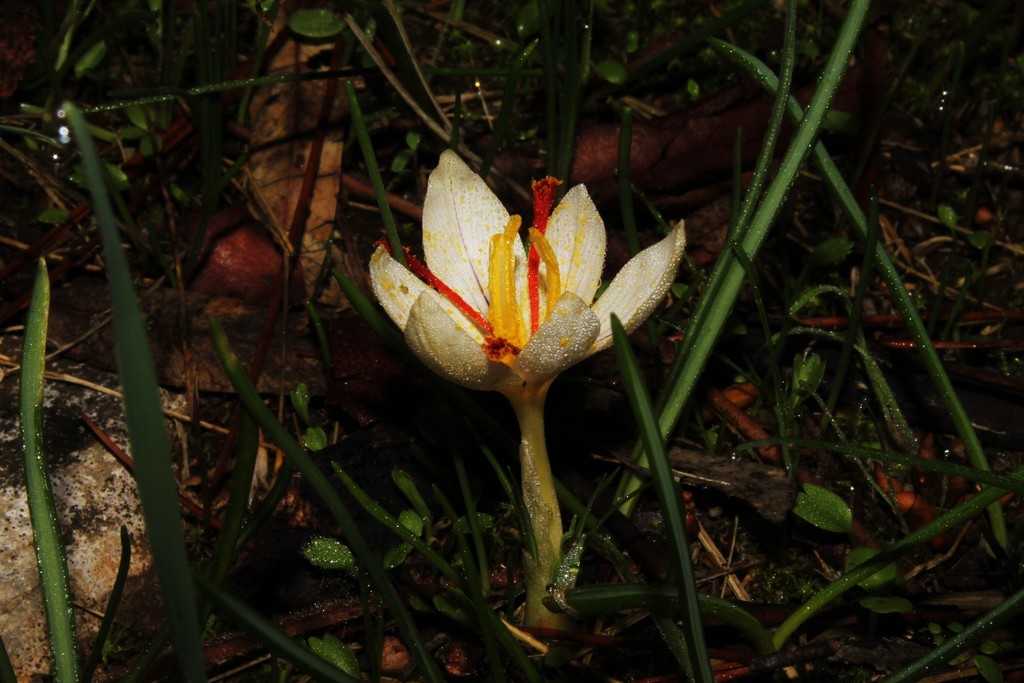
Wild Saffron
Crocus cartwrightianus
Crocus cartwrightianus is a species of flowering plant in the family Iridaceae. It is native to mainland Greece, Euboea, Crete, Skyros and some islands of the Cyclades. It is a cormous perennial growing to 5 cm (2 in). The flowers, in shades of lilac or white with purple veins and prominent red stigmas, appear with the leaves in autumn and winter.
From the article Crocus cartwrightianus on Wikipedia (CC BY-SA), quoted section by section
Description
The flower style divides while still within the throat of the flower, well below the bases of the anthers. The branches of the stigma are taller than the anthers and about the same length as the petals. The throat of the flower is bearded. The leaves and flowers are produced at the same. The Latin specific epithet cartwrightianus refers to the 19th-century British consul to Constantinople, John Cartwright. C. cartwrightianus is possibly a wild progenitor of the domesticated triploid Crocus sativus – the saffron crocus with a population in Attica, Greece suggested as the closest known modern population to the saffron ancestors. Saffron likely originated in Iran, Greece or Mesopotamia.
Range & habitat
This species is commonly found growing on limestone soil areas of the Attica Peninsula of Greece.
Wikipedia: “Habitat”
How it is grown
There is evidence that this plant was cultivated in ancient Crete at least as early as the Middle Minoan Period, as exhibited by a mural, the "Saffron Gatherer", illustrating the gathering of crocuses. In the 19th century, wild Crocus cartwrightianus was harvested on Andros in the islands of the Cyclades, for medicinal purposes and the stigmas for making a pigment called Zafran. This plant has received the Royal Horticultural Society's Award of Garden Merit.
Wikipedia: “Cultivation”
Where it lives
Recorded sightings
—
geo-referenced records in GBIF, from museums, herbaria and field observers.
Drag the globe to turn it. Dots are where records exist, not a range map; darker means more records.
In the old herbals & bestiaries


In the stacks
Searching the stacks…
Every page naming Crocus cartwrightianus in the Biodiversity Heritage Library →
This page is assembled live from iNaturalist, GBIF, Wikipedia, the Source Library and the Internet Archive. It is not yet part of the hand-edited codex. iNaturalist taxon 346198.