- Plants
- ›Vascular Plants
- ›flowering plants
- ›Dicots
- ›Legumes, Milkworts, and Allies
- ›Legumes
- ›orchid trees and redbuds
- ›Bauhinieae
- ›Bauhinia
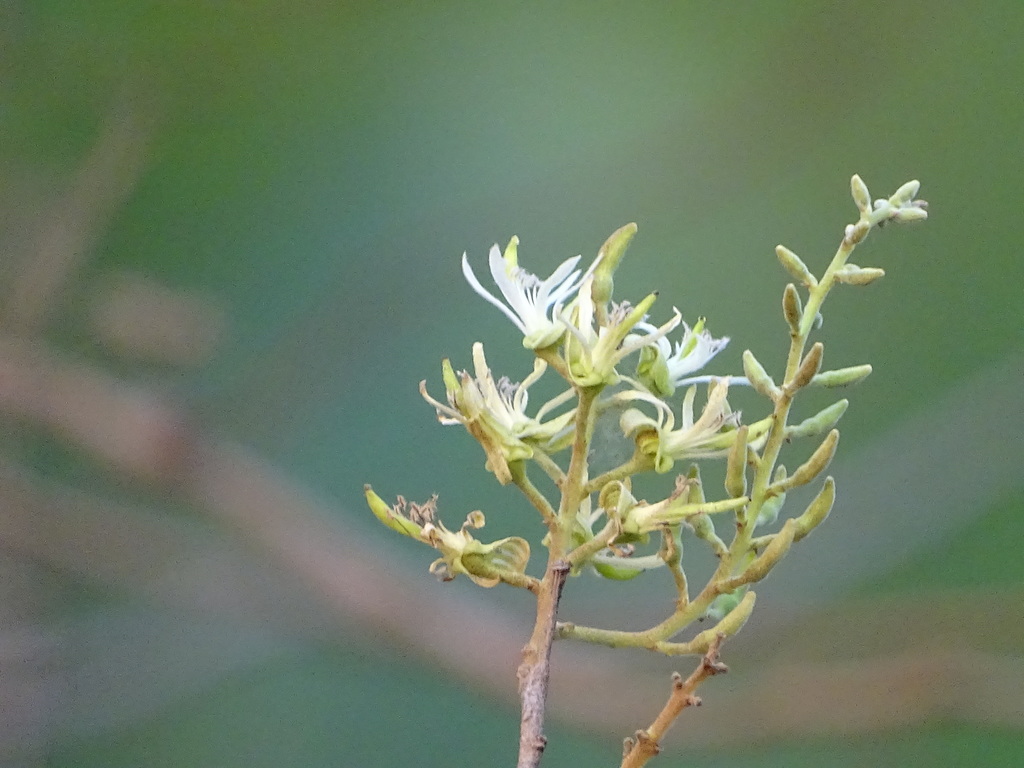
Bidi leaf tree
Bauhinia racemosa
Bauhinia racemosa, commonly known as the bidi leaf tree, is a rare medicinal species of flowering shrub with religious significance. It is a small crooked tree with drooping branches that grows 3–5 metres (10–16 ft) tall and flowers between February and May. It is native to Southeast Asia, the Indian subcontinent and China.
From the article Bauhinia racemosa on Wikipedia (CC BY-SA), quoted section by section
Description
The tree's leaves are relatively small and wide, with dimensions ranging from 2 to 5 cm in length and 2.5 to 6.3 cm in width. A cleft divides each leaf into two rounded globes. The flowers appear in terminal racemes, measuring 5 to 12.5 cm in length. The pods are stalked, smooth, and turgid, featuring a blunt apex and a tapered base. Ripe pods exhibit a dark brown color, are indehiscent, and house 12 to 20 seeds. The bark is scabrous, displaying vertical cracks, and has a bluish-black hue. The tree blossoms between March and June, and its pods mature in November-December, persisting on the tree for several additional months.
At the table
The leaves are used in the production of beedi, a thin Indian and Sri Lankan cigarillo.
Wikipedia: “Other uses”
Where it lives
Recorded sightings
—
geo-referenced records in GBIF, from museums, herbaria and field observers.
Drag the globe to turn it. Dots are where records exist, not a range map; darker means more records.
In the stacks
Searching the stacks…
Every page naming Bauhinia racemosa in the Biodiversity Heritage Library →
This page is assembled live from iNaturalist, GBIF, Wikipedia, the Source Library and the Internet Archive. It is not yet part of the hand-edited codex. iNaturalist taxon 346365.