- Animals
- ›Arthropods
- ›Crustaceans
- ›Typical Crustaceans
- ›Barnacles and Copepods
- ›Copepods
- ›Neocopepoda
- ›Gymnoplea
- ›Calanoid Copepods
- ›Calanidae
- ›Calanus
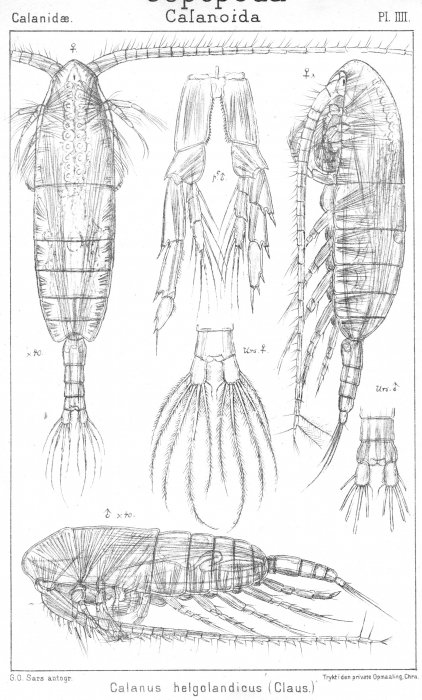
Calanus helgolandicus
Calanus helgolandicus is a copepod found in the Atlantic, from the North Sea south to the western coast of Africa. The female has an average size of about 2.9 millimetres (0.11 in) and the male has an average size of about 2.7 millimetres (0.11 in).
From the article Calanus helgolandicus on Wikipedia (CC BY-SA), quoted section by section
Description
The female has an average size of about 2.9 millimetres (0.11 in) and the male has an average size of about 2.7 millimetres (0.11 in).
Range & habitat
Calanus helgolandicus is found in the Atlantic, from the North Sea south to the western coast of Africa. It can also be found in the Mediterranean and Black Sea. Because of increasing temperatures due to climate change, its range is expanding northward. It is usually found in waters between 9 and 20 °C (48 and 68 °F) in temperature, with maximum abundance being between 13 and 17 °C (55 and 63 °F).
Wikipedia: “Distribution”
What it does
Calanus helgolandicus overwinters as a stage V copepodite. However, only those with enough energy stores can overwinter; the rest stay at the surface. In fact, it has been observed that overwintering copepods are heavier than those that stay at the surface. During this overwintering process, the copepodites moult into adult females. After moulting, the females breed the next spring. In the absence of food during this time, they can lay their first few eggs from accumulated energy stores. Although this is true, it is mainly an income breeder, reproducing using recently gained energy. It has a maximum of about three generations per year. In the central North Sea, it is most abundant during spring and autumn. It is likely that warmer temperatures can facilitate egg production for more of the year.
Wikipedia: “Life cycle and reproduction”
Where it lives
Recorded sightings
—
geo-referenced records in GBIF, from museums, herbaria and field observers.
Drag the globe to turn it. Dots are where records exist, not a range map; darker means more records.
In the stacks
Searching the stacks…
Every page naming Calanus helgolandicus in the Biodiversity Heritage Library →
This page is assembled live from iNaturalist, GBIF, Wikipedia, the Source Library and the Internet Archive. It is not yet part of the hand-edited codex. iNaturalist taxon 346580.