- Plants
- ›Vascular Plants
- ›flowering plants
- ›Dicots
- ›pepper plants, birthworts, and allies
- ›pepper plant family
- ›Piper
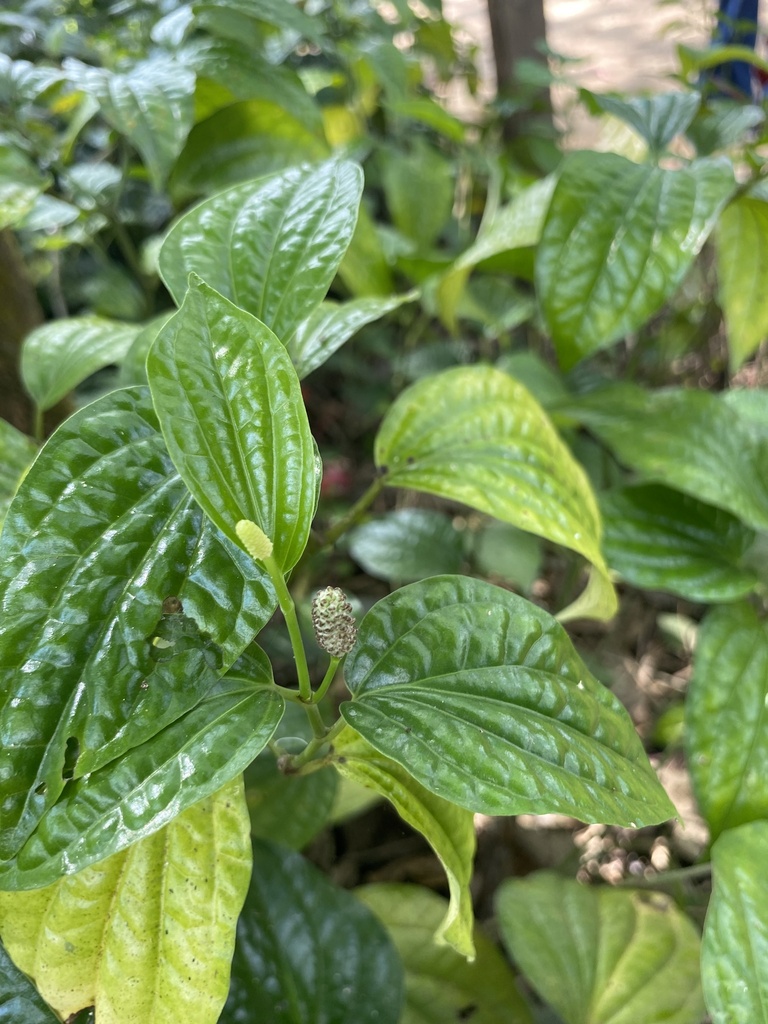
Long pepper
Piper longum
Long pepper (Piper longum), sometimes called Indian long pepper or pippali, is a flowering vine in the family Piperaceae, cultivated for its fruit, which is usually dried and used as a spice and seasoning. Long pepper has a taste similar to, but is sweeter and more pungent than, its close relative Piper nigrum – from which black, green and white pepper are obtained.
The fruit of the pepper consists of many minuscule fruits – each about the size of a poppy seed – embedded in the surface of a flower spike that closely resembles a hazel tree catkin. Like Piper nigrum, the fruits contain the compound piperine, which contributes to their pungency. Another species of long pepper, Piper retrofractum, is native to Java, Indonesia. The fruits of this plant are often confused with chili peppers, which belong to the genus Capsicum, originally from the Americas.
From the article Long pepper on Wikipedia (CC BY-SA), quoted section by section
In human culture
Use of long pepper occurred in Greece in the sixth or fifth century BCE, though Hippocrates discussed it as a medicine rather than a spice. Among the Greeks and Romans and prior to the Columbian exchange, long pepper was a common spice. The ancient history of long pepper is often interlinked with that of black pepper (Piper nigrum). Theophrastus distinguished the two in his work of botany. The Romans knew of both but their word for pepper usually meant black pepper. Pliny erroneously believed dried black pepper and long pepper came from the same plant. Round, or black, pepper began to compete with long pepper in Europe from the twelfth century and had displaced it by the fourteenth. The quest for cheaper and more dependable sources of black pepper fueled the Age of Discovery. After the discovery of the American continents and of chili pepper, called by the Spanish pimiento, employing their word for long pepper, the popularity of long pepper faded away. Chili peppers, some of which, when dried, are similar in shape and taste to long pepper, were easier to grow in a variety of locations more convenient to Europe. Today, long pepper is a rarity in general commerce.
Etymology. The word pepper itself is derived from the word for long pepper, Sanskrit pippali. The plant itself is a native of India. …
Wikipedia: “History”
Where it lives
Recorded sightings
—
geo-referenced records in GBIF, from museums, herbaria and field observers.
Drag the globe to turn it. Dots are where records exist, not a range map; darker means more records.
In the old herbals & bestiaries

History of Aromatics and Simple Medicines of the Indies
Garcia de Orta (trans. Clusius) · 1567 · p.86

Medicinal History of the Things Brought from Our West Indies
Nicolás Monardes · 1574 · p.185

The Plants of Egypt
Prospero Alpini · 1592 · p.92

Ten Books of Exotic Things
Carolus Clusius · 1605 · p.40

Thesaurus of Medical Things of New Spain, or History of Mexican Plants, Animals, and Minerals
Francisco Hernández; Nardo Antonio Recchi (ed.) · 1651 · p.153

Thesaurus of Medical Things of New Spain, or History of Mexican Plants, Animals, and Minerals
Francisco Hernández; Nardo Antonio Recchi (ed.) · 1651 · p.154

Treasury of Medical Matters of New Spain
Francisco Hernández · 1651 · p.168

De Indiae utriusque re naturali et medica
Willem Piso · 1658 · p.585

The Book of Household Management
Mrs Isabella Beeton · 1861 · p.246

Ten Books of Exotic Things
Carolus Clusius · 1605 · p.362
In the stacks
Searching the stacks…
Every page naming Piper longum in the Biodiversity Heritage Library →
This page is assembled live from iNaturalist, GBIF, Wikipedia, the Source Library and the Internet Archive. It is not yet part of the hand-edited codex. iNaturalist taxon 346856.