- Plants
- ›Vascular Plants
- ›flowering plants
- ›Dicots
- ›Mustards, Capers, and Allies
- ›mustard family
- ›Brassicoideae
- ›Camelinodae
- ›Cardamineae
- ›Cardamine
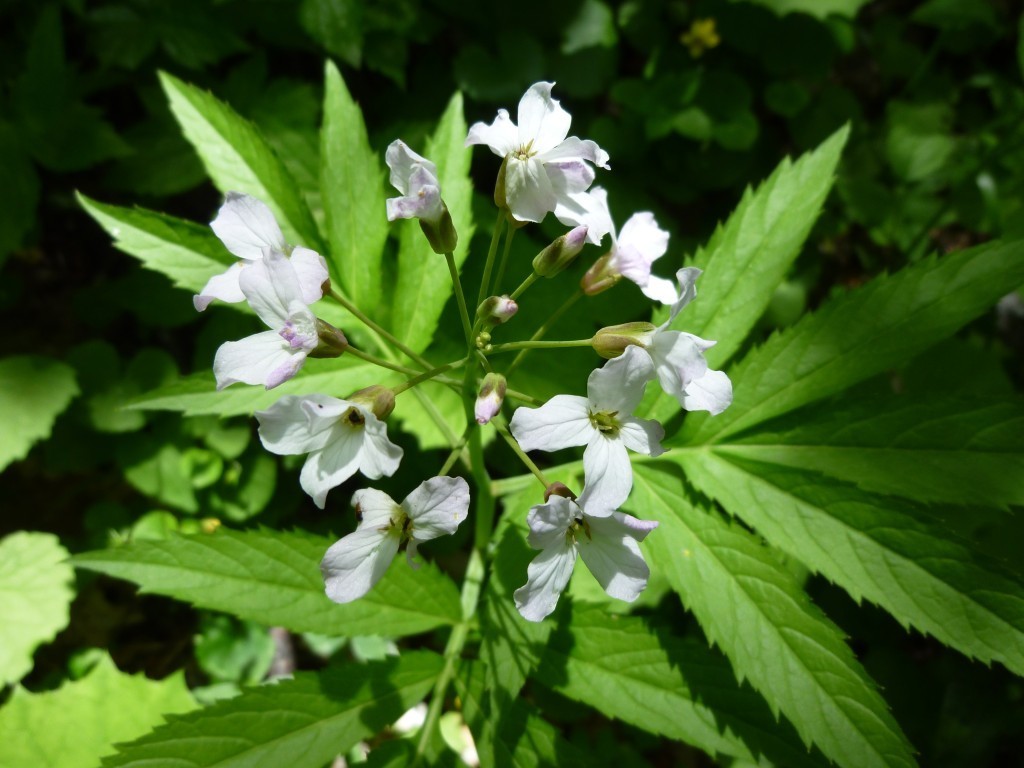
pinnate coralroot
Cardamine heptaphylla
Cardamine heptaphylla, common name pinnate coralroot is a species of flowering plants in the family Brassicaceae....
From the article Cardamine heptaphylla on Wikipedia (CC BY-SA), quoted section by section
Description
Cardamine heptaphylla can reach a size of 30–60 millimetres (1.2–2.4 in). These deciduous, perennial, rhizomatous, herbaceous, flowering plants are characterized by a glabrous, erect, unbranched stem, and by few but very large imparipinnate leaves, with 5 to 9 large opposite leaflets, ovate-lanceolate, irregularly toothed. They have a horizontally crawling rhizome. The large flowers grow in a many-flowered inflorescence. The inflorescence is composed by a cluster with four cup-shaped broad flowers. Each flower is carried by a rather long pedicel. Flowers may be white, pink or purplish. Petals are 18 to 23 mm long, obovate, usually somewhat wrinkled and three times longer than the calyx. Corolla has a diameter of 15–25 millimetres (0.59–0.98 in). They bloom from April to July. The flowers are hermaphroditic. The pollination is done by bees, flies, butterflies and moths. The fruit is a 4 to 7 cm long pod.
Range & habitat
This species is widespread in Central and Southern Europe, from Northern Spain, to Italy and S.W. Germany.
Wikipedia: “Distribution”
In human culture
The genus name Cardamine is derived from the Greek kardamon, cardamom, an unrelated plant in the ginger family, used as a pungent spice in cooking. The specific epithet heptaphylla is composed of ancient Greek ἑπτά, hepta (seven) and φύλλον, phullon (leaf).
Wikipedia: “Etymology”
Where it lives
Recorded sightings
—
geo-referenced records in GBIF, from museums, herbaria and field observers.
Drag the globe to turn it. Dots are where records exist, not a range map; darker means more records.
In the stacks
Searching the stacks…
Every page naming Cardamine heptaphylla in the Biodiversity Heritage Library →
This page is assembled live from iNaturalist, GBIF, Wikipedia, the Source Library and the Internet Archive. It is not yet part of the hand-edited codex. iNaturalist taxon 346983.