- Animals
- ›Arthropods
- ›Hexapods
- ›Insects
- ›Winged and Once-winged Insects
- ›Flies
- ›Brachyceran Flies
- ›Cyclorrhaphan Flies
- ›Schizophoran Flies
- ›Acalyptrate Flies
- ›Ephydroidea
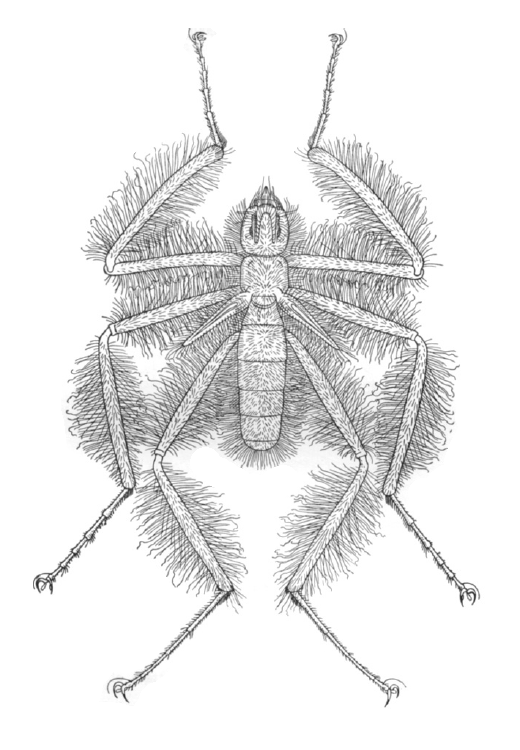
Frightful Hairy Flies
Mormotomyiidae
The family Mormotomyiidae (Diptera: Ephydroidea) contains only one known species, Mormotomyia hirsuta, commonly known as the frightful hairy fly or terrible hairy fly, which is found in Kenya. The fly was first described by English entomologist Ernest Edward Austen, and specimens have been collected from one location on a mountain in the Ukasi Hill (Okazzi Hills), in a cleft where a bat roost is located; this may possibly be the most restricted geographic distribution for any fly family. The larvae have been collected from bat guano. Adult flies are believed to feed on bodily secretions of bats. The fly measures about 1 cm long, with hairy legs, and, due to its nonfunctional wings and tiny eyes, looks more like a spider than a fly. Specimens have been collected only three times, in 1933, 1948, and 2010. Tested members of the population showed higher levels of genetic variation than would be expected for such a restricted range, suggesting that additional undiscovered populations exist with gene flow occurring between them and the known population in Ukasi Hill.
1 branches of this family, most-observed first
See this branch on the Wheel of Life →
Where it lives
Recorded sightings
—
geo-referenced records in GBIF, from museums, herbaria and field observers.
Drag the globe to turn it. Dots are where records exist, not a range map; darker means more records.
In the stacks
Searching the stacks…
Every page naming Mormotomyiidae in the Biodiversity Heritage Library →
This page is assembled live from iNaturalist, GBIF, Wikipedia, the Source Library and the Internet Archive. It is not yet part of the hand-edited codex. iNaturalist taxon 347850.