- Fungi Including Lichens
- ›Basidiomycete Fungi
- ›Higher Basidiomycetes
- ›Mushrooms, Bracket Fungi, Puffballs, and Allies
- ›Agaricomycetidae
- ›Common Gilled Mushrooms and Allies
- ›Hygrophorineae
- ›Waxcaps and Allies
- ›Hygrocyboideae
- ›Humidicuteae
- ›Gliophorus
- ›Gliophorus
- ›Gliophorus psittacinus
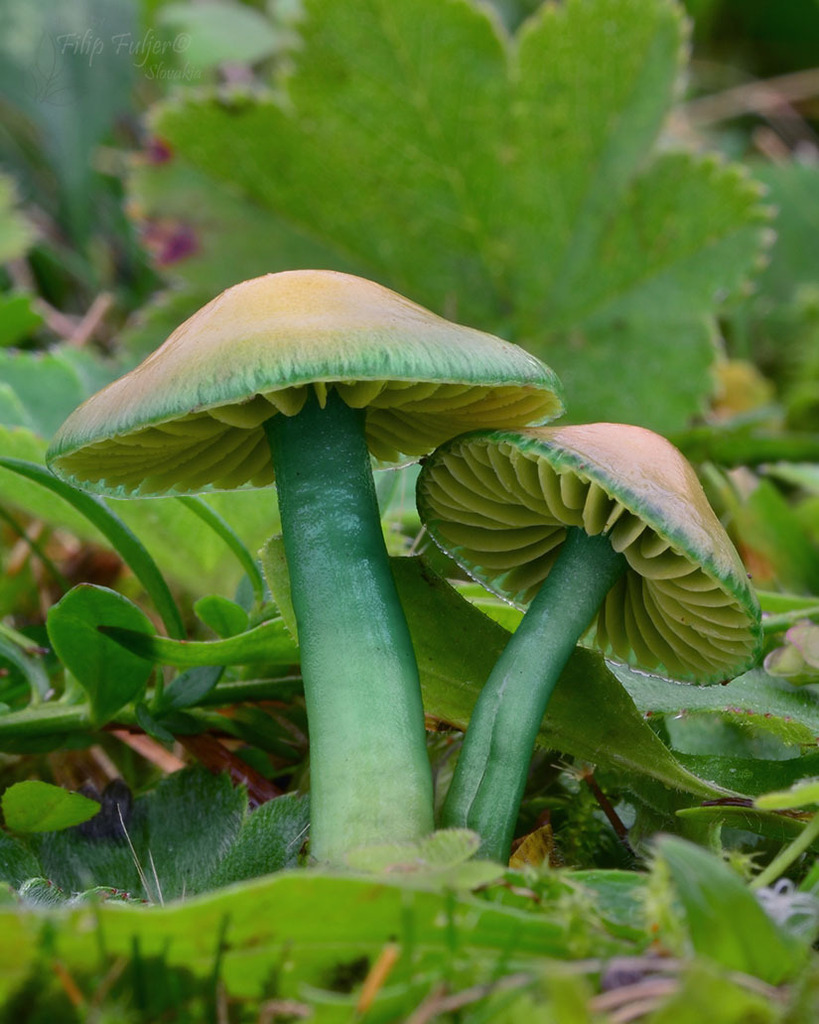
Parrot Mushroom
Gliophorus psittacinus
Gliophorus psittacinus, commonly known as the parrot toadstool or parrot waxcap, is a colourful mushroom that is a member of the genus Gliophorus. It was formerly known as Hygrocybe psittacina, but a molecular phylogenetics study found it to belong in the genus Gliophorus. It had already been placed in Gliophorus, but it had been considered a synonym of Hygrocybe. It has a cosmopolitan distribution.
From the article Gliophorus psittacinus on Wikipedia (CC BY-SA), quoted section by section
Description
The parrot toadstool is a small mushroom, with a convex to umbonate cap up to 4 centimetres (1.6 in) in diameter, which is green when young and later yellowish or even pinkish tinged. The stipe, measuring 2–8 cm (0.8–3.1 in) in length and 3–5 mm in width, is green to greenish yellow. The broad adnate gills are greenish with yellow edges and spore print white. The green colouring persists at the stem apex even in old specimens. The spores are white, elliptical, smooth and inamyloid. The spore print is white. Its odour and taste are mild. There are no known chemical tests. It fruits late summer to autumn (September to November).
Similar species. It can resemble other species of its genus and Bolbitius callistus.
Range & habitat
Gliophorus psittacinus is widely distributed in grasslands in western Europe, United Kingdom, Iceland, Greenland, North America, Americas, South Africa, Japan, being found in late summer and autumn. Early Australian records of this form have been found to be the similar green toadstools Gliophorus graminicolor or G. viridis on reexamination. Gliophorus psittacinus is known to occur at one site in the Lane Cove River valley near Sydney.
Wikipedia: “Distribution and habitat”
At the table
Gliophorus psittacinus is generally considered edible, but not worthwhile due to its small size and sliminess.
Wikipedia: “Edibility”
Where it lives
Recorded sightings
—
geo-referenced records in GBIF, from museums, herbaria and field observers.
Drag the globe to turn it. Dots are where records exist, not a range map; darker means more records.
In the stacks
Searching the stacks…
Every page naming Gliophorus psittacinus in the Biodiversity Heritage Library →
This page is assembled live from iNaturalist, GBIF, Wikipedia, the Source Library and the Internet Archive. It is not yet part of the hand-edited codex. iNaturalist taxon 348711.