- Fungi Including Lichens
- ›Basidiomycete Fungi
- ›Higher Basidiomycetes
- ›Mushrooms, Bracket Fungi, Puffballs, and Allies
- ›Agaricomycetidae
- ›Common Gilled Mushrooms and Allies
- ›Agaricineae
- ›Galeropsidaceae
- ›Panaeolus
- ›Panaeolina
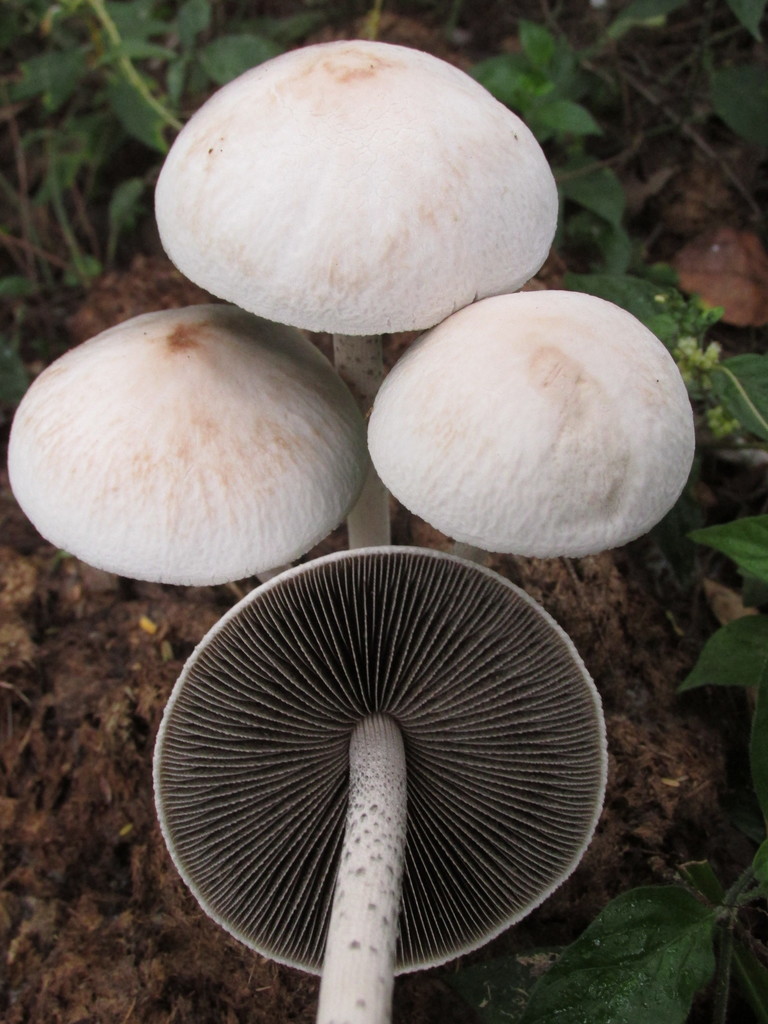
Panaeolus antillarum
Panaeolus antillarum is a species of mushroom in the family Bolbitiaceae.
From the article Panaeolus antillarum on Wikipedia (CC BY-SA), quoted section by section
Description
Cap: 3 to 6 cm, bell-shaped to convex, white to light gray or yellowish. The caps are thick, smooth, often with fine wrinkles and acquire a silver white shiny color in age. Gills: Gray in young specimens, turning black as the spores mature. Spore print: Black. Stipe: 4 to 22 cm long and .5 to 2 cm thick, solid, sometimes slightly larger at the base. Taste: Fungal. Odor: Fungal. Size: Small to medium. Microscopic features: Spores ellipsoid, 15 - 20 (21) x 10 - 14 x 8 - 10(11) μm. Cheilocystidia cylindrical to narrowly utriform, colorless, 30 - 45 μm. Sulphidia clavate, sometimes with a stalk, 25 - 50 μm. Basidia four spored, 30 - 35 micrometers long.
Similar species. It is often mistaken for Panaeolus semiovatus var. phalaenarum or Panaeolus cyanescens, the latter species can be distinguished by the thinner, grayer cap and blue bruising.
Range & habitat
It's common and widely distributed. It grows on dung. It is found from northern North America through Mexico into northern South America.
Wikipedia: “Distribution and habitat”
Where it lives
Recorded sightings
—
geo-referenced records in GBIF, from museums, herbaria and field observers.
Drag the globe to turn it. Dots are where records exist, not a range map; darker means more records.
In the stacks
Searching the stacks…
Every page naming Panaeolus antillarum in the Biodiversity Heritage Library →
This page is assembled live from iNaturalist, GBIF, Wikipedia, the Source Library and the Internet Archive. It is not yet part of the hand-edited codex. iNaturalist taxon 348989.