- Plants
- ›Vascular Plants
- ›flowering plants
- ›Dicots
- ›Mints, Plantains, Olives, and Allies
- ›figwort family
- ›Myoporeae
- ›Myoporum
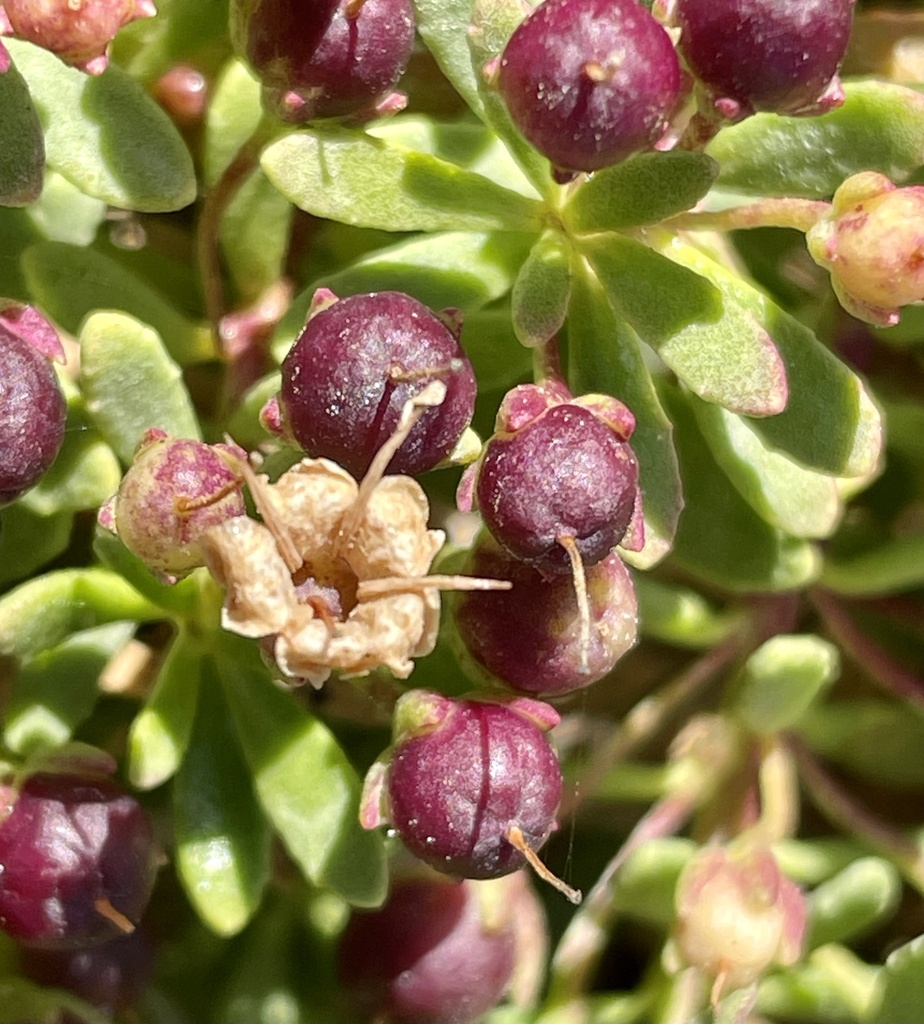
Creeping Myoporum
Myoporum parvifolium
Myoporum parvifolium, commonly known as creeping boobialla, creeping myoporum, dwarf native myrtle or small leaved myoporum is a plant in the figwort family, Scrophulariaceae. It is a low, spreading shrub with long, trailing stems and white, star-shaped flowers and is endemic to southern Australia including Flinders Island.
From the article Myoporum parvifolium on Wikipedia (CC BY-SA), quoted section by section
Description
Creeping boobialla is a prostrate, spreading shrub sometimes forming a mat 3 metres (10 ft) in diameter. Its leaves are fleshy and glabrous, usually 18–40 millimetres (0.7–2 in) long, 3–6.5 millimetres (0.1–0.3 in) wide and egg-shaped with the narrower end towards the base. They are arranged alternately, sometimes have a few serrations on the margins near the leaf tip and sometimes have raised, wart-like tubercles on their surface. White flowers with purple spots appear in the leaf axils singly or in clusters of two or three on a stalk 7.5–33 millimetres (0.3–1 in) long. The flowers have five lance-shaped sepals and five petals joined at their bases to form a tube. The tube is about 3 millimetres (0.1 in) long and the lobes are spreading, blunt and 3–4 millimetres (0.1–0.2 in) long. As a result, the diameter of the flower is about 7.5 millimetres (0.3 in). There are four stamens which extend beyond the petals. Peak flowering times are winter to summer in New South Wales and October to March in South Australia and the fruit that follows are succulent, rounded, yellowish-white and up to 8.5 millimetres (0.3 in) in diameter.
Range & habitat
Myoporum parvifolium occurs in the south-west corner of New South Wales, and from the Eyre Peninsula in South Australia eastwards to Victoria. It is common along much of the Murray River in South Australia. It often grows on limestone cliffs, along river flats and in woodland in sandy sometimes saline soils.
Wikipedia: “Distribution and habitat”
How it is grown
Creeping boobialla is a useful ground cover and is often cultivated for that purpose. It prefers a well-drained, sunny position but is hardy in most situations. It is usually propagated from cuttings and has been used as a rootstock for more difficult related species such as Eremophila.
== References ==
Wikipedia: “Use in horticulture”
Where it lives
Recorded sightings
—
geo-referenced records in GBIF, from museums, herbaria and field observers.
Drag the globe to turn it. Dots are where records exist, not a range map; darker means more records.
In the stacks
Searching the stacks…
Every page naming Myoporum parvifolium in the Biodiversity Heritage Library →
This page is assembled live from iNaturalist, GBIF, Wikipedia, the Source Library and the Internet Archive. It is not yet part of the hand-edited codex. iNaturalist taxon 349227.