- Animals
- ›Arthropods
- ›Hexapods
- ›Insects
- ›Winged and Once-winged Insects
- ›Mantises
- ›Extant Mantises
- ›Schizomantodea
- ›Hymenopoidea
- ›Flower Mantises
- ›Flower Mantises
- ›Hymenopodini
- ›Pseudocreobotrina
- ›Pseudocreobotra
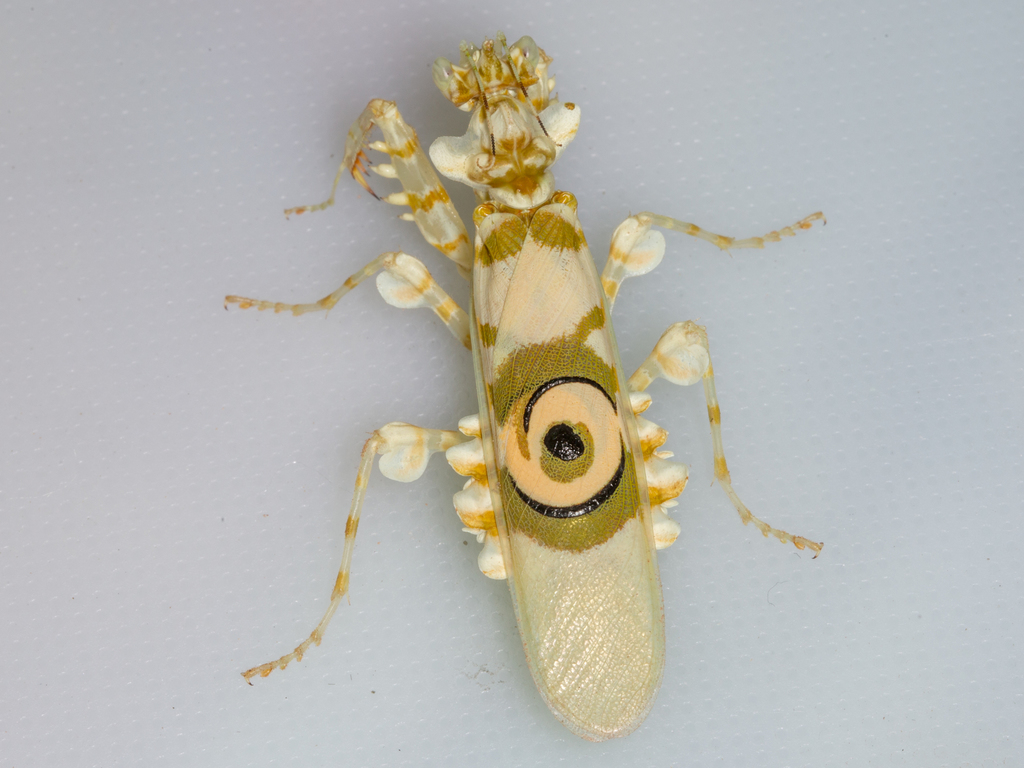
Common Spiny Flower Mantis
Pseudocreobotra wahlbergi
Pseudocreobotra wahlbergi, or the spiny flower mantis, is a small flower mantis (40 millimetres or 1+1⁄2 inches) native to southern and eastern Africa.
From the article Pseudocreobotra wahlbergi on Wikipedia (CC BY-SA), quoted section by section
Description
The adult has spiny structures on the underside of its abdomen, giving it its name. It is variable in colour, being typically light green, but it can equally be tinted yellow, pink, or red. It has a large eyespot on its forewings, which is black, green and cream and is surrounded by a green patch. The inner hind wings are orange and the outer hind wings are transparent. Nymphs are black until the third instar.
Sexual dimorphism. P. wahlbergi exhibits sexual dimorphism. Females have small spines towards the base of their wings and six to seven segments on their abdomen. Females also tend to have slightly shorter antennae, longer wings, and take seven moults to reach maturity. On the other hand, males lack the spines found near females' wings, have eight abdominal segments, shorter wings, longer antennae and require six moults to reach maturity.
Wikipedia: “Morphology”
What it does
P. wahlbergi has a deimatic display in which it spreads its forewings, making itself appear larger and prominently displaying its eyespots to startle would-be predators. While at rest it is well camouflaged, and is a sufficiently good aggressive mimic of a flower that prey insects can attempt to pollinate it, at which moment the mantis seizes and eats them. They prefer to prey on flying insects and spiders, but if unavailable, will eat virtually any insect. Like with many mantis species, P. wahlbergi females practice sexual cannibalism; however, nymphs are not cannibalistic until their fourth instar.
Wikipedia: “Behaviour and ecology”
Listen
Looking for field recordings…
Where it lives
Recorded sightings
—
geo-referenced records in GBIF, from museums, herbaria and field observers.
Drag the globe to turn it. Dots are where records exist, not a range map; darker means more records.
In the stacks
Searching the stacks…
Every page naming Pseudocreobotra wahlbergi in the Biodiversity Heritage Library →
This page is assembled live from iNaturalist, GBIF, Wikipedia, the Source Library and the Internet Archive. It is not yet part of the hand-edited codex. iNaturalist taxon 349764.