- Fungi Including Lichens
- ›Basidiomycete Fungi
- ›Higher Basidiomycetes
- ›Mushrooms, Bracket Fungi, Puffballs, and Allies
- ›Agaricomycetidae
- ›Common Gilled Mushrooms and Allies
- ›Pluteineae
- ›amanita mushrooms and allies
- ›Amaniteae
- ›Amanita
- ›Amanitina
- ›Phalloideae
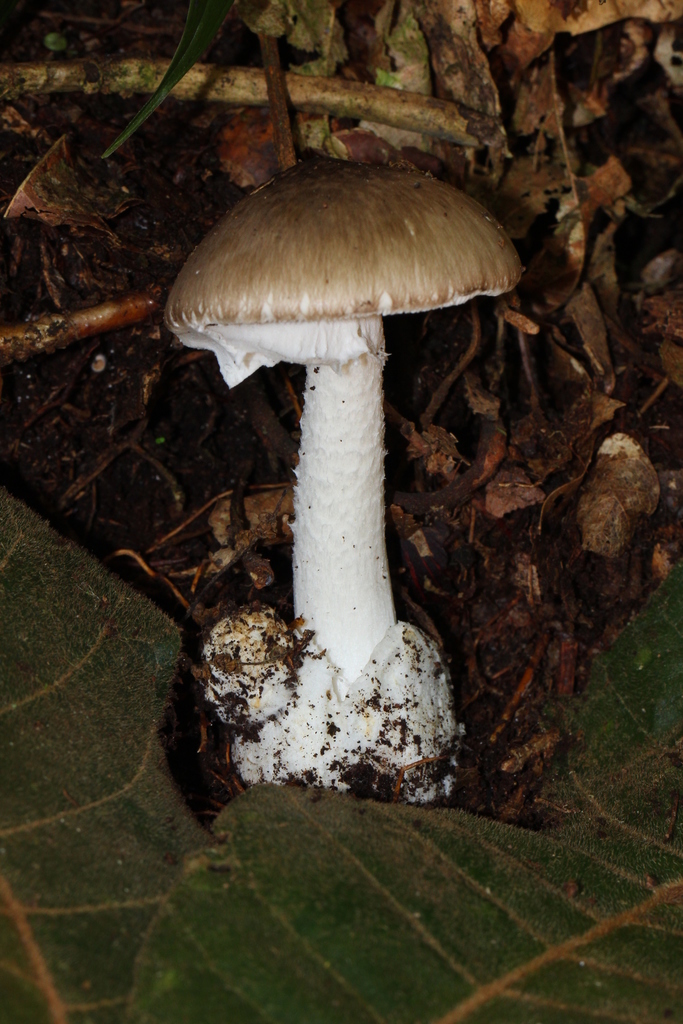
Latin American Death Cap
Amanita arocheae
Amanita arocheae, also known as the Latin American death cap, is a mushroom of the large genus Amanita, which occurs in Colombia, Central America and South America. Deadly poisonous, it is a member of Amanita sect. Phalloideae and related to the death cap, A. phalloides.
From the article Amanita arocheae on Wikipedia (CC BY-SA), quoted section by section
Description
The cap is convex to plano-convex, reaching dimensions of 3–11 centimetres (1+1⁄4–4+1⁄4 inches). The cap surface is sticky or tacky. The center of the cap is gray to brown with a gray edge. The white gills are closely crowded together and free from attachment to the stipe. In young mushrooms, the gills exude drops of clear fluid. The dry, white to pale grey stipe measures 8–20 cm (3–8 in) long by 0.5–1.7 cm (1⁄4–3⁄4 in) thick. It has a bulbous base, a white to grey, membranous volva at the stipe base, and white mycelium at the base. The stipe has a white ring. The odor of the flesh is mild to unpleasant. The spore print is white. Spores are smooth, amyloid, spherical or roughly so, and measure 7–10 by 6.8–9.5 μm. Clamp connections are absent from the hyphae.
Similar species. Amanita vaginata is similar, however A. vaginata has non-amyloid spores and lacks a ring on the stipe. It differs from A. phalloides (the death cap) in the colour of its cap.
Range & habitat
A. arocheae is found in Mexico, Costa Rica, and Colombia. It is a mycorrhizal species that associates with oak as a host.
Wikipedia: “Distribution and habitat”
Where it lives
Recorded sightings
—
geo-referenced records in GBIF, from museums, herbaria and field observers.
Drag the globe to turn it. Dots are where records exist, not a range map; darker means more records.
In the stacks
Searching the stacks…
Every page naming Amanita arocheae in the Biodiversity Heritage Library →
This page is assembled live from iNaturalist, GBIF, Wikipedia, the Source Library and the Internet Archive. It is not yet part of the hand-edited codex. iNaturalist taxon 350030.