- Fungi Including Lichens
- ›Ascomycete Fungi
- ›Sac Fungi and Lichens
- ›Eurotiomycetes
- ›Eurotiomycetidae
- ›green and blue molds
- ›Aspergillaceae
- ›Aspergillus
- ›Nidulantes
- ›Nidulantes
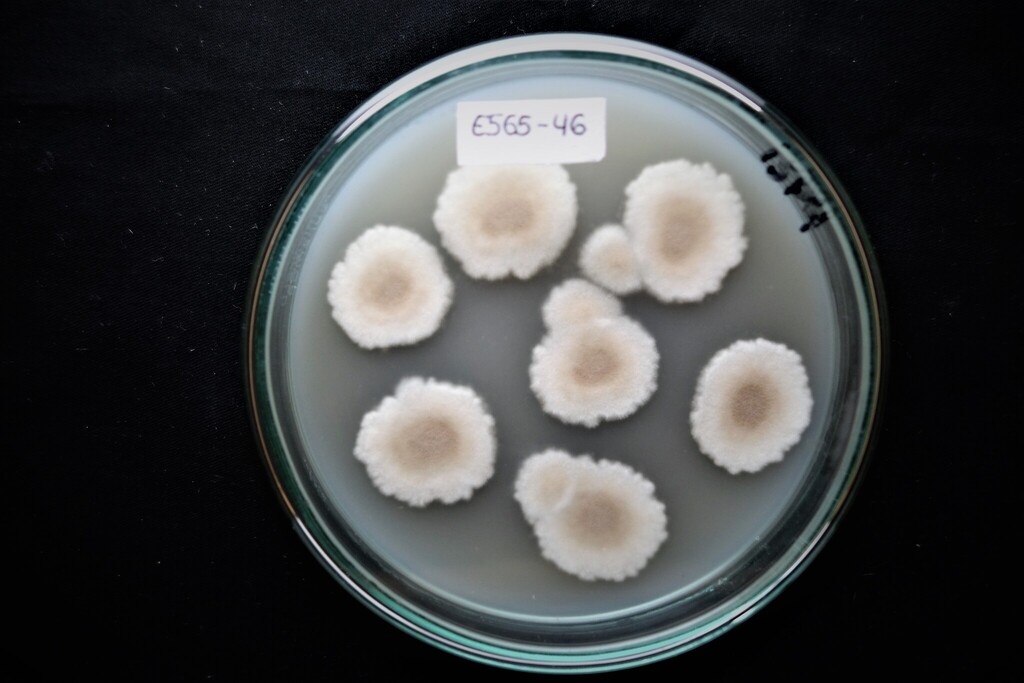
Aspergillus sydowii
Aspergillus sydowii is a pathogenic fungus that causes several diseases in humans. It has been implicated in the death of sea fan corals (Gorgonia spp.) in the Caribbean Sea.
From the article Aspergillus sydowii on Wikipedia (CC BY-SA), quoted section by section
Description
When grown in pure culture on agar plates, A. sydowii produces blue-green colonies with reddish-brown shades. The conidial heads are effuse (spread out), while the stalks of the conidiophores are hyaline (translucent), smooth, and measure up to 500 μm. Swollen cells (vesicles) are spherical or nearly so, and the conidiogenous cells (cells that produce conidia) are biseriate—having phialides that arise from metulae (sterile cells below the phialides). The conidia are echinulate (spiky), roughly spherical, and measure 2.5–4.0 μm in diameter.
Range & habitat
Aspergillus sydowii is a saprophytic fungus found in soil that can contaminate food and is occasionally pathogenic to humans. It is the predominant fungus found on wheat Qu, the most widely used source of raw microorganisms and crude enzymes for Chinese rice wine brewing. Since the 1990s it has been found to be present in sea water in the Caribbean region and has been shown to be the cause of aspergillosis in sea fans. It is not known to reproduce in the marine environment and several hypotheses exist as to its source. The infective agent may have always existed in the ocean but not previously caused the disease or it may have accumulated after run-off of soil from land. The hypothesis that it entered the ocean via dust blown across the Atlantic from Africa seems unlikely to be correct as none of the samples of dust collected from African locations contained A. sydowii though they did contain other species of Aspergillus. A more likely vector seems to be the flamingo tongue snail (Cyphoma gibbosum), a specialist predator on sea fans, and the fungus has been found in its faeces.
Wikipedia: “Habitat and distribution”
Where it lives
Recorded sightings
—
geo-referenced records in GBIF, from museums, herbaria and field observers.
Drag the globe to turn it. Dots are where records exist, not a range map; darker means more records.
In the stacks
Searching the stacks…
Every page naming Aspergillus sydowii in the Biodiversity Heritage Library →
This page is assembled live from iNaturalist, GBIF, Wikipedia, the Source Library and the Internet Archive. It is not yet part of the hand-edited codex. iNaturalist taxon 350141.