- Fungi Including Lichens
- ›Basidiomycete Fungi
- ›Higher Basidiomycetes
- ›Mushrooms, Bracket Fungi, Puffballs, and Allies
- ›Agaricomycetidae
- ›boletes and allies
- ›boletes
- ›Xerocomoideae
- ›Boletellus
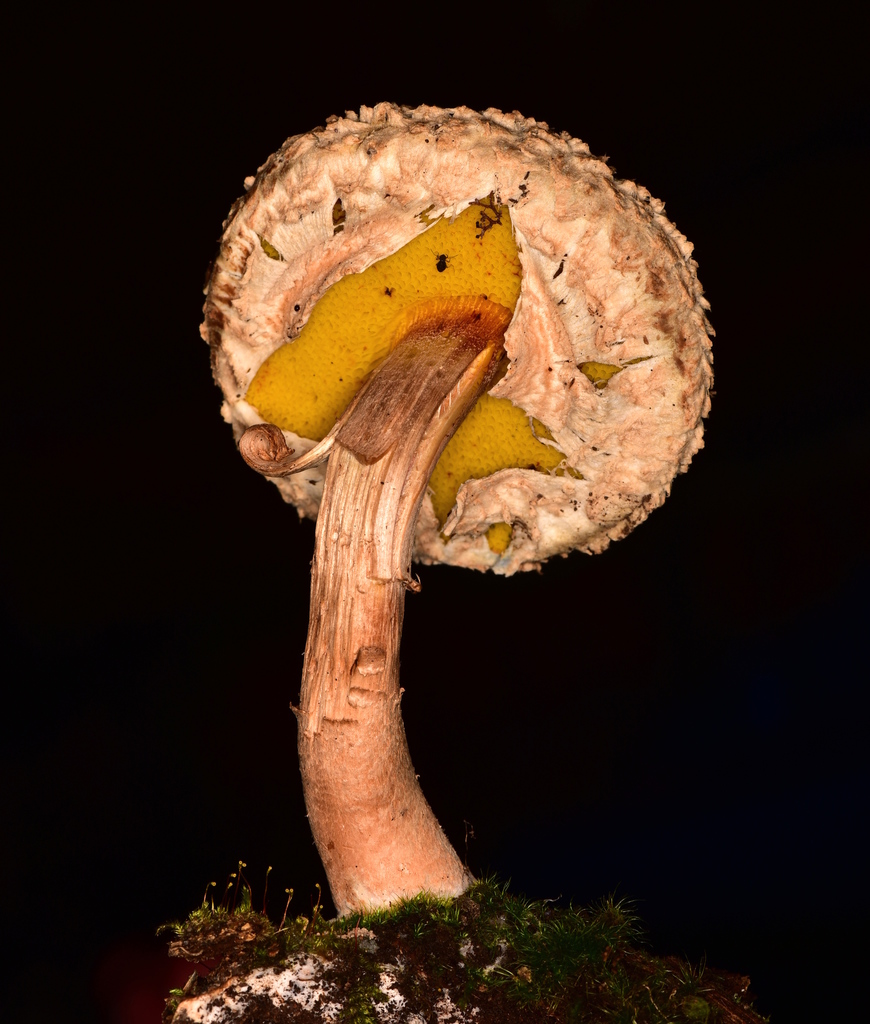
Boletellus coccineus
Boletellus ananas, commonly known as the pineapple bolete, is a mushroom in the family Boletaceae, and the type species of the genus Boletellus. It is distributed in southeastern North America, northeastern South America, Asia, and New Zealand, where it grows scattered or in groups on the ground, often at the base of oak and pine trees. The fruit body is characterized by the reddish-pink (or pinkish-tan to yellowish if an older specimen) scales on the cap...
From the article Boletellus on Wikipedia (CC BY-SA), quoted section by section
Description
According to Murrill's definition of the genus, species of Boletellus have an annual fruit body that grows on wood and a stem that is centrally placed. The cap surface is floccose-verrucose (covered with tufts of hairs or warts) and yellowish. The fruit body flesh is light colored and fleshy. The tubes on the underside of the cap are angular, depressed, yellowish, and covered with a partial veil. The spores of Boletellus are oblong to ellipsoid, smooth, and rust-colored. The stem is solid (i.e., not hollow), white, and not reticulate. Additional characteristics of the genus have been delineated or amended since its original description over 100 years ago: spores have longitudinal ridges or "wings", are inamyloid, and rarely dextrinoid (staining deep reddish to reddish brown in Melzer's reagent). Species usually have hymenial cystidia present, and clamp connections are typically absent (with the exception of B. fibuliger). Murrill placed Boletellus ananas (formerly Boletus ananas) as the sole and type species. Singer's fourth edition (1986) of his Agaricales in Modern Taxonomy included 33 species, which were classified into sections depending on moisture content, scaliness of the cap or amount of ornamentation on the stem. Although some species of Boletellus are rated as edible, none are considered choice.
Where it lives
Recorded sightings
—
geo-referenced records in GBIF, from museums, herbaria and field observers.
Drag the globe to turn it. Dots are where records exist, not a range map; darker means more records.
In the stacks
Searching the stacks…
Every page naming Boletellus coccineus in the Biodiversity Heritage Library →
This page is assembled live from iNaturalist, GBIF, Wikipedia, the Source Library and the Internet Archive. It is not yet part of the hand-edited codex. iNaturalist taxon 350194.