- Fungi Including Lichens
- ›Basidiomycete Fungi
- ›Higher Basidiomycetes
- ›Mushrooms, Bracket Fungi, Puffballs, and Allies
- ›Thelephorales
- ›Boletopsidaceae
- ›Boletopsis
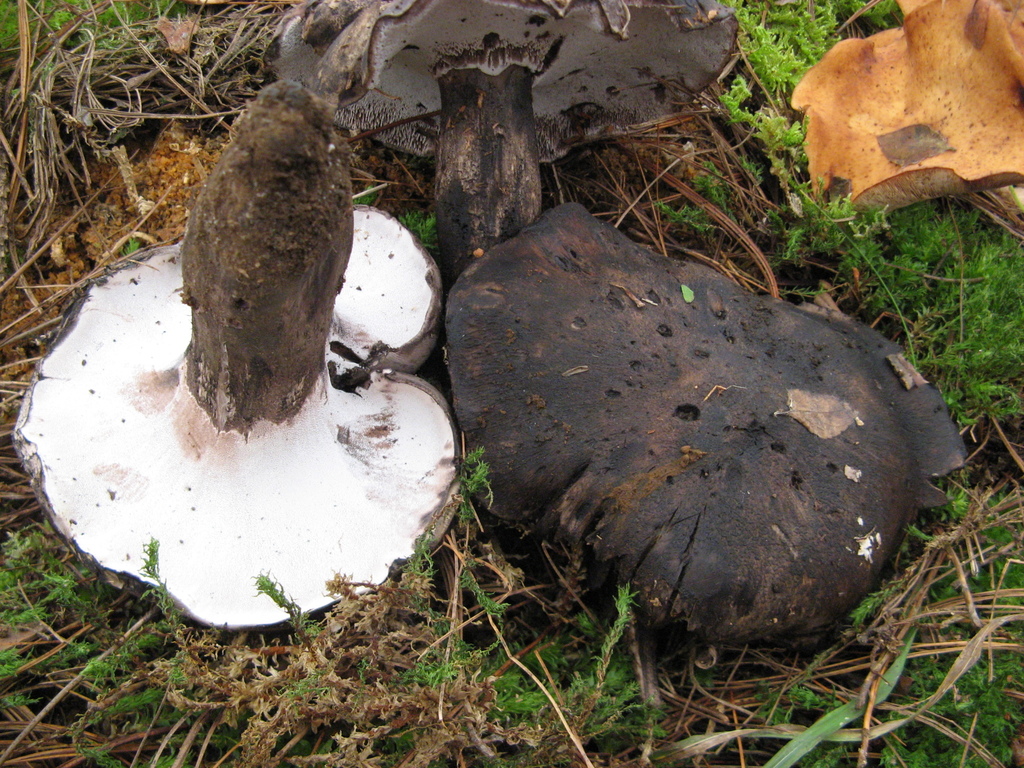
Boletopsis leucomelaena
Boletopsis leucomelaena is a species of hydnoid fungus in the family Bankeraceae. It was originally described in 1801 as Boletus leucomelas by Christian Hendrik Persoon. Swiss mycologist Victor Fayod transferred it to Boletopsis in 1889. The fungus is listed as a priority species in the United Kingdom Biodiversity Action Plan. B. leucomelaena is found in the Pacific Northwest region of North America, in Japan, and throughout Europe, although it is less common than the lookalike B. grisea.
From the article Boletopsis leucomelaena on Wikipedia (CC BY-SA), quoted section by section
Description
Boletopsis leucomelaena produces terrestrial fruit bodies that typically grow in dense clusters of three to ten. The cap is roundish, measuring 4–10 cm in diameter, with a flat-convex shape and a slightly raised centre. Both cap and stipe are fragile when fresh, easily cracking without fibrous orientation. The stipe is cylindrical or tapers toward the base, measuring 3–10 cm in length and 1–2.5 cm in diameter. The fungi dry rapidly, with all parts becoming soft and brittle. When potassium hydroxide (KOH) solution is applied, it creates a permanent sepia-black stain on all parts of the fungus. The upper surface of the cap is smooth, matt, and water-absorbing, lacking zones and displaying a greyish sepia or black-brown colour, often with a tinge of magenta. Young fruit bodies are paler toward the margin, while older specimens develop a rougher surface, sometimes with minute scales at the centre. Areas damaged by snails display a distinctive pink-grey colouration. Upon drying, the cap becomes dark brownish grey to greenish black and wrinkled. The pore surface starts cream-coloured but develops a pale lilac-grey or smoky grey-brown tint, turning pinkish where bruised and grey-brown or olivaceous grey when dried. When cut, the cap context (internal tissue) is homogeneous, soft and fleshy, measuring 1–2 cm thick at the stipe attachment. …
Range & habitat
Boletopsis leucomelaena favours relatively rich habitats, being found characteristically in spruce-dominated forests. In Finland, it occurs primarily in two forest types: spruce-dominated grass-herb forests (with intermixed birch, aspen, hazel and other deciduous trees and shrubs) and moist heath forests dominated by Norway spruce. The former habitat type features a ground layer with demanding grasses and herbs, with hygromorphic mosses that do not form a continuous mat, instead being interspersed with areas of decaying leaf litter and bare mull soil. The latter habitat contains more dwarf shrubs (especially bilberry), with a thicker moss layer. Both environments are shady with moist microclimates, and the lower vegetation under which the fruit bodies hide helps stabilise moisture even during dry periods. The species appears to tolerate soils on calcareous bedrock, though whether it is truly calciphilous is uncertain. In Fennoscandia, B. leucomelaena is rare, with its distribution largely restricted to the hemiboreal zone and southern parts of the southern boreal zone. The species shows a distinctly southerly distribution pattern in Nordic countries, with northern occurrences typically limited to isolated patches in botanically rich limestone areas. …
Wikipedia: “Habitat, distribution, and ecology”
Where it lives
Recorded sightings
—
geo-referenced records in GBIF, from museums, herbaria and field observers.
Drag the globe to turn it. Dots are where records exist, not a range map; darker means more records.
In the stacks
Searching the stacks…
Every page naming Boletopsis leucomelaena in the Biodiversity Heritage Library →
This page is assembled live from iNaturalist, GBIF, Wikipedia, the Source Library and the Internet Archive. It is not yet part of the hand-edited codex. iNaturalist taxon 350201.