- Fungi Including Lichens
- ›Basidiomycete Fungi
- ›Higher Basidiomycetes
- ›Mushrooms, Bracket Fungi, Puffballs, and Allies
- ›Agaricomycetidae
- ›boletes and allies
- ›boletes
- ›Boletoideae
- ›Boletus
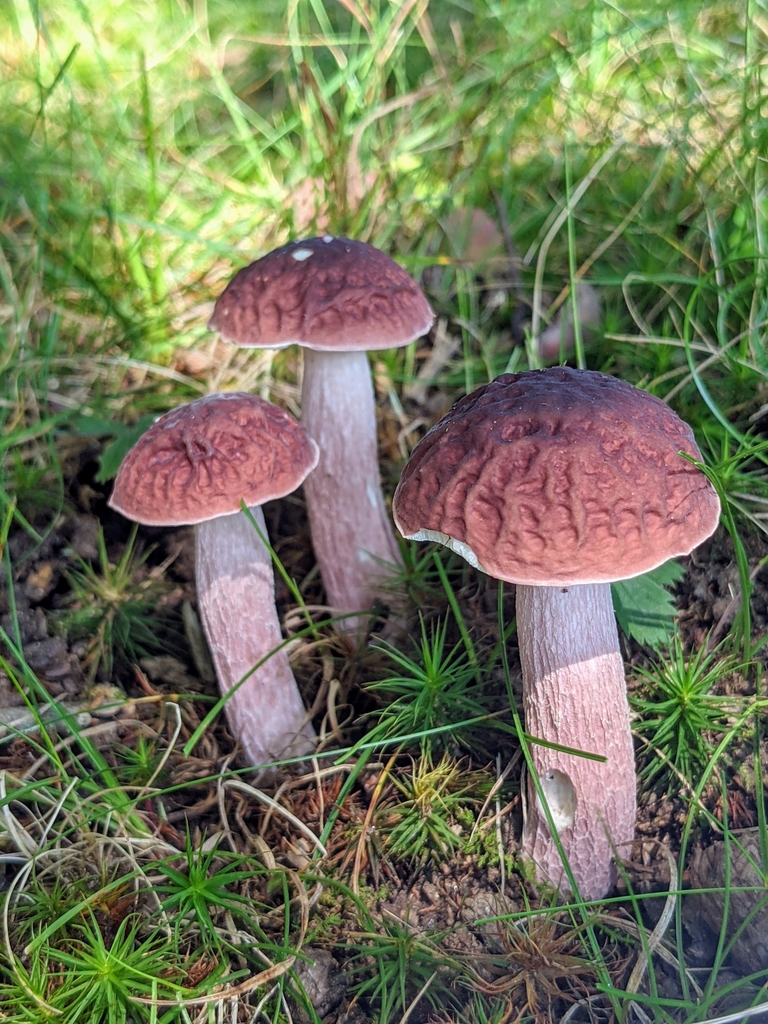
lilac bolete
Boletus separans
Boletus separans is a species of bolete fungus in the family Boletaceae. It was described as new to science in 1873 by American mycologist Charles Horton Peck. In 1998, Roy Halling and Ernst Both transferred the bolete to the genus Xanthoconium. Molecular phylogenetic analysis published in 2013 shows that it is more closely related to Boletus sensu stricto than to Xanthoconium.
From the article Boletus separans on Wikipedia (CC BY-SA), quoted section by section
Description
The brownish cap is 4–12 centimetres (1+1⁄2–4+3⁄4 in) wide with dented pits. There are 1–3 pores per millimetre, white when young, aging to yellow. The stem is 4–12 cm tall and 1.5–3 cm (1⁄2–1+1⁄4 in) thick. The flesh is white, with a mild scent and taste; the smell is unpleasant when dried. The spore print is brownish. It resembles Xanthoconium purpureum and Tylopilus rubrobrunneus.
Where it lives
Recorded sightings
—
geo-referenced records in GBIF, from museums, herbaria and field observers.
Drag the globe to turn it. Dots are where records exist, not a range map; darker means more records.
In the stacks
Searching the stacks…
Every page naming Boletus separans in the Biodiversity Heritage Library →
This page is assembled live from iNaturalist, GBIF, Wikipedia, the Source Library and the Internet Archive. It is not yet part of the hand-edited codex. iNaturalist taxon 350217.