- Animals
- ›Chordates
- ›Vertebrates
- ›Reptiles
- ›Snakes and Lizards
- ›Snakes
- ›Elapid Snakes
- ›Australian Elapids (inc. Sea Snakes)
- ›Acanthophis
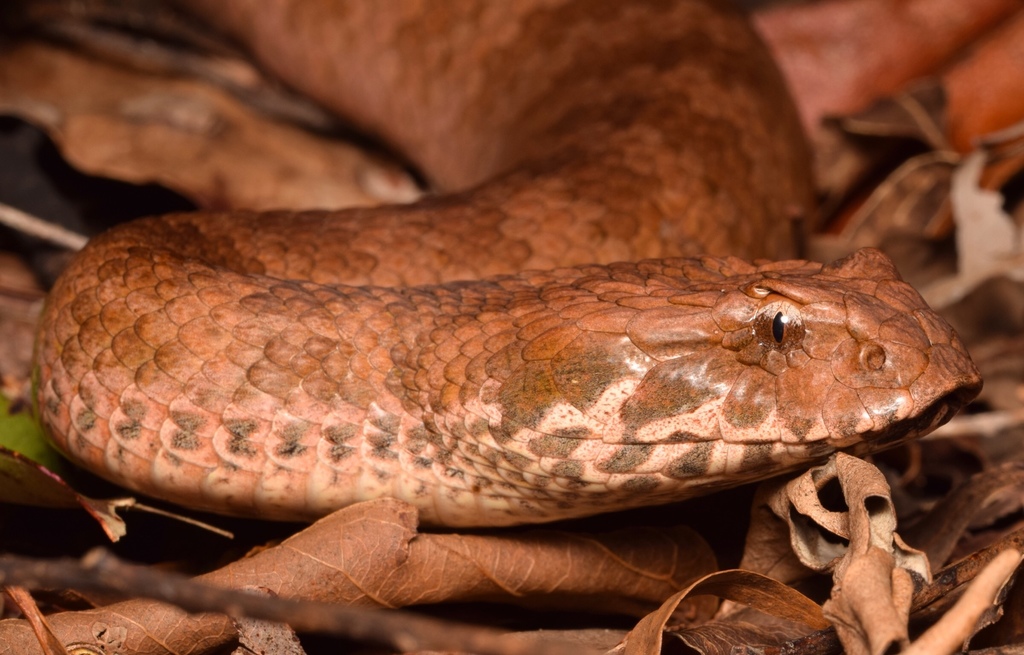
Southern Death Adder
Acanthophis antarcticus
The common death adder (Acanthophis antarcticus) is a species of death adder, a venomous snake in the family Elapidae. The species is endemic to Australia. It is one of the most venomous land snakes in Australia and globally. While it remains widespread (unlike related species), it is facing increased threat from the ongoing Australian cane toad invasion.
From the article Common death adder on Wikipedia (CC BY-SA), quoted section by section
Description
The common death adder has a broad, flattened, triangular head and a thick body. Dorsally, its color pattern consists of crossbands of red, brown, and black on a lighter background. Ventrally, it is grey, cream, or pink. It is known to reach a snout-to-vent length (SVL) of 70–100 cm (2.3–3.3 ft). The dorsal scales are arranged in 21–23 rows at midbody. The ventrals number 113–130. The anal plate is entire. The subcaudals number 41–51, and are undivided (single) anteriorly but divided (paired) posteriorly.
Range & habitat
The common death adder occurs abundantly over much of eastern and coastal southern Australia: Queensland, New South Wales, and South Australia. It is more scarce in the Northern Territory, Western Australia and the western parts of South Australia, and is no longer found in Victoria.
Wikipedia: “Geographic distribution”
What it does
The common death adder preys upon small mammals and birds as a primary diet. Unlike other elapids, the common death adder lies in wait for its prey (often for many days) until a meal passes. It covers itself with leaves, making itself inconspicuous, and lies coiled in ambush, twitching its grub-like tail close to its head as a lure. When an animal approaches to investigate the movement, the death adder quickly strikes, injecting its venom and then waiting for the victim to die before eating it. The common death adder is not aggressive toward humans, yet its ambush hunting technique and reliance on camouflage rather than flight to avoid threats renders it more dangerous than other elapids to humans who venture into bushland habitats.
Wikipedia: “Diet”
Where it lives
Recorded sightings
—
geo-referenced records in GBIF, from museums, herbaria and field observers.
Drag the globe to turn it. Dots are where records exist, not a range map; darker means more records.
In the stacks
Searching the stacks…
Every page naming Acanthophis antarcticus in the Biodiversity Heritage Library →
This page is assembled live from iNaturalist, GBIF, Wikipedia, the Source Library and the Internet Archive. It is not yet part of the hand-edited codex. iNaturalist taxon 35060.