- Fungi Including Lichens
- ›Basidiomycete Fungi
- ›Higher Basidiomycetes
- ›Mushrooms, Bracket Fungi, Puffballs, and Allies
- ›Auriculariales
- ›Auriculariaceae
- ›Exidia
- ›Exidia nigricans
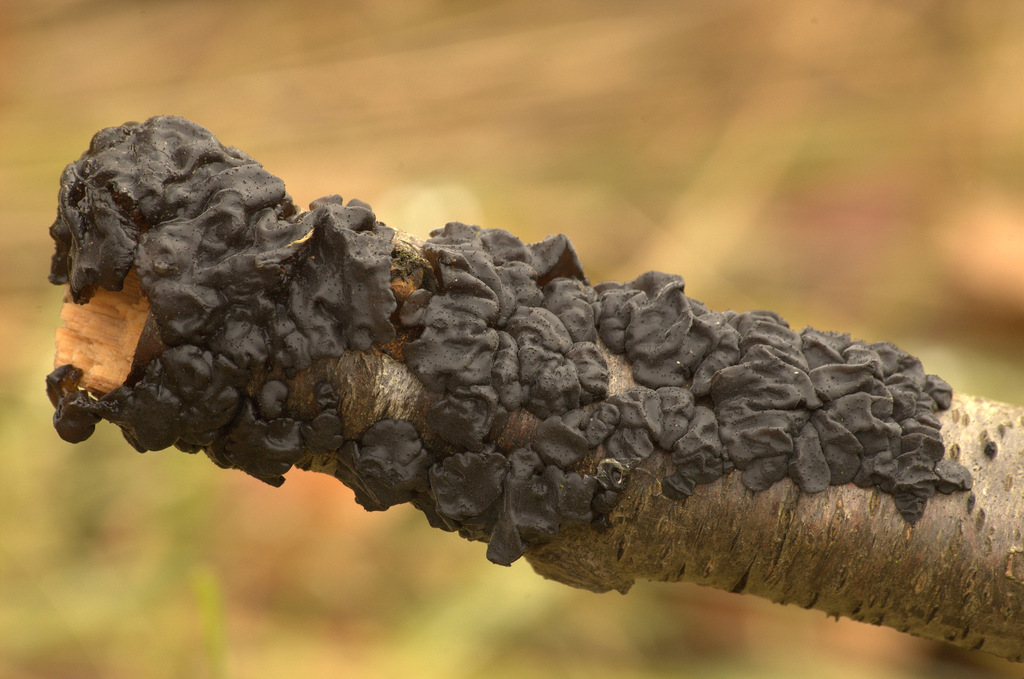
Warlock's Butter
Exidia nigricans
Exidia pithya is a species of fungus in the family Auriculariaceae. In the UK, it has the recommended English name of warlock's butter. It produces black, gelatinous basidiocarps (fruit bodies) and is a common, wood-rotting species in Europe, typically growing on dead attached branches of broadleaf trees, more rarely conifers. It was formerly known as Exidia nigricans and has been much confused with Exidia friesiana.
From the article Exidia pithya on Wikipedia (CC BY-SA), quoted section by section
Description
Exidia pithya forms dark sepia to blackish, rubbery-gelatinous fruit bodies that are button-shaped at first and up to 5 centimetres (2 inches) across. The fruitbodies occur in groups and coalesce to form effused, irregular masses up to 30 cm (12 in) across. The upper, spore-bearing surface becomes irregularly folded, shiny, and dotted with small pimples or pegs. The individual fruitbodies are each attached to the wood at the base.
Microscopic characters. The microscopic characters are typical of the genus Exidia. The basidia are ellipsoid, septate, 11–20 × 8–12 μm. The spores are cylindrical, allantoid (sausage-shaped), 8–16.5 × 3–5.5 μm.
Similar species. On conifers, Exidia friesiana is very similar, but has a smooth surface without small pimples or pegs. On broadleaf trees, Exidia spiculata is similar, but also has a smooth surface. Exidia glandulosa and Exidia truncata are frequently confused with E. pithya but produce discrete, top-shaped fruitbodies that rarely if ever coalesce.
Range & habitat
Exidia pithya is a wood-rotting species, typically found on dead attached branches of a wide range of broadleaf trees and, less frequently, conifers. It persists for some while on fallen branches and logs. It is widely distributed in Europe, but its presence in North America is uncertain.
== References ==
Wikipedia: “Habitat and distribution”
Where it lives
Recorded sightings
—
geo-referenced records in GBIF, from museums, herbaria and field observers.
Drag the globe to turn it. Dots are where records exist, not a range map; darker means more records.
In the stacks
Searching the stacks…
Every page naming Exidia nigricans in the Biodiversity Heritage Library →
This page is assembled live from iNaturalist, GBIF, Wikipedia, the Source Library and the Internet Archive. It is not yet part of the hand-edited codex. iNaturalist taxon 350760.