- Fungi Including Lichens
- ›Basidiomycete Fungi
- ›Higher Basidiomycetes
- ›Mushrooms, Bracket Fungi, Puffballs, and Allies
- ›Thelephorales
- ›Boletopsidaceae
- ›Hydnellum
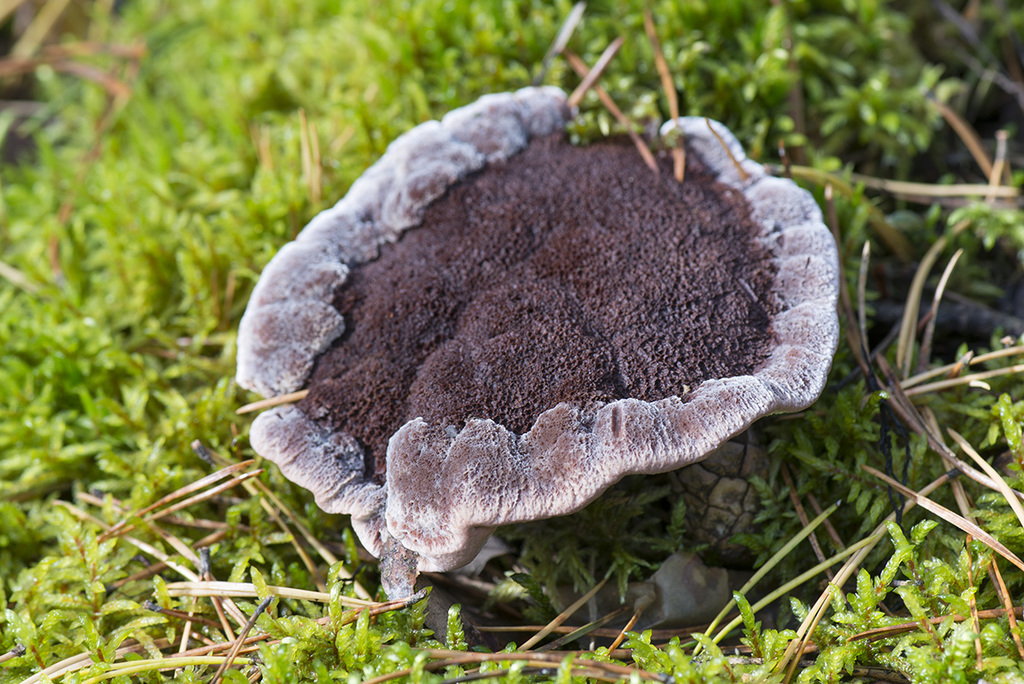
Mealy Tooth
Hydnellum ferrugineum
Hydnellum ferrugineum, commonly known as the mealy tooth or the reddish-brown corky spine fungus, is a species of tooth fungus in the family Bankeraceae. A widely distributed species, it is found in north Africa, Asia, Europe, and North America. The fungus fruits on the ground singly or in clusters in conifer forest, usually in poor (low nutrient) or sandy soil. Fruit bodies are somewhat top-shaped, measuring 3–10 cm (1–4 in) in diameter. Their velvety surfaces, initially white to pink, sometimes exude drops of red liquid. The lower surface of the fruit body features white to reddish-brown spines up to 6 mm long. Mature fruit bodies become dark reddish brown in color, and are then difficult to distinguish from other similar Hydnellum species. H. ferrugineum forms a mat of mycelia in the humus and upper soil where it grows. The presence of the fungus changes the characteristics of the soil, making it more podzolized.
From the article Hydnellum ferrugineum on Wikipedia (CC BY-SA), quoted section by section
Description
The fruit bodies of Hydnellum ferrugineum are more or less top-shaped with caps that are 3–10 cm (1.2–3.9 in) in diameter. They are at first convex, then pulvinate (cushion-shaped), later flattening or becoming slightly depressed in the center. The cap surface of young fruit bodies is uneven, with a velvety to felted texture, and a whitish to pink color. It sometimes exudes blood-red drops of fluid in the depressions. The surface later becomes flesh-colored to dark reddish brown, but with wavy margin remaining whitish. The lower surface of the fruit body bears the hymenium, the fertile spore-bearing tissue. It comprises a dense arrangement of white to reddish brown spines up to 6 mm long, hanging vertically downwards. The stout stipe measures 1–6 cm (0.4–2.4 in) long by 1–3 cm (0.4–1.2 in) thick, and is the same color as the cap. Fruit bodies have a "distinctly mealy" odor (similar to the smell of freshly ground flour), but are inedible.
The flesh is reddish or purplish-brown with white flecks. Initially spongy and soft, it becomes tough and corky as the fruit body matures. In the stipe, the flesh can become blackish in age. Like other Hydnellum species, fruit body tissue is made of generative hyphae that do not expand. This slows the growth of the fruit body, often enabling it to persist for several months. …
Range & habitat
Hydnellum ferrugineum is found mainly in coniferous woodland, often near pines, but occasionally with spruce. Fruit bodies have a preference for sandy soil with low levels of organic matter and nutrients, and grow singly or in clusters. They are more likely to be found in older-growth forests. The fungus occurs in North America, including Mexico. It is widespread but generally uncommon throughout Europe, although there may be local areas where it is common. In Britain, H. ferrugineum is provisionally classified as endangered, and is protected under the Wildlife and Countryside Act 1981; it was included as one of 14 species considered in the United Kingdom Biodiversity Action Plan for stipitate hydnoid fungi (i.e., hydnoid fungi with a cap and stipe) in 2004. The fungus is protected in Montenegro. It has been collected in India and North Africa. The fungus forms a tough mat of mycelia in the humus and upper soil of pine forests. This mycelial mat grows larger with old trees, and can cover an area of several square meters. These areas generally lack dwarf shrubs and promote the vigorous growth of mosses; reindeer lichens often occur in the center of large mats. …
Wikipedia: “Habitat and distribution”
Where it lives
Recorded sightings
—
geo-referenced records in GBIF, from museums, herbaria and field observers.
Drag the globe to turn it. Dots are where records exist, not a range map; darker means more records.
In the stacks
Searching the stacks…
Every page naming Hydnellum ferrugineum in the Biodiversity Heritage Library →
This page is assembled live from iNaturalist, GBIF, Wikipedia, the Source Library and the Internet Archive. It is not yet part of the hand-edited codex. iNaturalist taxon 351029.