- Fungi Including Lichens
- ›Basidiomycete Fungi
- ›Higher Basidiomycetes
- ›Mushrooms, Bracket Fungi, Puffballs, and Allies
- ›Russulales
- ›Milkcaps, Brittlegills and Allies
- ›Lactarius
- ›Lactarius
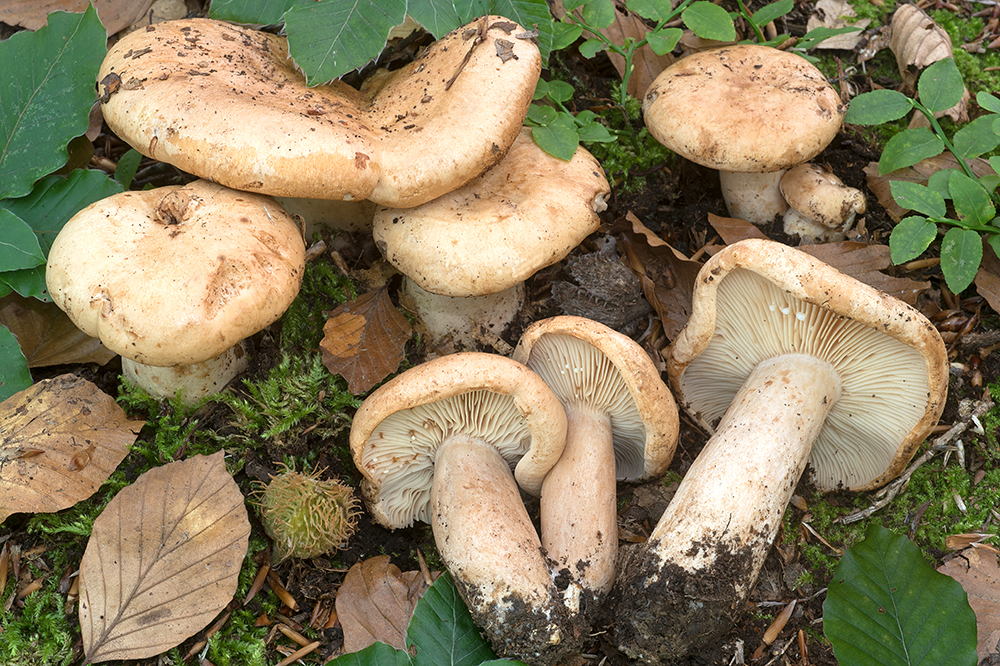
Pale Milkcap
Lactarius pallidus
Lactarius pallidus, the pale milkcap, is an edible mushroom of the genus Lactarius. It is pale in colour, and found on the floor in beech or birch woodland. Its smooth cap features a particularly thick layer of flesh, and often has an incurved margin. Though generally considered edible, it is not recommended to be eaten raw. It is common in Europe, and less common in North America and Australasia.
From the article Lactarius pallidus on Wikipedia (CC BY-SA), quoted section by section
Description
Lactarius pallidus has a cap of 4 to 10 centimetres (1.6 to 3.9 in) across. In shape, it is initially a flattened convex, developing a funnel-shaped depression with age. It is pale buff in colour, sometimes dull but often with a rosy tint. It can also be a pale brown or pale flesh colour. The cap is smooth, firm, and sticky, and has a thick layer of white to buff flesh. The margin is incurved on younger specimens. The pale colour, incurved margin, and smooth cap are its most distinguishing features. The stem is 3 to 8 centimetres (1.2 to 3.1 in) long, by 6 to 28 millimetres (0.24 to 1.10 in) thick. In shape, the stem is cylindrical or slightly narrowed at the base, and is concolorous with the cap or whitish. The moderately decurrent, crowded gills are pale rosy buff to yellowish buff, and leak white milk. The spores are elliptic, with ridges of varying thickness running across them, forming few cross-connections. They typically measure 8 to 10 by 6 to 7 micrometres. The spores leave a spore print that is pale ochre with a slight salmon tinge. Lactarius pallidus is similar in appearance to L. affinis, but is differentiated by the fact that the former lacks the peppery taste of the latter.
Range & habitat
Lactarius pallidus is typically found growing mycorrhizally under beech, but can also be found under birch. It is typically half-buried among leaf litter. It can sometimes be found in large groups, and occurs throughout summer and autumn. It can be found commonly in Europe but is much rarer in North America. It can also be found in Australia.
Wikipedia: “Distribution and habitat”
At the table
Though generally considered edible, especially after cooking, L. pallidus has been described by some mycologists as inedible. The milk has a mild to moderately hot taste.
Wikipedia: “Edibility”
Where it lives
Recorded sightings
—
geo-referenced records in GBIF, from museums, herbaria and field observers.
Drag the globe to turn it. Dots are where records exist, not a range map; darker means more records.
In the stacks
Searching the stacks…
Every page naming Lactarius pallidus in the Biodiversity Heritage Library →
This page is assembled live from iNaturalist, GBIF, Wikipedia, the Source Library and the Internet Archive. It is not yet part of the hand-edited codex. iNaturalist taxon 351301.