- Fungi Including Lichens
- ›Basidiomycete Fungi
- ›Higher Basidiomycetes
- ›Mushrooms, Bracket Fungi, Puffballs, and Allies
- ›Agaricomycetidae
- ›boletes and allies
- ›boletes
- ›Leccinoideae
- ›Leccinum
- ›Leccinum
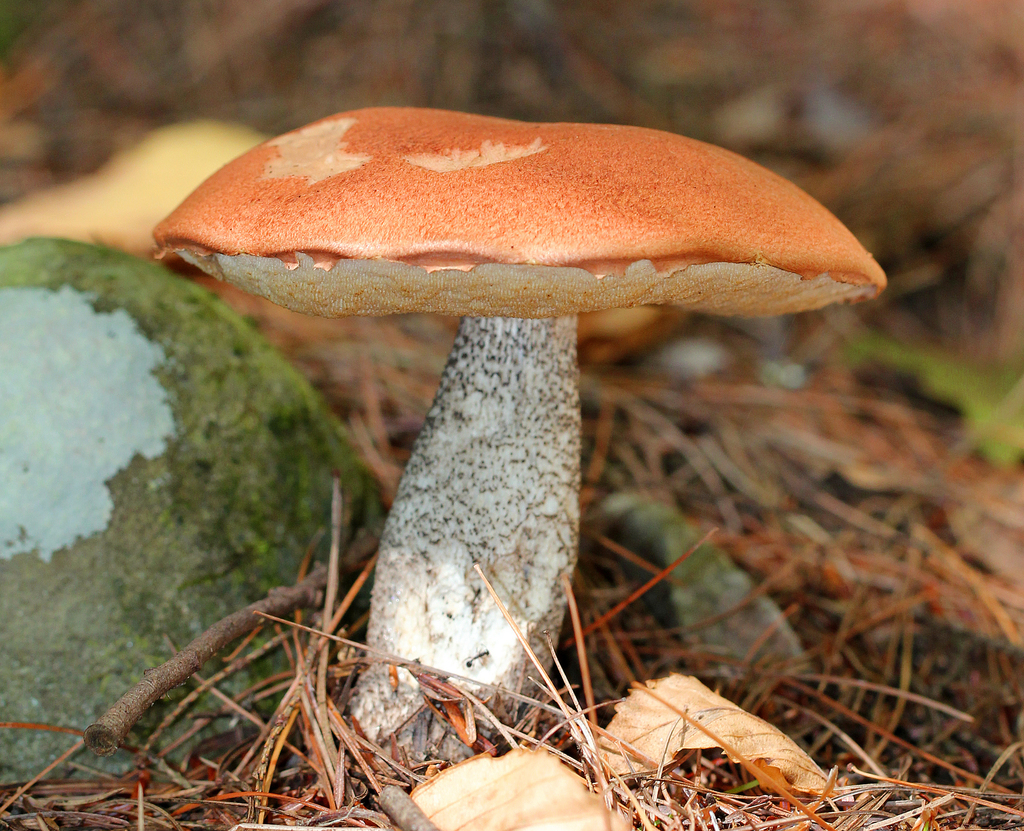
Foxy Bolete
Leccinum vulpinum
Leccinum vulpinum, commonly known as the foxy bolete, is a species of edible mushroom-forming fungus found in Europe. It is characterized by its muted fox-red cap with cocoa-brown tints, cream-coloured pore surface, and stout stipe covered with scales that darken from whitish to dark brown with age. This bolete is distinguished from its close relatives by its consistent association with conifers (especially Scots pine), subdued brown-reddish cap lacking vivid yellow-orange tones, and relatively narrow spores. Originally described by Roy Watling in 1961 from Scotland, it has since been recorded across several European countries including Poland, Portugal, Macedonia, and Montenegro.
From the article Leccinum vulpinum on Wikipedia (CC BY-SA), quoted section by section
Description
The fruit bodies (basidiocarps) have a cap (pileus) measuring 30–90 mm in diameter. The cap is convex at first, later broadly convex, with a dry surface covered in fine, woolly fibrils that are darkest at the centre. Its colour is a muted fox‑red with a cocoa‑brown tint, maturing to a deeper burnt sienna; bruising may produce a purplish‑sienna hue. On the cap underside, the pore surface beneath is pale cream, with small, round pores that may faintly bruise lilac. The tubes are 3–11 mm long and are adnate (broadly attached) to scarcely free from the stipe. The stipe is 85–135 mm long and 13–22 mm wide (up to 28 mm at the base), stout and stuffed. It is pallid overall, slightly swollen towards the base, and bears fine scales that change from whitish to reddish‑brown and finally to dark brown or chocolate. The stipe base often bruises blue‑green. Flesh throughout is white and may remain unchanging in the cap; when it does stain, changes are very slow—first to a pale pink or wine tint in the stipe apex, then to a blue‑green in the cortex at the base, and ultimately to a patchy steel‑blue. …
Range & habitat
Leccinum vulpinum is mycorrhizal with Scots pine (Pinus sylvestris). It was originally recorded from dry, upland pine woods in Inverness-shire, Scotland. Specimens were found among bilberry (Vaccinium myrtillus) beneath mature pines in the Rothiemurchus area and Cairngorms National Park, with known collections dating from 1957 to 1960. An edible species, it grows in mycorrhizal association with species of pine and bearberry. The fungus is known to have a broader European distribution and has been recorded from several additional countries, including Poland, Portugal, Macedonia, and Montenegro.
Wikipedia: “Habitat and distribution”
Where it lives
Recorded sightings
—
geo-referenced records in GBIF, from museums, herbaria and field observers.
Drag the globe to turn it. Dots are where records exist, not a range map; darker means more records.
In the stacks
Searching the stacks…
Every page naming Leccinum vulpinum in the Biodiversity Heritage Library →
This page is assembled live from iNaturalist, GBIF, Wikipedia, the Source Library and the Internet Archive. It is not yet part of the hand-edited codex. iNaturalist taxon 351354.