- Animals
- ›Chordates
- ›Vertebrates
- ›Reptiles
- ›Snakes and Lizards
- ›Snakes
- ›Elapid Snakes
- ›Australian Elapids (inc. Sea Snakes)
- ›Pseudechis
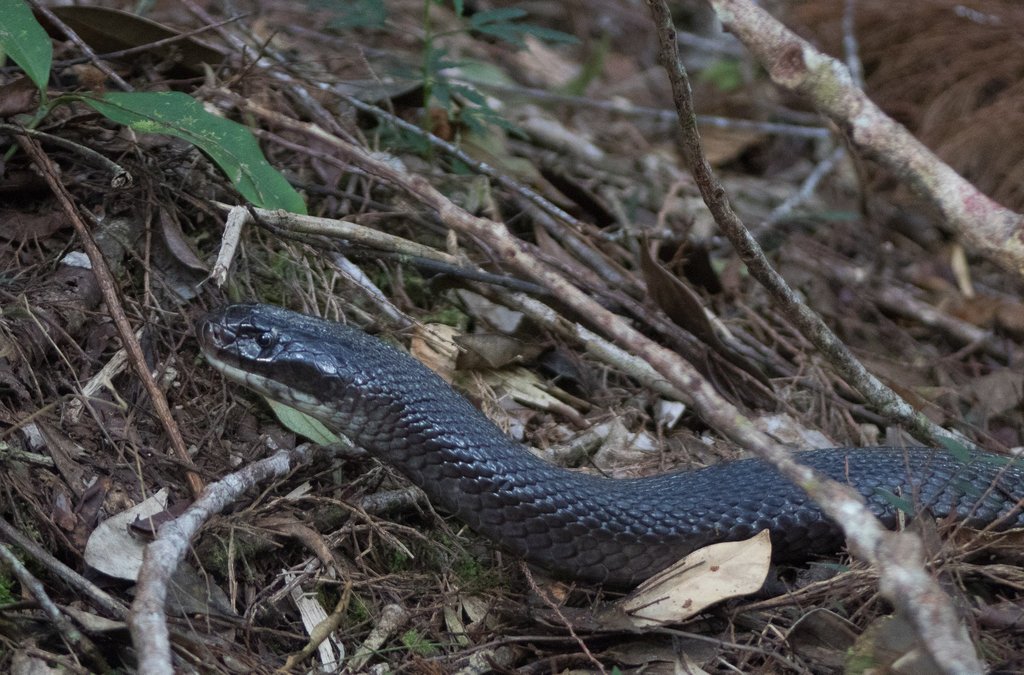
Papuan Black Snake
Pseudechis papuanus
The Papuan black snake (Pseudechis papuanus) is a highly venomous snake of the family Elapidae native to New Guinea. Reaching around 2 m (6 ft 7 in) in length, it is a predominantly black snake coloured grey underneath.
From the article Papuan black snake on Wikipedia (CC BY-SA), quoted section by section
Description
A solidly built snake with a wide round head and slight neck, the Papuan black snake ranges from 1.2 to 1.7 m in length, with individuals occasionally exceeding 2 metres. The longest specimen recorded was 2.44 m. The head and upperparts are dull or glossy black, or occasionally dark brown, and underparts are blue-grey or gunmetal grey. The neck is whitish with yellow and grey tinges. The labial scales are sometimes pale around the mouth and front of head.
Scalation. The number and arrangement of scales on a snake's body are key elements of identification to species level. The Papuan black snake has 19 to 21 rows of dorsal scales at midbody, 205 to 239 ventral scales, 43 to 63 subcaudal scales, and a divided anal scale.
Range & habitat
The range is southern New Guinea, both in Papua New Guinea and West Papua province of Indonesia, as well as offshore islands. In Papua New Guinea, it has possibly already vanished from Port Moresby and Central Province and is declining in Western Province. It just enters Australian territory as it occurs on Boigu and Saibai Islands in far northern Torres Strait off the New Guinea coast. Destruction of its habitat, killing of snakes by locals, and poisoning by the introduced cane toad have contributed to its decline.
Wikipedia: “Distribution and habitat”
Toxicity
The venom of the Papuan black snake is the most potent of all members of the black snake genus Pseudechis. Unlike those of other black snakes, the venom is predominantly neurotoxic in its effects, with muscle weakness and paralysis ensuing within 2 to 21 hours of being bitten. This can be life-threatening and intubation may be required. It is slightly more toxic than the equatorial spitting cobra (Naja sumatrana) and three times less toxic than that of the Coastal taipan (Oxyuranus scutellatus). A postsynaptic neurotoxin isolated has been given the name of papuantoxin-1, and can be treated with CSL black snake antivenom (used for the Mulga snake (Pseudechis australis)). Although widely feared in Papua New Guinea's Central Province, it is responsible for only a small minority of snakebites, eclipsed by the more dangerous taipan. Identifying snakes after snakebite can be difficult as victims are often bitten while walking through long kunai grass and hence the snake is not seen clearly. The Mekeo people know it as auguma, "to bite again", from its habit of repeatedly biting. Some local people in New Guinea believe it and the taipan to be opposite sexes of the same species. The Kiwai people believe the snake to be an agent of a magic-man known as Ove-devenor who sends it to kill enemies. …
Wikipedia: “Venom”
Where it lives
Recorded sightings
—
geo-referenced records in GBIF, from museums, herbaria and field observers.
Drag the globe to turn it. Dots are where records exist, not a range map; darker means more records.
In the stacks
Searching the stacks…
Every page naming Pseudechis papuanus in the Biodiversity Heritage Library →
This page is assembled live from iNaturalist, GBIF, Wikipedia, the Source Library and the Internet Archive. It is not yet part of the hand-edited codex. iNaturalist taxon 35160.