- Fungi Including Lichens
- ›Basidiomycete Fungi
- ›Higher Basidiomycetes
- ›Mushrooms, Bracket Fungi, Puffballs, and Allies
- ›Agaricomycetidae
- ›Common Gilled Mushrooms and Allies
- ›Cyphellopsidaceae
- ›Nia
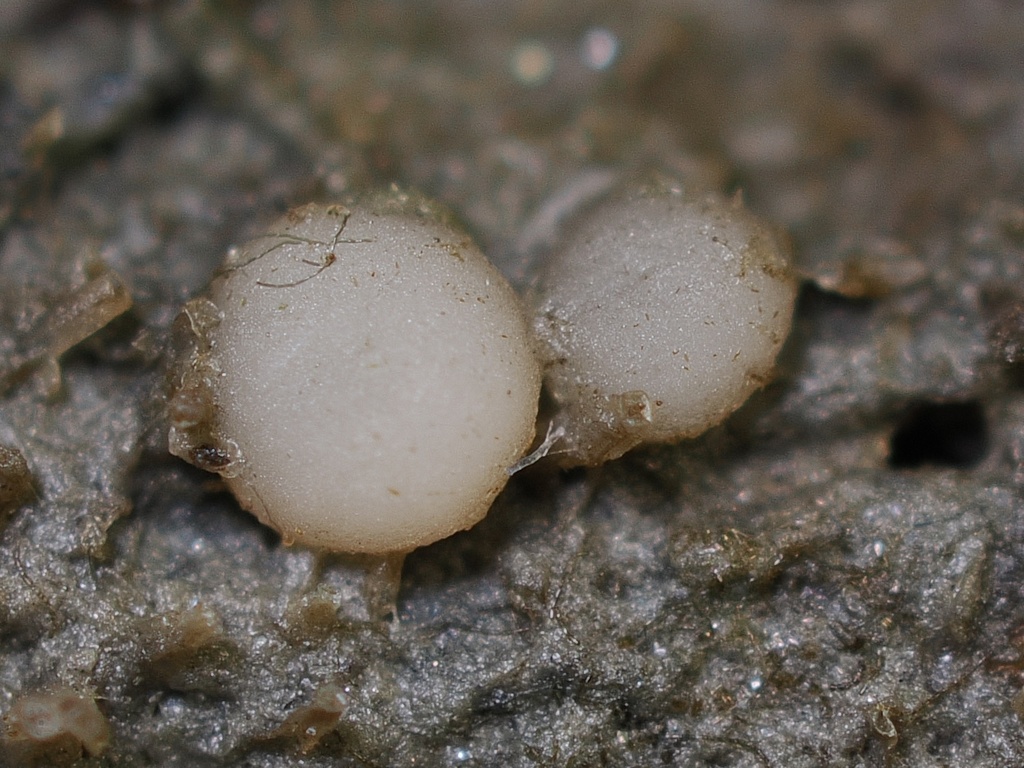
Nia vibrissa
Nia vibrissa is a species of fungus in the order Agaricales. The species is adapted to a marine environment and is a wood-rotting fungus, producing small, gasteroid basidiocarps (fruit bodies) on driftwood, submerged timber, mangrove wood, and similar substrates. The spores have long, hair-like projections and are widely dispersed in sea water, giving Nia vibrissa a cosmopolitan distribution.
From the article Nia vibrissa on Wikipedia (CC BY-SA), quoted section by section
Description
Fruit bodies are more or less spherical, yellow-orange to orange-brown, 1–4 mm across. The remarkable spores are oval, 10–15 by 6.5–8.5 μm with 4–5 bristle-like appendages up to 40 μm long.
Range & habitat
The species is widely distributed in the Atlantic Ocean, the Mediterranean Sea, the Indian Ocean, and the Pacific Ocean. Nia vibrissa has been shown to be a wood-rotting species and was first obtained by leaving wooden "baits" in the sea, retrieving them after a period of time, and then examining them in the laboratory. Other records of the fungus have come from a similar methodology, but it has also been found widely on dead mangrove wood and on natural driftwood. Fruit bodies of the fungus were found on wood salvaged from the wreck of King Henry VIII's 16th-century warship, the Mary Rose.
== References ==
Wikipedia: “Habitat and distribution”
Where it lives
Recorded sightings
—
geo-referenced records in GBIF, from museums, herbaria and field observers.
Drag the globe to turn it. Dots are where records exist, not a range map; darker means more records.
In the stacks
Searching the stacks…
Every page naming Nia vibrissa in the Biodiversity Heritage Library →
This page is assembled live from iNaturalist, GBIF, Wikipedia, the Source Library and the Internet Archive. It is not yet part of the hand-edited codex. iNaturalist taxon 351636.