- Animals
- ›Chordates
- ›Vertebrates
- ›Reptiles
- ›Snakes and Lizards
- ›Snakes
- ›Elapid Snakes
- ›Australian Elapids (inc. Sea Snakes)
- ›Oxyuranus
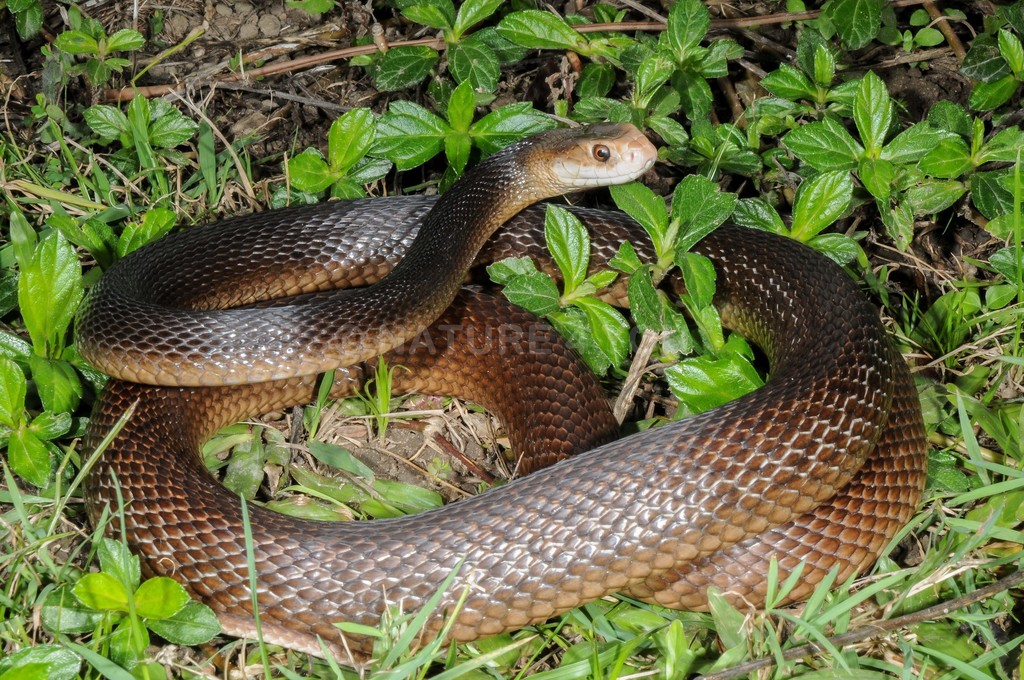
Coastal Taipan
Oxyuranus scutellatus
The coastal taipan (Oxyuranus scutellatus), or common taipan, is a species of extremely venomous snake in the family Elapidae. Described by Wilhelm Peters in 1867, the species is native to the coastal regions of northern and eastern Australia and the island of New Guinea. The second-longest venomous snake in Australia, the coastal taipan averages around 2.0 m (6.6 ft) long, with the longest specimens reaching 2.9 m (9.5 ft) in length. It has light olive or reddish-brown upperparts, with paler underparts. The snake is considered to be a least-concern species according to the International Union for Conservation of Nature.
The coastal taipan is found in a wide range of habitats, from monsoon forests to open woodland, as well as human-modified habitats such as sugarcane fields. It mainly hunts and eats small mammals, and opportunistically takes bird prey. The species is oviparous.
From the article Coastal taipan on Wikipedia (CC BY-SA), quoted section by section
Description
The coastal taipan is the second-longest venomous snake in Australia after the king brown snake (Pseudechis australis). Adult specimens of this species typically attain sexual maturity around 1.2 m (3.9 ft) in total length (including tail). More mature specimens can grow to between 1.5 and 2.0 m (4.9 and 6.6 ft). Other taipans, including the inland taipan, attain broadly similar sizes, although they tend to be slightly smaller in average size. A specimen of an average 2.0 m (6.6 ft) total length weighs around 3.0 kg (6.6 lb). According to the Queensland Museum, the longest recorded total length for the coastal taipan was a specimen that was 2.9 m (9.5 ft) and weighed 6.5 kg (14 lb). Though exceptionally rare, much larger specimens are widely believed to exist, including specimens of as much as 3.3 m (11 ft). O. scutellatus has a long and narrow head with an angular brow and is lighter-coloured on the face. The body is slender and colouration can vary. It is often uniformly light olive or reddish-brown in colour, but some specimens may be dark gray to black. The colouration is lighter on the sides of the body, and the ventral side (the belly) is usually a creamy-white to a pale light yellow in colour, and is often marked with orange or pink flecks. Individuals undergo a seasonal change in colour, becoming darker in winter and fading in summer. …
Range & habitat
Considered to be a least-concern species according to the International Union for Conservation of Nature, the coastal taipan occurs in northern Australia and southern New Guinea. Its range extends from north-western Western Australia, the Northern Territory, across Cape York Peninsula, and south in eastern Queensland into northern New South Wales (as far south as Grafton). The coastal taipan, though, is not found in regions where the maximum winter temperature is below 20 °C (68 °F). The second subspecies (O. s. canni ) is found throughout the island of New Guinea, with higher concentrations of the snake being found in the nation of Papua New Guinea. The coastal taipan can be found in a variety of different habitats, in warm, wetter, temperate to tropical coastal regions, monsoon forests, wet and dry sclerophyll forests and woodlands, and natural and artificial grassy areas, including grazing paddocks and disused rubbish tips. It appears to have become more common since the 1935 introduction of the cane toad. Whether this is because of reduced competition, as other large venomous snakes have declined after being poisoned by toads, or due to increased food supply of rodents is unclear. It has adapted well to sugarcane fields, where it thrives on the rodent population in the fields. In Far North Queensland in the Cape York Peninsula, it is usually found in open woodland areas. …
Wikipedia: “Distribution and habitat”
What it does
The coastal taipan is primarily diurnal, being mostly active in the early to midmorning period, although it may become nocturnal in hot weather conditions. The consensus of snake handlers is that the coastal taipan tends to avoid confrontation, but becomes highly defensive if provoked.
Reproduction and lifespan. Breeding season takes place between August and December. The coastal taipan is oviparous, laying a clutch of 7 to 20 eggs. The eggs take 60 to 80 days to hatch, with the newly hatched snakes ranging from 30 to 34 cm (12 to 13 in) in length. The young grow quickly, averaging 6.7 cm (2.6 in) a month, and reaching a length of 1.0 m (3.3 ft) in a year. Male coastal taipans reach sexual maturity when they reach 80 cm in length, which they reach around 16 months of age, while females are able to breed when they are around 100 cm long, around 28 months old.
Diet. The coastal taipan's diet consists predominantly of rats, mice, and bandicoots, with various species of birds taken opportunistically. In 2010, a dead coastal taipan was found to have ingested a cane toad. …
Wikipedia: “Behaviour”
Toxicity
Generally feared more than any other Australian snake, the coastal taipan is considered the third-most venomous terrestrial snake in the world, behind the inland taipan and eastern brown snake. It is classified as a snake of medical importance by the World Health Organization. In 1935, local health authorities established a register of cases of injury by plants and animals in northern Queensland. By 1940, one survivor (who lost his sense of smell for some months) and two fatalities had been recorded from coastal taipan bites, with another three historical fatalities added in 1944. George Rosendale, a Guugu Yimithirr man, was bitten through his boots and thick socks while stacking wood. He became sick 15–30 minutes later, with ptosis, nausea, and difficulty breathing, and was conveyed to Cooktown Hospital. A doctor visiting the area on holiday treated him with fluids, and tiger snake antivenom flown up from Cairns. He was flown to Cairns Hospital the next day and was discharged after 19 days. He also reported losing his sense of smell. Rosendale became a Lutheran pastor and died at age 89 in 2019. Articles about how dangerous the species was appeared more frequently in newspapers and books from the late 1930s onwards, including wild tales of it hiding in trees and dropping on victims. …
Wikipedia: “Venom”
Where it lives
Recorded sightings
—
geo-referenced records in GBIF, from museums, herbaria and field observers.
Drag the globe to turn it. Dots are where records exist, not a range map; darker means more records.
In the stacks
Searching the stacks…
Every page naming Oxyuranus scutellatus in the Biodiversity Heritage Library →
This page is assembled live from iNaturalist, GBIF, Wikipedia, the Source Library and the Internet Archive. It is not yet part of the hand-edited codex. iNaturalist taxon 35170.