- Fungi Including Lichens
- ›Basidiomycete Fungi
- ›Higher Basidiomycetes
- ›Mushrooms, Bracket Fungi, Puffballs, and Allies
- ›Phallomycetidae
- ›Gomphales
- ›Gomphaceae
- ›Phaeoclavulina
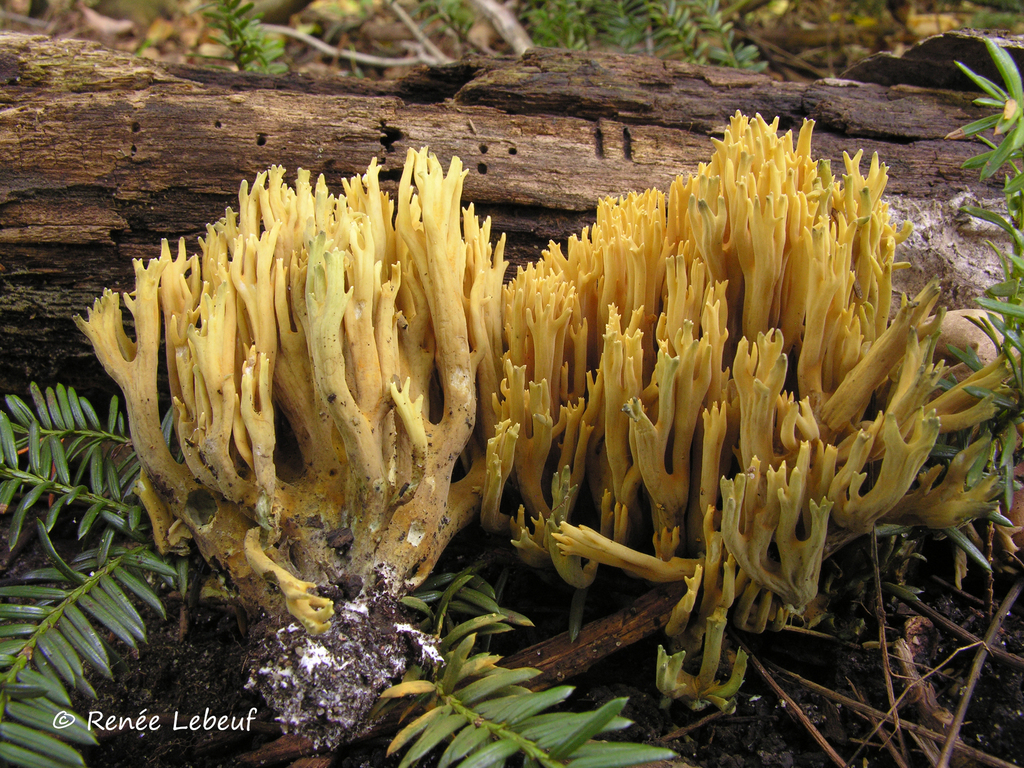
Green-staining Coral Mushroom
Phaeoclavulina abietina
Phaeoclavulina abietina, commonly known as the green-staining coral, is a coral mushroom in the family Gomphaceae. It is characterized by the green staining reaction it develops in response to bruising or injury.
From the article Phaeoclavulina abietina on Wikipedia (CC BY-SA), quoted section by section
Description
The fruit bodies are leathery, and brittle when dry. They are small, measuring 2–5 cm (3⁄4–2 in) tall by 1–5 cm (1⁄2–2 in) wide, and branch from the central stem up to five times. The slender branches are slightly flattened or spreading, and forked or crested near the top. The color of the fruit body is medium yellow green to light olive, but will bruise a darker olive green to dark olive green. The stem is 5–15 mm (1⁄4–5⁄8 in) long and 2–10 mm (1⁄8–3⁄8 in) thick; it has a mat of mycelia at its base, which is attached to rhizomorphs that branch into the substrate. The odor of the mushroom tissue ranges from indistinct to earthy, and it tastes initially sweet, then somewhat bitter. The species is inedible. The spores are dark orange-yellow when collected in mass. The spores are pip-shaped to broadly elliptical, with one oblique end; their dimensions are 6–9 by 3.5–4.5 μm. The basidia (spore-bearing cells) are typically four-spored, with the spores attached by sterigmata up to 7 μm long.
Similar species. Phaeoclavulina myceliosa is very similar but does not produce a greenish stain. Ramaria apiculata differs in its bright teal tips. Also similar in appearance is R. invalii, which does not stain when bruised.
Range & habitat
Fruit bodies grow scattered or in groups (sometimes arranged in rows) on the ground in duff of coniferous forests. In North America, it is found in the United States (mostly October–February on the West Coast and July–October inland), including the Pacific Northwest, as well as Mexico. It is also found in Europe.
== References ==
Wikipedia: “Habitat and distribution”
Where it lives
Recorded sightings
—
geo-referenced records in GBIF, from museums, herbaria and field observers.
Drag the globe to turn it. Dots are where records exist, not a range map; darker means more records.
In the stacks
Searching the stacks…
Every page naming Phaeoclavulina abietina in the Biodiversity Heritage Library →
This page is assembled live from iNaturalist, GBIF, Wikipedia, the Source Library and the Internet Archive. It is not yet part of the hand-edited codex. iNaturalist taxon 351744.