- Animals
- ›Chordates
- ›Vertebrates
- ›Reptiles
- ›Snakes and Lizards
- ›Snakes
- ›Elapid Snakes
- ›Australian Elapids (inc. Sea Snakes)
- ›Notechis
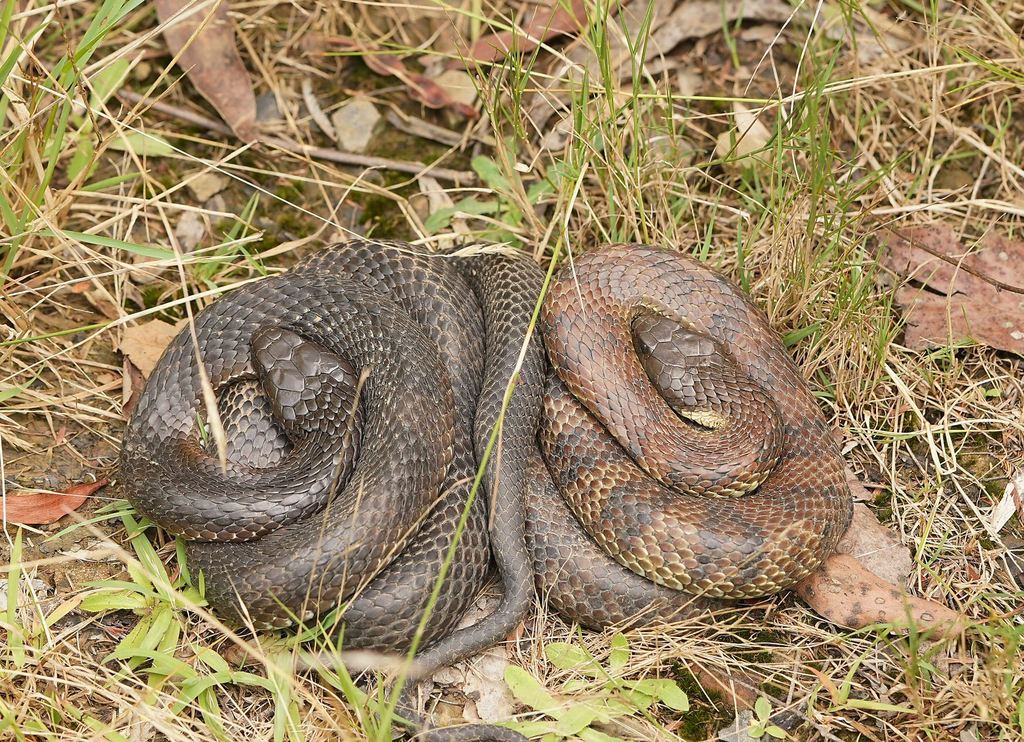
Tiger Snake
Notechis scutatus
The tiger snake (Notechis scutatus) is a large and highly venomous snake of southern Australia, including its coastal islands and Tasmania. These snakes are often observed and locally well known by their banding, black and yellow like a tiger, although the species can be highly variable in colouration and patterning. All populations are classified within the genus Notechis (Elapidae). Their diverse characteristics have been classified either as distinct species or by subspecies and regional variation.
While tiger snakes are usually ground-dwelling, they are able to swim as well as climb into trees and buildings.
From the article Tiger snake on Wikipedia (CC BY-SA), quoted section by section
Description
Notechis is a genus of large venomous snakes in the family Elapidae restricted to subtropical and temperate regions of Australia. Tiger snakes are a large group of distinct populations, which may be isolated or overlapping, with extreme variance in size and colour. Individuals also show seasonal variation in colour. The total length is typically about 1.2 metres (3 ft 11 in) The patterning is darker bands, strongly contrasting or indistinct, which are pale to very dark in colour. Colouration is olive, yellow, orange-brown, or jet-black, and the underside of the snake is light yellow or orange. Tiger snakes use venom to kill prey, and may also bite an aggressor; they are potentially fatal to humans. Tolerant of low temperatures, the snake may be active on warmer nights. When threatened, they flatten their bodies and raise their heads above the ground in a classic prestrike stance.
Morphs. The widely dispersed populations (sometimes referred as polymorphs) show some conformity in their descriptions, but these characters may be shared by separate or adjacent groups. Tiger snakes are also identified by the region or island in which the forms occur, which is prefixed to a common name. The common tiger snake has a flat, blunt head, slightly distinct from a robust body. Its body is capable of being flattened along its entire length when the snake is agitated or basking. …
Range & habitat
Tiger snakes are usually found in coastal regions, where they favour wetlands, creeks, dams, and other habitat around watercourses, or at shelter near permanent sources of water in pastoral areas. Habitat providing an abundance of prey can support large populations. The species' distribution extends from the south of Western Australia through to South Australia, Tasmania, up through Victoria, and New South Wales. Its common habitat includes the coastal areas of Australia.
Wikipedia: “Habitat”
What it does
Tiger snakes give birth to 20 to 30 live young; an exceptional record was made of 64 from an eastern female. They usually mate in spring when it is in the warmer seasons and will give birth to live young in summer.
Wikipedia: “Reproduction”
Toxicity
Tiger snakes accounted for 17% of identified snakebite victims in Australia between 2005 and 2015, with four deaths recorded from 119 confirmed envenomations. Tiger snake venoms possess potent neurotoxins, coagulants, haemolysins, and myotoxins. Symptoms of a bite include localized pain in the foot and neck region, tingling, numbness, and sweating, followed by a fairly rapid onset of breathing difficulties and paralysis. In a study, the mortality rate from untreated bites is reported to be between 40% and 60%. Treatment is the same for all Australian venomous snakes. The pressure immobilization method is used to inhibit the flow of venom through the lymphatic system. Broad, thick bandages are applied over the bite, then down and back along the limb to the armpit or groin. The affected limb is then immobilized with a splint. Identification of the venom is possible if traces are left near the wound. Identifying the snake is not necessary if bitten in Tasmania, because the same antivenom is used to treat all Tasmanian snakes' bites. The availability of antivenom has greatly reduced the incidence of fatal tiger snake bites. Among the number of deaths caused by snakebite in Australia, those from tiger snakes are exceeded only by the brown snake. The venom yield is 35–65 milligrams (0.54–1.00 gr), while the lethal dose for humans is 3 milligrams (0.046 gr). …
Wikipedia: “Venom”
Where it lives
Recorded sightings
—
geo-referenced records in GBIF, from museums, herbaria and field observers.
Drag the globe to turn it. Dots are where records exist, not a range map; darker means more records.
In the stacks
Searching the stacks…
Every page naming Notechis scutatus in the Biodiversity Heritage Library →
This page is assembled live from iNaturalist, GBIF, Wikipedia, the Source Library and the Internet Archive. It is not yet part of the hand-edited codex. iNaturalist taxon 35178.