- Fungi Including Lichens
- ›Basidiomycete Fungi
- ›Higher Basidiomycetes
- ›Mushrooms, Bracket Fungi, Puffballs, and Allies
- ›Russulales
- ›Milkcaps, Brittlegills and Allies
- ›Russula
- ›Brevipes
- ›Lactarioideae
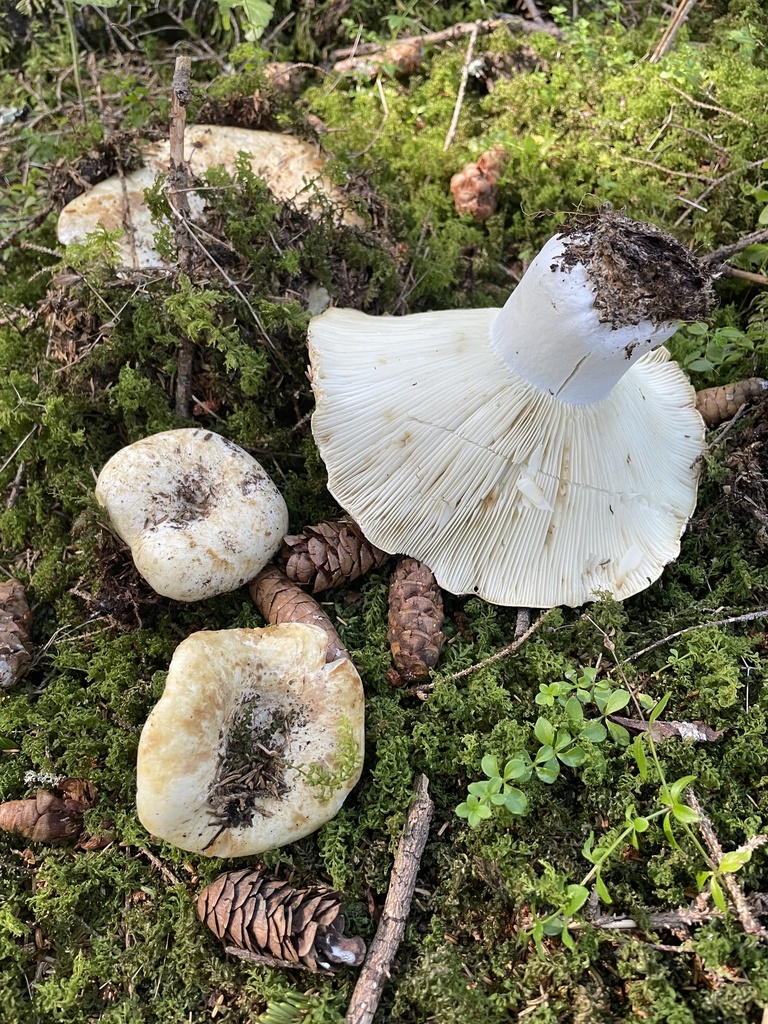
milk-white brittlegill
Russula delica
Russula delica is a mushroom that goes by the common name of milk-white brittlegill, and is a member of the genus Russula, all of which are collectively known as brittlegills. It is mostly white, with ochraceous or brownish cap markings, and a short robust stem. It is edible, but poor in taste, and grows in coniferous, broadleaved, or mixed woods. It can be confused with other white Russula species and certain white Lactarius species.
From the article Russula delica on Wikipedia (CC BY-SA), quoted section by section
Description
The basidiocarps (fruiting bodies) of Russula delica seem loath to leave the soil, and are often found half buried, or sometimes growing hypogeously. As a result, the caps often trap the surrounding leaf debris and soil on their rough surfaces. The cap can be 16 cm (6.3 in) in diameter. It is white, usually tinged with ochre or brown, with an inrolled margin, which usually remains white. At first it is convex, but later flattens, and is often funnel shaped. The firm, white stipe is short and stout, measuring 2–6 cm (1–2.5 in) high and 2–4 cm (1–1.5 in) wide. The gills are decurrent, and are quite closely spaced initially. The spore print is creamy white, and the warty oval spores measure 8–12 x 7–9 μm. The flesh is white, and does not change colour on cutting. It has a pleasant, fruity smell when young, but at maturity it may develop a faintly fishy or unpleasant smell. It has a spicy, tangy taste.
Similar species. Russula chloroides is very similar and often confused with R. delica. …
Range & habitat
Russula delica is widespread in the northern temperate zones, including Europe and Asia. It is particularly common in the Eastern Mediterranean. It is a thermophylic species, appearing during hot spells in summer and autumn in broadleaved and coniferous woods. In North America Russula delica is rare and is largely replaced by R. brevipes, which is very similar, but not found in Europe.
Wikipedia: “Distribution and habitat”
At the table
This mushroom is edible but poor, having an unpleasant taste, leading some to classify it as inedible. However, in Cyprus, as well as certain Greek islands such as Lesvos, huge numbers of Russula delica are collected and consumed every year. They are usually pickled and preserved in olive oil, vinegar or brine, after prolonged boiling. In Ukraine and Russia, this mushroom is used for salting too. Only caps are used, which are boiled for about half an hour, and then salted in cold brine with dill and garlic.
Wikipedia: “Edibility”
Where it lives
Recorded sightings
—
geo-referenced records in GBIF, from museums, herbaria and field observers.
Drag the globe to turn it. Dots are where records exist, not a range map; darker means more records.
In the stacks
Searching the stacks…
Every page naming Russula delica in the Biodiversity Heritage Library →
This page is assembled live from iNaturalist, GBIF, Wikipedia, the Source Library and the Internet Archive. It is not yet part of the hand-edited codex. iNaturalist taxon 352278.