- Fungi Including Lichens
- ›Basidiomycete Fungi
- ›Higher Basidiomycetes
- ›Mushrooms, Bracket Fungi, Puffballs, and Allies
- ›Agaricomycetidae
- ›Common Gilled Mushrooms and Allies
- ›Marasmiineae
- ›Physalacriaceae
- ›Strobilurus
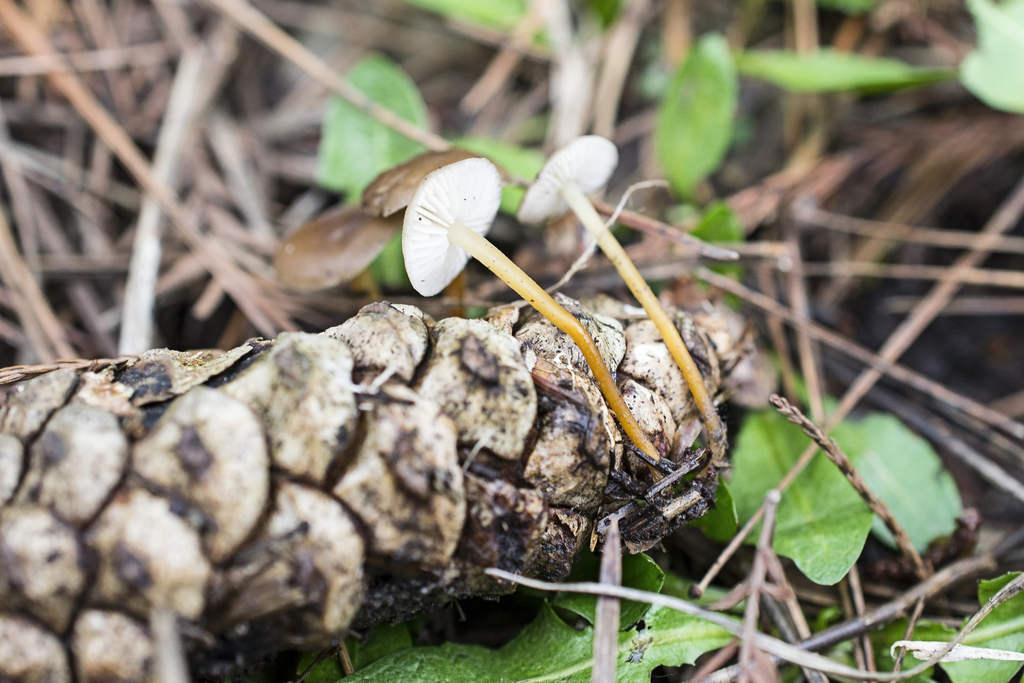
Pinecone Cap
Strobilurus tenacellus
Strobilurus tenacellus, commonly known as the pinecone cap, is a species of agaric fungus in the family Physalacriaceae. It is found throughout Asia and Europe, where it grows on the fallen cones of pine and spruce trees. The fruit bodies (mushrooms) are small, with convex to flat, reddish to brownish caps up to 15 mm (0.6 in) in diameter, set atop thin cylindrical stems up to 4–7.5 cm (1.6–3.0 in) long with a rooting base. A characteristic microscopic feature of the mushroom is the sharp, thin-walled cystidia found on the stipe, gills, and cap. The mushrooms, sometimes described as edible, are too small to be of culinary interest. The fungus releases compounds called strobilurins that suppress the growth and development of other fungi. Derivatives of these compounds are used as an important class of agricultural fungicides.
From the article Strobilurus tenacellus on Wikipedia (CC BY-SA), quoted section by section
Description
The cap is initially convex before flattening out, sometimes retaining a small central papilla, and sometimes developing a central depression; the cap diameter reaches 5–15 mm (0.2–0.6 in). The smooth cap is hygrophanous (i.e., it changes colour as it loses or absorbs moisture), and has shallow radial grooves extending about halfway up the cap. Its colour is reddish to brownish, and is often paler in the center than the margin; when dry, the colour fades to greyish. The greyish-white gills have a free to deeply emarginate (notched) attachment to the cap. They are somewhat crowded together, numbering 20–25 gills with 1 to 7 tiers of interspersed lamellulae (short gills that do not extend fully from the cap margin to the stipe). The cylindrical stipe measures 4–7.5 cm (1.6–3.0 in) long by 0.5–2 mm thick, and has at its base a root-like pseudorrhiza that extends into the substrate. The upper stipe is yellowish brown, while lower it is dark orange-brown to reddish brown. The flesh has no odour and usually has a bitter taste. While the fruit bodies are sometimes described as are edible, they are too small to be of culinary interest. The spore print is white. Spores are roughly elliptical to tear-shaped, with dimensions of 5.0–7.5 by 2.4–4.0 μm. The basidia (spore-bearing cells) are four-spored, and measure 20–40 by 7–11 μm. …
Range & habitat
Strobilurus tenacellus is a saprobic wood-rotting fungus. It fruits singly or in small groups on fallen and often partially buried cones of Scots pine (Pinus sylvestris), European black pine (Pinus nigra) and sometimes spruce (Picea) in coniferous and mixed forests. It is found in Europe and Asia, where it has been recorded in Japan and Jordan. In Europe, the fungus usually fruits from March to June. Its occurrence is occasional.
Wikipedia: “Habitat and distribution”
Where it lives
Recorded sightings
—
geo-referenced records in GBIF, from museums, herbaria and field observers.
Drag the globe to turn it. Dots are where records exist, not a range map; darker means more records.
In the stacks
Searching the stacks…
Every page naming Strobilurus tenacellus in the Biodiversity Heritage Library →
This page is assembled live from iNaturalist, GBIF, Wikipedia, the Source Library and the Internet Archive. It is not yet part of the hand-edited codex. iNaturalist taxon 352463.