- Fungi Including Lichens
- ›Basidiomycete Fungi
- ›Higher Basidiomycetes
- ›Tremellomycetes
- ›Tremellales
- ›Tremellaceae
- ›Tremella
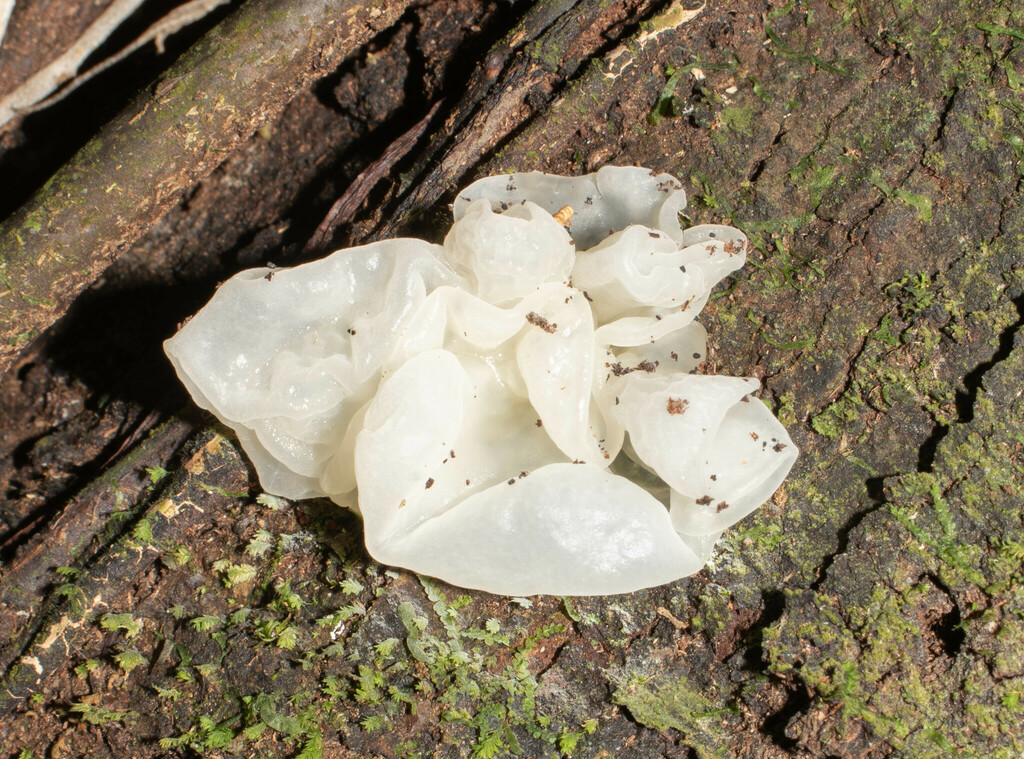
Tremella fibulifera
Tremella fibulifera is a species of fungus in the family Tremellaceae. It produces soft, whitish, lobed to frondose, gelatinous basidiocarps (fruit bodies) and is parasitic on other fungi on dead branches of broad-leaved trees. It was originally described from Brazil.
From the article Tremella fibulifera on Wikipedia (CC BY-SA), quoted section by section
Description
Fruit bodies are soft, gelatinous, whitish, up to 2.5 cm (1 in) across, and lobed. Microscopically, the basidia are tremelloid (subglobose, with oblique to vertical septa), 4-celled, 13 to 18 by 9 to 16 μm. The basidiospores are ellipsoid, smooth, 7 to 10 by 6 to 7 μm.
Range & habitat
Tremella fibulifera is a parasite on lignicolous fungi, but its host species is unknown, though collections have been noted on pyrenomycetes. It is found on dead, attached or fallen branches of broad-leaved trees. The species is currently known from Brazil, Colombia, Costa Rica, Panama, Venezuela (as T. olens), and Jamaica (as T. olens).
== References ==
Wikipedia: “Habitat and distribution”
Where it lives
Recorded sightings
—
geo-referenced records in GBIF, from museums, herbaria and field observers.
Drag the globe to turn it. Dots are where records exist, not a range map; darker means more records.
In the stacks
Searching the stacks…
Every page naming Tremella fibulifera in the Biodiversity Heritage Library →
This page is assembled live from iNaturalist, GBIF, Wikipedia, the Source Library and the Internet Archive. It is not yet part of the hand-edited codex. iNaturalist taxon 352564.