- Fungi Including Lichens
- ›Basidiomycete Fungi
- ›Higher Basidiomycetes
- ›Mushrooms, Bracket Fungi, Puffballs, and Allies
- ›Agaricomycetidae
- ›Common Gilled Mushrooms and Allies
- ›Agaricineae
- ›Hymenogastraceae
- ›Hebeloma
- ›Porphyrospora
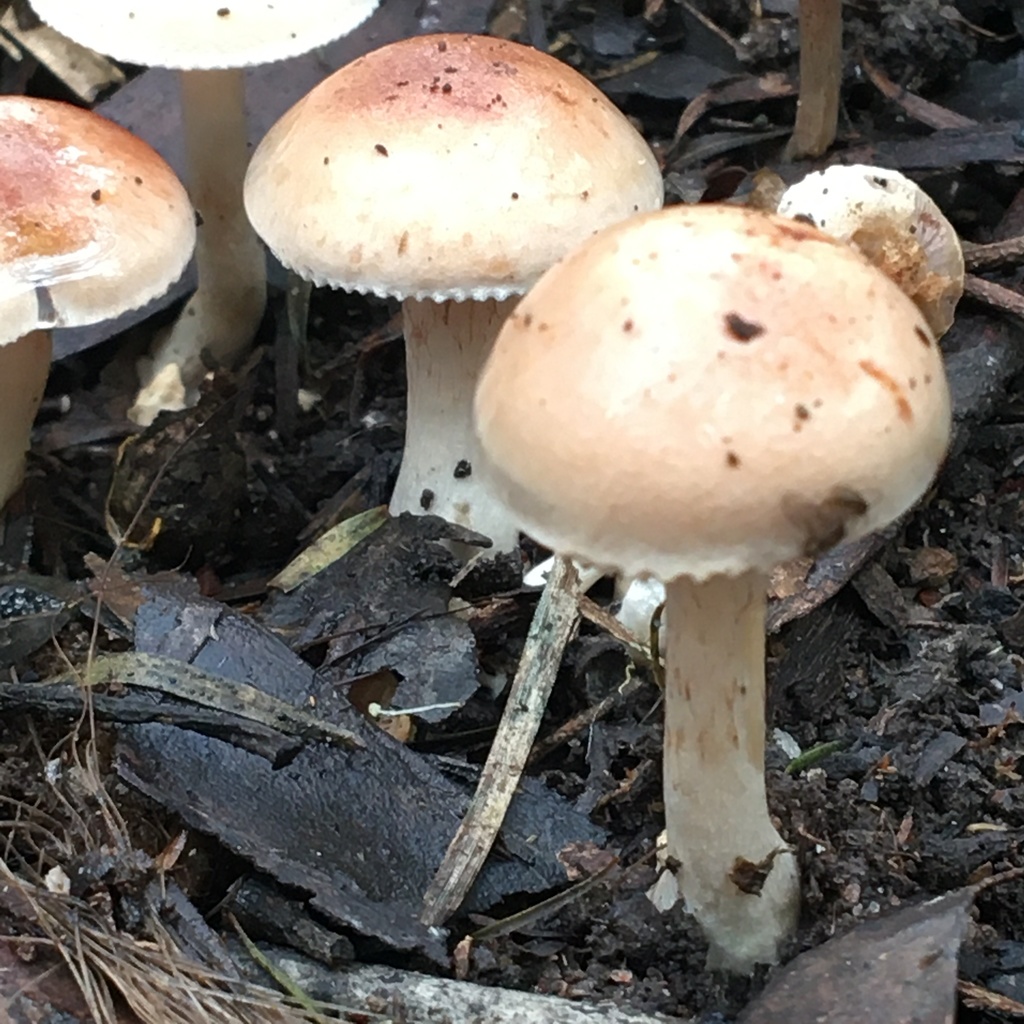
Ghoul Fungus
Hebeloma aminophilum
Hebeloma aminophilum, commonly known as the ghoul fungus, is a species of mushroom in the Hymenogastraceae family. Found in Western Australia, it gets its common name from the propensity of the fruiting bodies to spring out of decomposing animal remains. Its edibility is unknown.
From the article Hebeloma aminophilum on Wikipedia (CC BY-SA), quoted section by section
Description
The dull pinkish brown or cream cap is 3–11 centimetres (1–4+1⁄2 inches) in diameter, convex initially before flattening out with age. There is a slight umbo, and the cap margin is inrolled when young. A thin white veil rapidly disappears in young mushrooms. The cap surface is sticky initially. The adnate (or sometimes adnexed) gills are pale pink to pinkish brown and up to 1 cm deep. With age, they can be encrusted with clumps of spores. The cylindrical stipe is 6.5–9 cm (2+1⁄2–3+1⁄2 in) high, 1–1.2 cm in diameter and has a thickened base and lacks a ring. The thick flesh is cream or pale yellow, with a bitter taste and a stale smell. The spore print is pinkish brown, and the oval spores measure 8.5 by 4.9 μm. The mycelium is white.
Similar species. Similar species include the introduced poisonpie (Hebeloma crustuliniforme), which has been recorded in pine plantations, the native western Australian poisonpie (H. westraliense), which does not grow near carcasses, and the Australian white webcap (Cortinarius austroalbidus), which is paler and smells of curry.
Range & habitat
An uncommon fungus, H. aminophilum is found in southern Western Australia, southeastern South Australia and Victoria. Fruiting bodies arise in eucalyptus woodland in the vicinity of sheep, reptile and bird carcasses. The habit of growing from flesh gives it the term sarcophilous.
== References ==
Wikipedia: “Distribution and habitat”
In human culture
The generic name is derived from the Ancient Greek Hebe, "youth", and -loma, a fringe (pertaining to the fungal veil), referring to how the fungal veil is only seen in immature specimens. It gets its common name of ghoul fungus from its habit of growing around animal carcasses.
Wikipedia: “Etymology”
Where it lives
Recorded sightings
—
geo-referenced records in GBIF, from museums, herbaria and field observers.
Drag the globe to turn it. Dots are where records exist, not a range map; darker means more records.
In the stacks
Searching the stacks…
Every page naming Hebeloma aminophilum in the Biodiversity Heritage Library →
This page is assembled live from iNaturalist, GBIF, Wikipedia, the Source Library and the Internet Archive. It is not yet part of the hand-edited codex. iNaturalist taxon 353492.