- Plants
- ›Vascular Plants
- ›flowering plants
- ›Dicots
- ›myrtles, evening primroses, and allies
- ›myrtle family
- ›Myrtoideae
- ›Leptospermeae
- ›Leptospermum
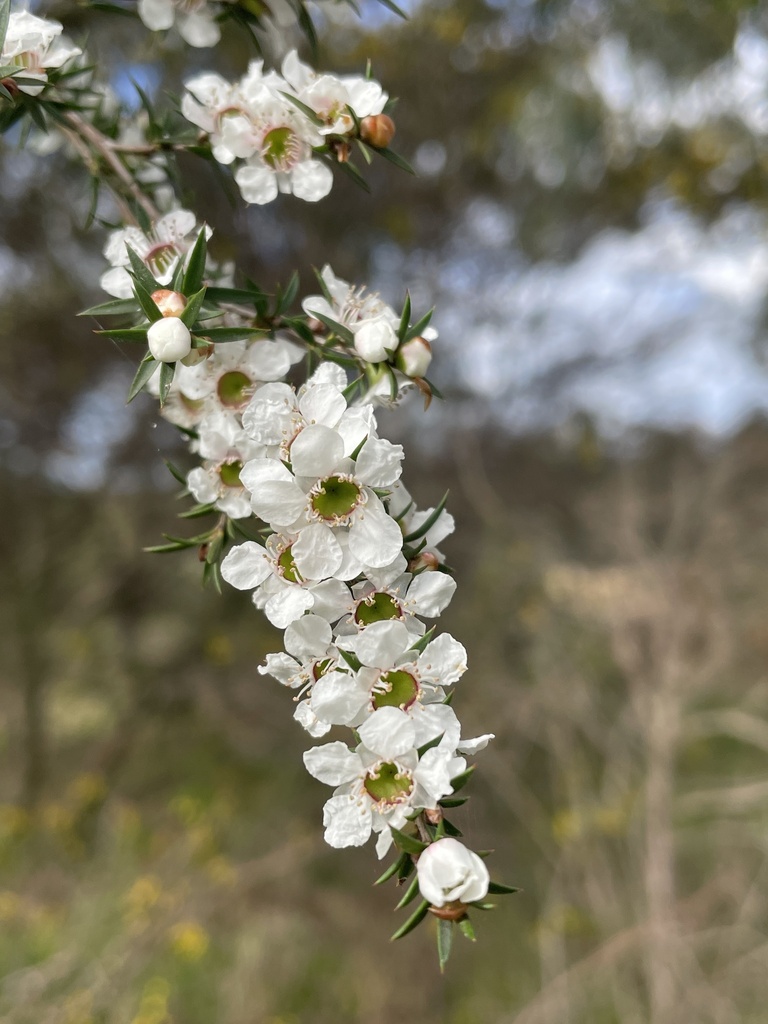
prickly tea-tree
Leptospermum continentale
Leptospermum continentale, commonly known as prickly tea-tree, is a shrub species that is endemic to south-eastern Australia. It grows to between 1 and 2 metres high and has narrow leaves that are about 10 mm long and 1 to 3 mm wide. The flowers, which are white or occasionally pink, appear between October and January in the species native range.
From the article Leptospermum continentale on Wikipedia (CC BY-SA), quoted section by section
Description
Leptospermum continentale is a slender, straggling shrub that typically grows to a height of 1–2 m (3 ft 3 in – 6 ft 7 in) or more. It has smooth bark that is shed in stringy strips. The leaves are narrow egg-shaped, 5–13 mm (0.20–0.51 in) long and 1–3.5 mm (0.039–0.138 in) wide with a sharp point on the end. The flowers are arranged singly in leaf axils, 8–12 mm (0.31–0.47 in) in diameter on a pedicel up to 1 mm (0.039 in) long and the floral cup is 2–3 mm (0.079–0.118 in) long. The sepals are triangular, mostly glabrous, about 1.5 mm (0.059 in) long and fall off as the flower opens. The petals are usually white, rarely pink, 3–5 mm (0.12–0.20 in) long and the stamens are 1.5–2 mm (0.059–0.079 in) long. Flowering occurs between September and February and the fruit is a broadly hemispherical capsule 5–8 mm (0.20–0.31 in) wide and remaining on the plant when mature.
Range & habitat
Prickly tea-tree occurs from Mudgee in central eastern New South Wales and the Australian Capital Territory to the southern half of Victoria and south-eastern South Australia. It is widespread in heath and woodland in well-drained sandy soil but also in swampy places.
Wikipedia: “Distribution and habitat”
How it is grown
This tea-tree can be propagated from cuttings or from seed and is a hardy shrub that tolerates most soils and aspects, including poorly-drained sites.
== References ==
Wikipedia: “Use in horticulture”
Where it lives
Recorded sightings
—
geo-referenced records in GBIF, from museums, herbaria and field observers.
Drag the globe to turn it. Dots are where records exist, not a range map; darker means more records.
In the stacks
Searching the stacks…
Every page naming Leptospermum continentale in the Biodiversity Heritage Library →
This page is assembled live from iNaturalist, GBIF, Wikipedia, the Source Library and the Internet Archive. It is not yet part of the hand-edited codex. iNaturalist taxon 353876.