- Plants
- ›Vascular Plants
- ›flowering plants
- ›Dicots
- ›myrtles, evening primroses, and allies
- ›myrtle family
- ›Myrtoideae
- ›gum trees
- ›Eucalyptus
- ›Eucalyptus
- ›Eucalyptus
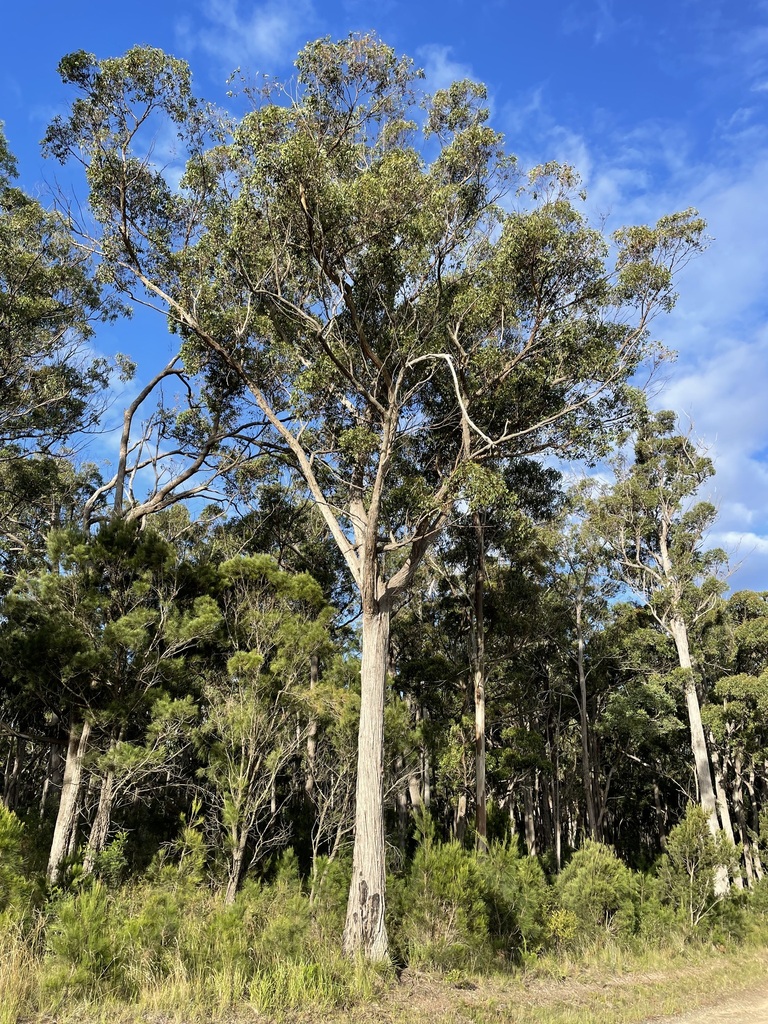
White Stringybark
Eucalyptus globoidea
Eucalyptus globoidea, commonly known as the white stringybark, is a tree that is endemic to near-coastal areas of south-eastern Australia. It has rough, stringy bark, often furrowed on the trunk, glossy, lance-shaped to egg-shaped, often curved leaves, oval to spindle-shaped green to yellowish flower buds, white flowers and small, more or less spherical to hemispherical fruit.
From the article Eucalyptus globoidea on Wikipedia (CC BY-SA), quoted section by section
Description
Eucalyptus globoidea is a tree that grows to a height of 30–40 metres (98–131 ft) with rough bark to the thinnest branches. The bark is grey to reddish brown and stringy, often furrowed on the trunk. The leaves on young trees are glossy green, a lighter shade on the lower side, egg-shaped to broadly lance-shaped 40–100 mm (2–4 in) long, 20–45 mm (0.8–2 in) wide and wavy. Adult leaves are egg-shaped to lance-shaped, often curved, glossy green on both sides, 70–135 mm (3–5 in) long and 12–40 mm (0.5–2 in) wide. The flowers are arranged in groups of mostly between eleven and fifteen on an angular or flattened peduncle 4–10 mm (0.2–0.4 in) long, individual flowers on a cylindrical pedicel up to 2 mm (0.08 in) long. The mature buds are green to yellowish, oval to spindle-shaped, 5–7 mm (0.2–0.3 in) long and 3–4 mm (0.1–0.2 in) wide. The operculum is cone-shaped and about as long and wide as the flower cup. The stamens are white. Flowering occurs from July to February but mostly from September to January. The fruit is a globe-shaped to hemispherical capsule, 4–7 mm (0.2–0.3 in) long and 6–9 mm (0.2–0.4 in) wide.
Range & habitat
White stringbark grows in forest and woodland on hills and slopes on the coast and nearby tablelands, south from Woolgoolga in New South Wales to near Melbourne in Victoria. Globoidnan A is a lignan found in E. globoidea. This molecule has been found to inhibit the action of HIV integrase, an enzyme which is responsible for the introduction of HIV viral RNA into a host's cellular DNA.
== References ==
Wikipedia: “Distribution and habitat”
Where it lives
Recorded sightings
—
geo-referenced records in GBIF, from museums, herbaria and field observers.
Drag the globe to turn it. Dots are where records exist, not a range map; darker means more records.
In the stacks
Searching the stacks…
Every page naming Eucalyptus globoidea in the Biodiversity Heritage Library →
This page is assembled live from iNaturalist, GBIF, Wikipedia, the Source Library and the Internet Archive. It is not yet part of the hand-edited codex. iNaturalist taxon 353879.