- Plants
- ›Vascular Plants
- ›flowering plants
- ›Dicots
- ›myrtles, evening primroses, and allies
- ›myrtle family
- ›Myrtoideae
- ›gum trees
- ›Eucalyptus
- ›Eucalyptus
- ›Eucalyptus
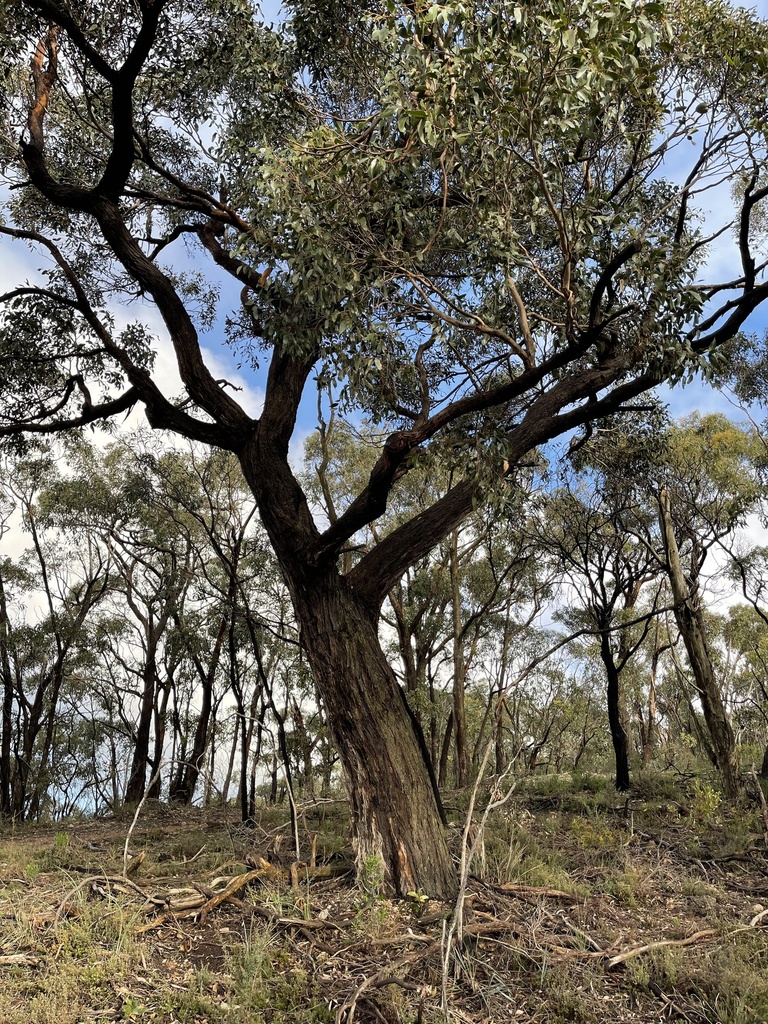
Brown Stringybark
Eucalyptus baxteri
Eucalyptus baxteri, commonly known as brown stringybark is a eucalypt which is native to Australia's south-east, occurring from southern New South Wales through Victoria and into the Fleurieu Peninsula and Kangaroo Island of eastern South Australia. It is a medium-sized tree which can reach 40 m in height. The rough stringy bark is grey - brown in colour. The broad juvenile leaves are 13 cm by 8 cm, while the leathery adult leaves are 13 cm by 3 cm and...
From the article Eucalyptus baxteri on Wikipedia (CC BY-SA), quoted section by section
Description
Eucalyptus baxteri is a tree that grows to a height of 40 metres (131 ft) and forms a lignotuber. It has grey to brownish, stringy or fibrous bark from the trunk to the thinnest branches. Young plants and coppice regrowth have egg-shaped, glossy green leaves 25–105 mm (0.98–4.1 in) long and 13–75 mm (0.5–3 in) wide. Adult leaves are lance-shaped, curved or egg-shaped, 60–150 mm (2.4–5.9 in) long and 15–55 mm (0.6–2 in) wide on a petiole 10–29 mm (0.39–1.1 in) long. The leaves are the same glossy green on both sides. The flowers are borne in groups of between nine and fifteen in leaf axils on an unbranched peduncle 2–14 mm (0.079–0.55 in) long, the individual buds on a pedicel up to 2 mm (0.079 in), rarely 5 mm (0.20 in) long. Mature buds are green to yellow, oval to oblong, 5–10 mm (0.20–0.39 in) long and 3–6 mm (0.1–0.2 in) wide with a rounded, conical or flattened, warty operculum about as long as the floral cup. Flowering mainly occurs from June to January and the flowers are white. The fruit is a woody cup-shaped, hemispherical or shortened spherical capsule 4–12 mm (0.16–0.47 in) long and 6–18 mm (0.2–0.7 in) wide with the valves level with the rim or slightly above.
Range & habitat
Brown stringybark grows in wet forest, woodland, heath and on coastal dunes and headlands in New South Wales, Victoria and South Australia. In New South Wales it only occurs south from the Nadgee Nature Reserve. In Victoria it is found in coastal and near coastal areas and as far inland as places like Casterton, Clunes and the Grampians. It occurs in the far south-east of South Australia, including the Fleurieu Peninsula and Kangaroo Island.
Wikipedia: “Distribution and habitat”
What it does
The seeds of trees of this species that are over 100 years old are an important source of food for the endangered south-eastern subspecies of the red-tailed black cockatoo.
Wikipedia: “Ecology”
Where it lives
Recorded sightings
—
geo-referenced records in GBIF, from museums, herbaria and field observers.
Drag the globe to turn it. Dots are where records exist, not a range map; darker means more records.
In the stacks
Searching the stacks…
Every page naming Eucalyptus baxteri in the Biodiversity Heritage Library →
This page is assembled live from iNaturalist, GBIF, Wikipedia, the Source Library and the Internet Archive. It is not yet part of the hand-edited codex. iNaturalist taxon 353883.