- Plants
- ›Vascular Plants
- ›flowering plants
- ›Dicots
- ›Sunflowers, Bellflowers, Fanflowers, and Allies
- ›Sunflowers, Daisies, Asters, and Allies
- ›Asteroideae
- ›paper daisies
- ›cudweeds, everlastings, and pussytoes
- ›Coronidium
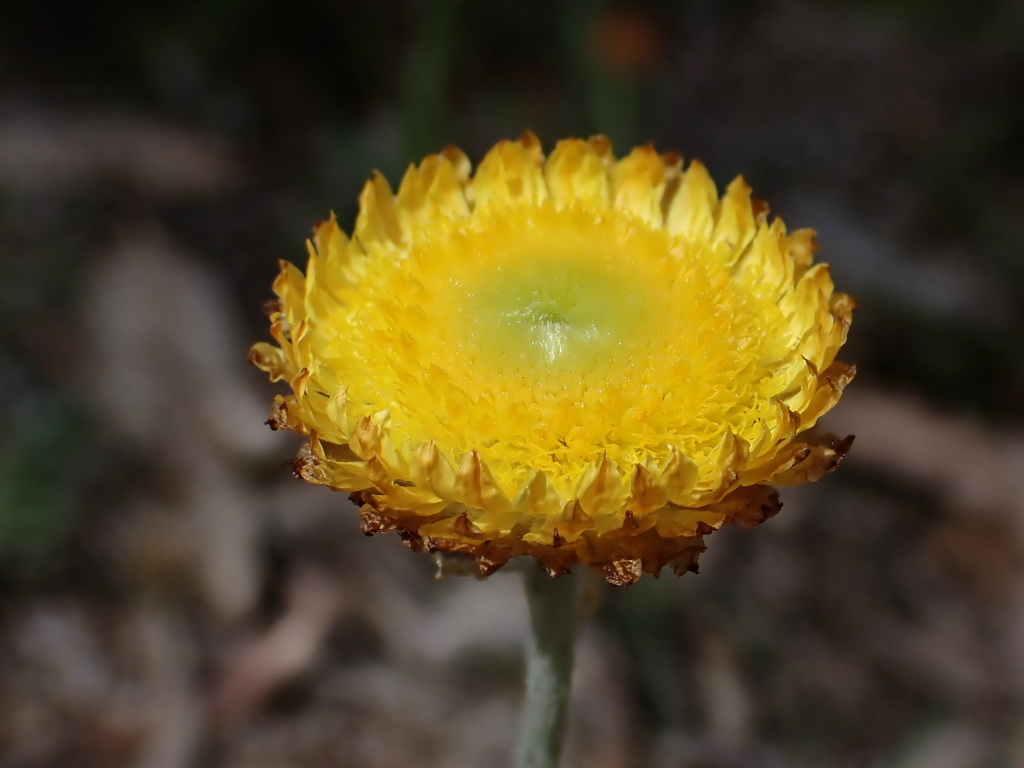
button everlasting
Coronidium scorpioides
Coronidium scorpioides, commonly known as button everlasting, is a perennial, herbaceous shrub in the family Asteraceae and is found in eastern Australia. It has sessile, egg-shaped to lance-shaped leaves, solitary heads of usually pale or lemon-yellow flowers and narrowly cylindrical achenes. It was previously known as Helichrysum scorpioides.
From the article Coronidium scorpioides on Wikipedia (CC BY-SA), quoted section by section
Description
Button everlasting is an ascending to erect, herbaceous perennial plant that typically grows to 5–55 cm (2.0–21.7 in) high with simple stems or few branches usually from arising from a rosette. The rosette leaves are egg-shaped to lance-shaped with the narrower end towards the base, the stem leaves similar to almost linear, 20–90 mm (0.79–3.54 in) long and 3–21 mm (0.12–0.83 in) wide. The flowers are borne in a more or hemispherical head 20–35 mm (0.79–1.38 in) in diameter with five to eight rows of pale- or lemon-yellow involucral bracts at the base. The florets have corollas 4.5–7.5 mm (0.18–0.30 in) long, the outermost series containing some female-only florets. Flowering mainly occurs from October to January, and the achenes are narrowly cylindrical, 2–3.5 mm (0.079–0.138 in) long with four ribs and glabrous, with a pappus about the same length as the corolla.
Range & habitat
Coronidium scorpioides is widespread and common from near the Queensland-New South Wales border, through Victoria to Port Lincoln in South Australia as well as in Tasmania. It grows on heavier more fertile soils, such as brown clay or clay-loam, derived from basalt, or sandstone-shale, in open forest under such trees as narrow-leaved peppermint (Eucalyptus radiata), Sydney peppermint (E. piperita), brown barrel (E. fastigata), grey gum (E. punctata), manna gum (E. viminalis) or Blaxland's stringybark (E. blaxlandii), or in more open woodland under scribbly gum (Eucalyptus sclerophylla) and narrow-leaved apple (Angophora bakeri).
Wikipedia: “Distribution and habitat”
What it does
Coronidium scorpioides resprouts after bushfire, some plants taking as little as 16 weeks to flower.
== References ==
Wikipedia: “Ecology”
Where it lives
Recorded sightings
—
geo-referenced records in GBIF, from museums, herbaria and field observers.
Drag the globe to turn it. Dots are where records exist, not a range map; darker means more records.
In the stacks
Searching the stacks…
Every page naming Coronidium scorpioides in the Biodiversity Heritage Library →
This page is assembled live from iNaturalist, GBIF, Wikipedia, the Source Library and the Internet Archive. It is not yet part of the hand-edited codex. iNaturalist taxon 353942.