- Plants
- ›Vascular Plants
- ›flowering plants
- ›monocots
- ›Agaves, Orchids, Irises, and Allies
- ›agave and allies
- ›cabbage tree subfamily
- ›Thysanotus
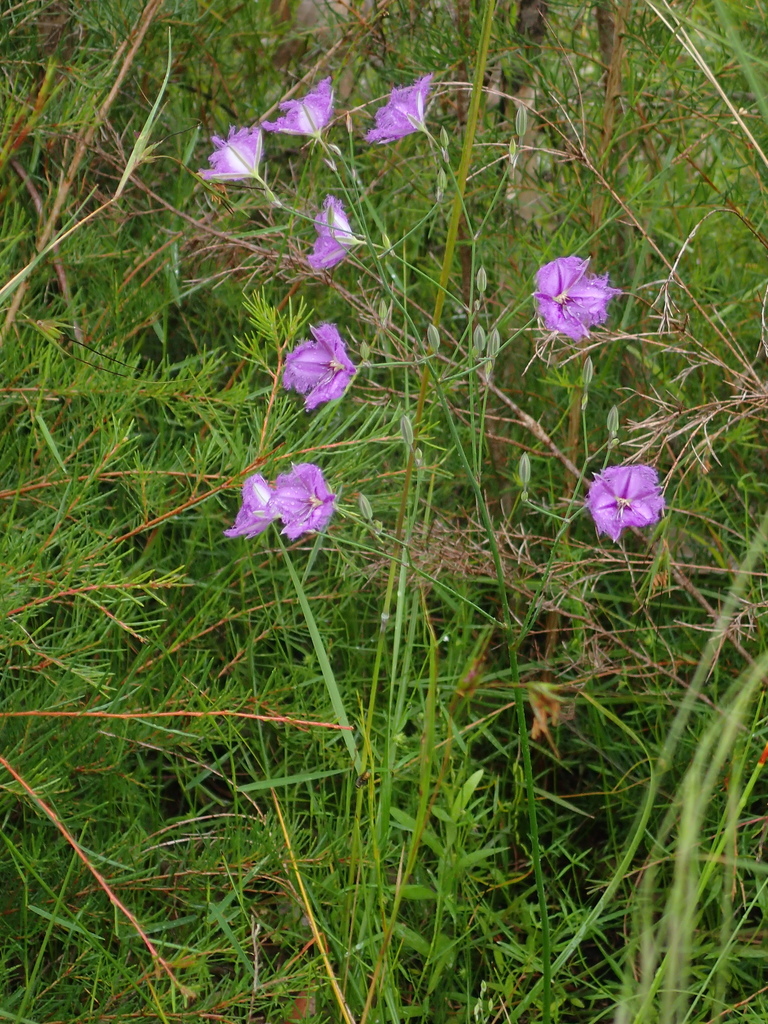
Thysanotus juncifolius
Thysanotus juncifolius, commonly known as branching fringe lily, is a species of flowering plant in the Asparagaceae family, and is endemic to Australia. It is a herb with a small horizontal rhizome and fibrous roots, up to three linear leaves, and flowering stems with up to five umbels of pink to mauve flowers with spreading perianth segments, fringed petals and six stamens.
From the article Thysanotus juncifolius on Wikipedia (CC BY-SA), quoted section by section
Description
Thysanotus juncifolius is a herb with a horizontal rhizome 10–30 mm (0.39–1.18 in) long and fibrous roots, that typically grows to a height of up to about 60 cm (24 in). It has up to three linear leaves 60–250 mm (2.4–9.8 in) long, produced annually or occasionally absent. The flowering stems are striated, 15–65 cm (5.9–25.6 in) long, sometimes with two or three branches with up to five pink to mauve flowers in up to five umbels on the ends, each flower on a pedicel 6–11.5 mm (0.24–0.45 in) long. The tepals are 10–14 mm (0.39–0.55 in) long, the sepals 1.5–2 mm (0.059–0.079 in) wide and the petals 4–5 mm (0.16–0.20 in) wide with a fringe up to 3.0–4.5 mm (0.12–0.18 in) long. There are six stamens shorter than the petals, the three outer anthers straight and 2–3 mm (0.079–0.118 in) long and the inner anthers curved, 6–8 mm (0.24–0.31 in) long. Flowering occurs from September to March, and the fruit is a capsule about 4 mm (0.16 in) in diameter containing cylindrical seeds 1.5 mm (0.059 in) long and 1 mm (0.039 in) in diameter with a yellowish aril.
Range & habitat
Thysanotus juncifolius grows in a range of habitats from tall forest to open mallee and heath, in sandy gravel and shallow loam to deep sand and gravel in south-eastern Queensland, coastal regions near Sydney and inland to the Blue Mountains, the far east of Victoria, and Ninety Mile Desert, Fleurieu and Eyre Peninsulas and Kangaroo Island of South Australia.
== References ==
Wikipedia: “Distribution and habitat”
Where it lives
Recorded sightings
—
geo-referenced records in GBIF, from museums, herbaria and field observers.
Drag the globe to turn it. Dots are where records exist, not a range map; darker means more records.
In the stacks
Searching the stacks…
Every page naming Thysanotus juncifolius in the Biodiversity Heritage Library →
This page is assembled live from iNaturalist, GBIF, Wikipedia, the Source Library and the Internet Archive. It is not yet part of the hand-edited codex. iNaturalist taxon 353956.