- Fungi Including Lichens
- ›Ascomycete Fungi
- ›Sac Fungi and Lichens
- ›Operculate Ascomycetes
- ›Pezizales
- ›Chorioactidaceae
- ›Chorioactis
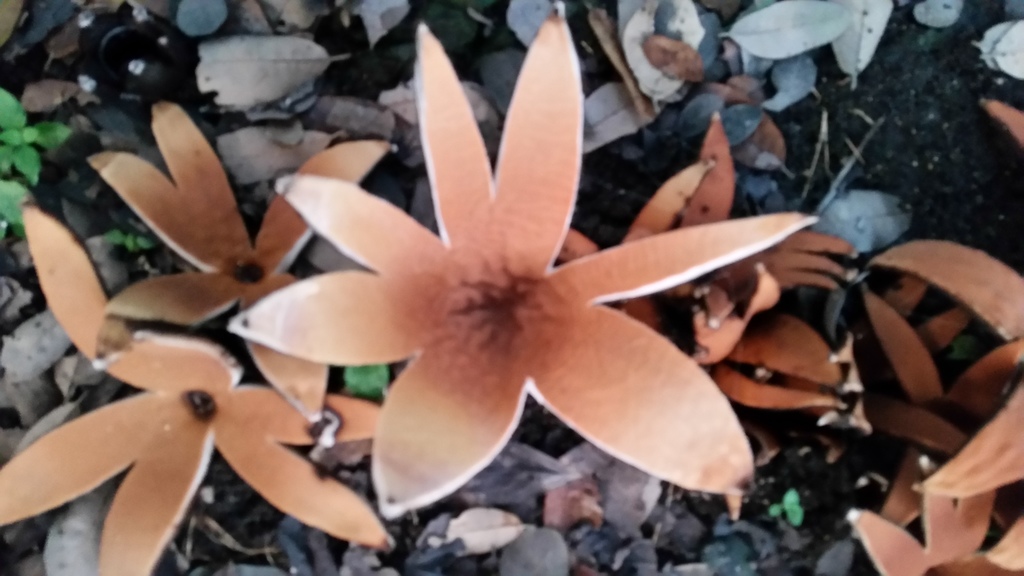
Texas Star
Chorioactis geaster
Chorioactis is a genus of fungi that contains the single species Chorioactis geaster. The mushroom is commonly known as the devil's cigar or the Texas star in the United States, while in Japan it is called kirinomitake (キリノミタケ).
This extremely rare mushroom is notable for its unusual appearance and disjunct distribution; it is found only in select locales in Texas, Oklahoma, Japan, and Taiwan. The fruit body, which grows on the stumps or dead roots of cedar elms (in Texas) or dead oaks (in Japan), somewhat resembles a dark brown or black cigar before it splits open radially into a starlike arrangement of four to seven leathery rays. The interior surface of the fruit body bears the spore-bearing tissue known as the hymenium, and is colored white to brown, depending on its age. The fruit body opening can be accompanied by a distinct hissing sound and the release of a smoky cloud of spores.
From the article Chorioactis on Wikipedia (CC BY-SA), quoted section by section
Description
Young specimens of C. geaster have a hollow, club-shaped, dark-brown fruit body, connected to a stem. The stem, which is usually buried in the ground, is shorter than the hollow fruit body or equals it in length, although the stem length is somewhat variable depending on the depth of the underground root to which it is attached. The flesh of the stem and the wall of the fruit body are white, while the inner surface is yellowish-white, turning light brown with age. The fruit body varies in width from 1.2 to 3.5 cm (0.5 to 1.4 in) in the thickest portion, and has a length of 4 to 12 cm (1.6 to 4.7 in); the stem is 0.75 to 1.5 cm (0.3 to 0.6 in) wide by 1 to 5 cm (0.4 to 2.0 in) long. Both stem and fruit body are covered by a dense layer of soft, brown, velvety "hairs", or tomentum. In maturity, the fruit body splits open into four to seven rays that curve downward, similar to mushrooms of the genus Geastrum. The spores are borne on the inner surface of the rays, which, depending on the maturity of the specimen, may range in color from whitish to saffron to salmon to butterscotch to chestnut. The leathery rays are up to 0.35 cm (0.1 in) thick. The fruit body remains closed until shortly before spore discharge; dehiscence (fruit body opening) is caused by the pressure exerted by swollen paraphyses—sterile (i.e., nonreproductive) cells that are interspersed between the ascospores. …
Range & habitat
Chorioactis geaster has a disjunct distribution, and has only been collected from Texas, Oklahoma, Japan, and Taiwan. The first reported collection in Japan was in Kyushu in 1937, and then it was not collected again in that location until 36 years later. In 2006, it was observed in a humid forest near Kawakami, Nara Prefecture. The fungus's natural habitat in Japan is disappearing because of the practice of deforestation and replanting with Japanese cedar (Cryptomeria japonica). This rare mushroom has been put on the list of threatened species in Japan. In Texas, the fungus has been reported in Collin, Hays, Travis, Dallas, Denton, Guadalupe, Tarrant, and Hunt Counties. Travis, Hays, and Guadalupe Counties are in central Texas, while the remainder are clustered together in the northeastern part of the state. Its habitat may be threatened in Texas by industrialization. The fungus was reported from Choctaw County, Oklahoma, in 2017, the first record in North America outside of Texas. A population of the fungus was also discovered in Taiwan in 2023. Although the species is considered rare due to its globally restricted distribution, it may be locally abundant.
Although it is not known definitively, Chorioactis is believed to be saprobic, deriving nutrients from decomposing organic matter. …
Wikipedia: “Distribution, ecology, and habitat”
In human culture
The fungus was first collected in 1893 by botanist Lucien Marcus Underwood, who sent the specimens to mycologist Charles Horton Peck for identification. Peck described the species as Urnula geaster in that year's Annual Report of the New York State Botanist, although he expressed doubt about its generic placement in Urnula. In 1902, student mycologist Elsie Kupfer questioned the proposed classification of various species in the genera Urnula and Geopyxis, as suggested in an 1896 publication on the Discomycetes by German mycologist Heinrich Rehm. She considered Rehm's transfer of the species to the genus Geopyxis illogical: ""Even externally, the fungus does not closely match Rehm's own description of the genus Geopyxis under which he places it. The texture of the apothecium is described as fleshy, the stem as short and sometimes thin, while in this plant, the leathery character of the cup and the length and thickness of the stem are its most noticeable features." Working with Underwood's guidance, Kupfer compared the microscopic structure of the hymenium (the fertile, spore-bearing tissue) of the Texan species with a number of similar ones—Geopyxis carbonaria, Urnula craterium, and Urnula terrestris (now known as Podophacidium xanthomelum). She concluded that the Texan species was so dissimilar as to warrant its own genus, which she named Chorioactis. …
Wikipedia: “History”
Where it lives
Recorded sightings
—
geo-referenced records in GBIF, from museums, herbaria and field observers.
Drag the globe to turn it. Dots are where records exist, not a range map; darker means more records.
In the stacks
Searching the stacks…
Every page naming Chorioactis geaster in the Biodiversity Heritage Library →
This page is assembled live from iNaturalist, GBIF, Wikipedia, the Source Library and the Internet Archive. It is not yet part of the hand-edited codex. iNaturalist taxon 355435.