- Plants
- ›Vascular Plants
- ›flowering plants
- ›Dicots
- ›Mallows, Rock Roses, and Allies
- ›Mallow and Hibiscus Family
- ›Helicteroideae
- ›Helictereae
- ›Helicteres
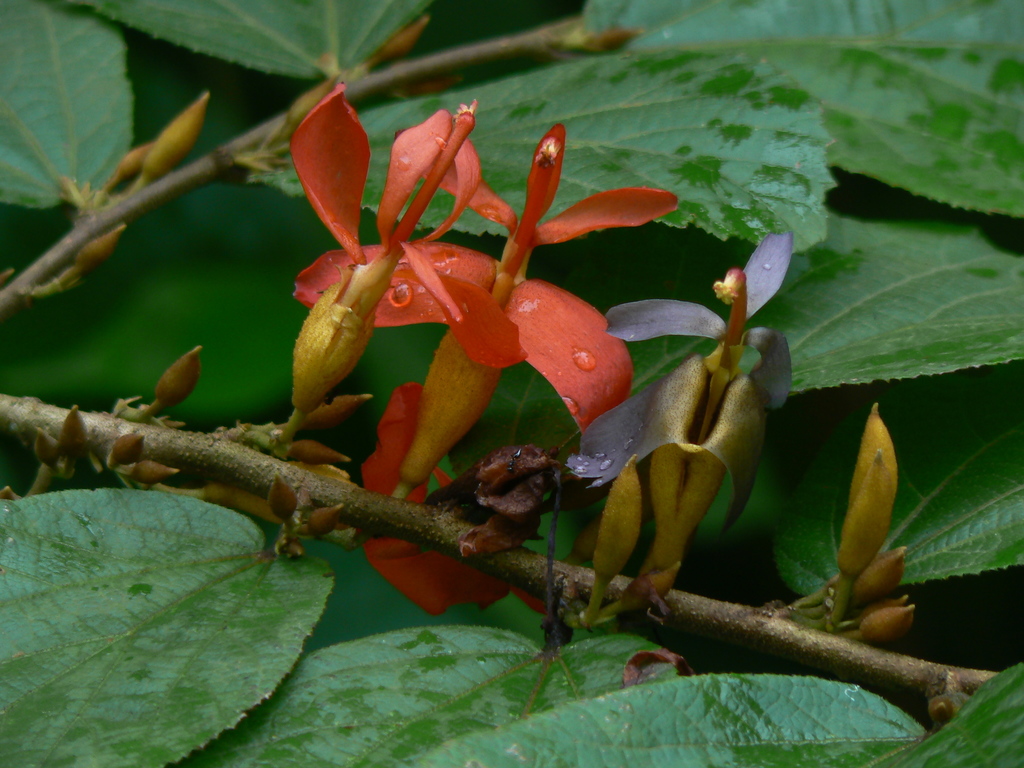
East Indian screw tree
Helicteres isora
Helicteres isora, sometimes called the Indian screw tree, is a small tree or large shrub found in southern Asia and northern Oceania. It is usually assigned to the family Malvaceae, but it is sometimes assigned to the family Sterculiaceae. The red flowers are pollinated mainly by sunbirds, butterflies, and Hymenoptera. In the 19th century fibers from the bark were used to make rope and sacks, although nowadays the tree is harvested for the fruits and roots which are used in folk medicine.
From the article Helicteres isora on Wikipedia (CC BY-SA), quoted section by section
Description
H. isora is a small tree or large shrub, five to eight metres in height. It has grey bark and alternately arranged, hairy, ovate leaves with serrate margins. Its flowers are brick red or orange-red, and its fruits are green when raw, brown or grey when dried, and twisted, with a screw at its pointed end. Seeds of the plant are black or brown and are highly polished, roughly rhomboid, and rectangular or triangular. Pollinators of the flower include the jungle babbler, the golden-fronted leafbird, the ashy drongo, and the white-bellied drongo.
Range & habitat
H. isora is a tropical Asian plant. It is found throughout India and Pakistan, Nepal, Myanmar, Thailand, and Sri Lanka. However, it gregariously grows in dry deciduous forests of central and western India on hill slopes. It is also found on the Malay Peninsula, Java, and Australia.
Wikipedia: “Distribution”
In medicine
H. isora is a rich source of antioxidants, carbohydrates, proteins, fibre, calcium, phosphorus, and iron. Active phytoconstituents include gallic acid, caffeic acid, vanillin, and p-coumaric acid. Cucurbitacin b and isocucurbitacin b have been isolated from the roots. Additionally, Satake et al. (1999) isolated rosmarinic acid and their derivatives; isoscutellarein and their derivatives; D-glucopyranosyl isorinic acid with rosmarinic acid; helisterculins A and B; and helisorin.
Wikipedia: “Phytochemistry”
Where it lives
Recorded sightings
—
geo-referenced records in GBIF, from museums, herbaria and field observers.
Drag the globe to turn it. Dots are where records exist, not a range map; darker means more records.
In the old herbals & bestiaries

In the stacks
Searching the stacks…
Every page naming Helicteres isora in the Biodiversity Heritage Library →
This page is assembled live from iNaturalist, GBIF, Wikipedia, the Source Library and the Internet Archive. It is not yet part of the hand-edited codex. iNaturalist taxon 356161.